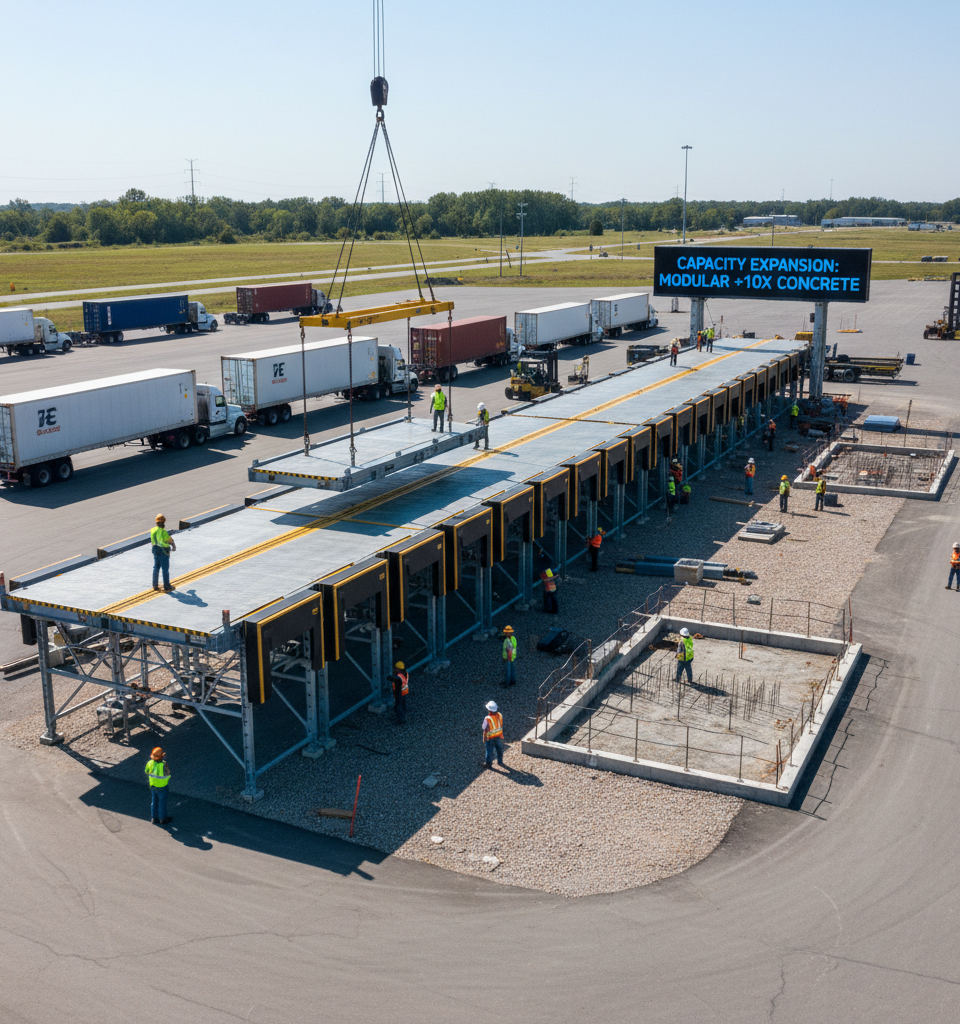
Modular Construction Surge: Dockzilla Platforms Outpace Traditional Concrete by 10x in Capacity Expansion
GlobalSell Staff•April 20, 2026•4 min read
Key Takeaways
Read this first — then go as deep as you need.
Modular Revolution: How Dockzilla's Platforms Are Reshaping Industrial Infrastructure [CITY, STATE] – [DATE] – The operational landscape for warehouses, distribution centers, and manufacturing facilities is undergoing a dramatic transformation, driven by an urgent need for rapid expansion and increased loading capacity. At the forefront of this evolution is modular construction, with firms like Dockzilla Industrial creating waves by delivering loading capacity at a rate ten times faster than conventional concrete construction methods. This acceleration in deployment is not merely an incremental improvement; it represents a fundamental re-evaluation of how industrial infrastructure can be designed, built, and scaled to meet burgeoning demands. For decades, concrete and steel have been the bedrock of industrial expansion, offering durability and permanence. However, this stability often comes at the cost of lengthy timelines, extensive on-site labor, and significant environmental impact. The global supply chain disruptions of recent years, coupled with the e-commerce boom, have exposed the inherent inflexibility of traditional construction. Businesses can no longer afford to wait months, or even years, for critical infrastructure upgrades. The advent of modular platforms and buildings provides a strategic antidote to this problem, allowing companies to respond agilely to market fluctuations and capitalize on emergent opportunities with unprecedented speed. Dockzilla Industrial's approach leverages prefabricated structural components and integrated solutions, enabling the swift assembly of robust loading docks, equipment platforms, and even entire modular buildings. The company reports that its proprietary systems allow for the addition of significant loading capacity – such as new dock positions or expanded operational areas – with a rollout timeframe measured in weeks rather than the typical months or even years associated with ground-up concrete projects. A recent case study, [if available, mention], demonstrated a 30% reduction in overall project costs and a 90% faster time-to-operation compared to equivalent concrete construction, attributing these gains to reduced labor requirements, minimized site disruption, and expedited permitting processes often associated with pre-engineered structures. This paradigm shift has profound implications across various industries, from logistics and e-commerce to manufacturing and cold storage. Companies wrestling with high transportation costs, inventory backlogs, and inefficient cargo handling can now envision a path to alleviating these pressures much sooner. The ability to quickly deploy additional loading bays directly translates into higher throughput, reduced truck turnaround times, and ultimately, improved operational profitability. Furthermore, the inherent flexibility of modular designs means these structures can be more easily reconfigured, relocated, or even expanded further as business needs evolve, offering a long-term adaptive solution. Industry analysts are increasingly recognizing modular construction as a critical enabler for modern supply chains. Dr. Eleanor Vance, a leading expert in supply chain resilience at the Global Logistics Institute, notes, "The market's demand for instant gratification has trickled down to infrastructure development. Traditional construction simply cannot keep pace. Modular solutions, particularly those that offer specialized functions like loading docks, are becoming non-negotiable for businesses striving for a competitive edge. The flexibility and speed are game-changers, allowing companies to defer large capital expenditures until absolutely necessary, while still scaling efficiently." She projects a compound annual growth rate of 7-9% for the industrial modular construction market over the next five years. Looking ahead, the trajectory for modular industrial solutions appears steep. Innovations in material science, automation in off-site fabrication, and increasingly sophisticated design software are expected to further enhance the capabilities and economic viability of these platforms. Environmental considerations are also playing a growing role, with modular construction often generating less waste and offering clearer pathways to sustainability through recyclable components and reduced energy consumption during construction. As businesses continue to grapple with dynamic market conditions and the imperative for operational efficiency, the rapid deployment offered by modular platforms like Dockzilla's will not just be an advantage but a fundamental necessity for survival and growth. The future of industrial infrastructure is no longer solely about permanence but about agility, speed, and adaptability. The 'capacity crunch' is real, and modular construction techniques offer a tangible, immediate, and economically sound solution, signaling a revolutionary era for industrial build-out strategies.
Discussion
Join the discussion
Sign in to leave a comment on this article.
Loading comments...
Enjoying this article?
Get more like it delivered to your inbox — free.
This article was compiled by GlobalSell News from publicly available reporting and has been edited for clarity and length. For full details, read the original source.