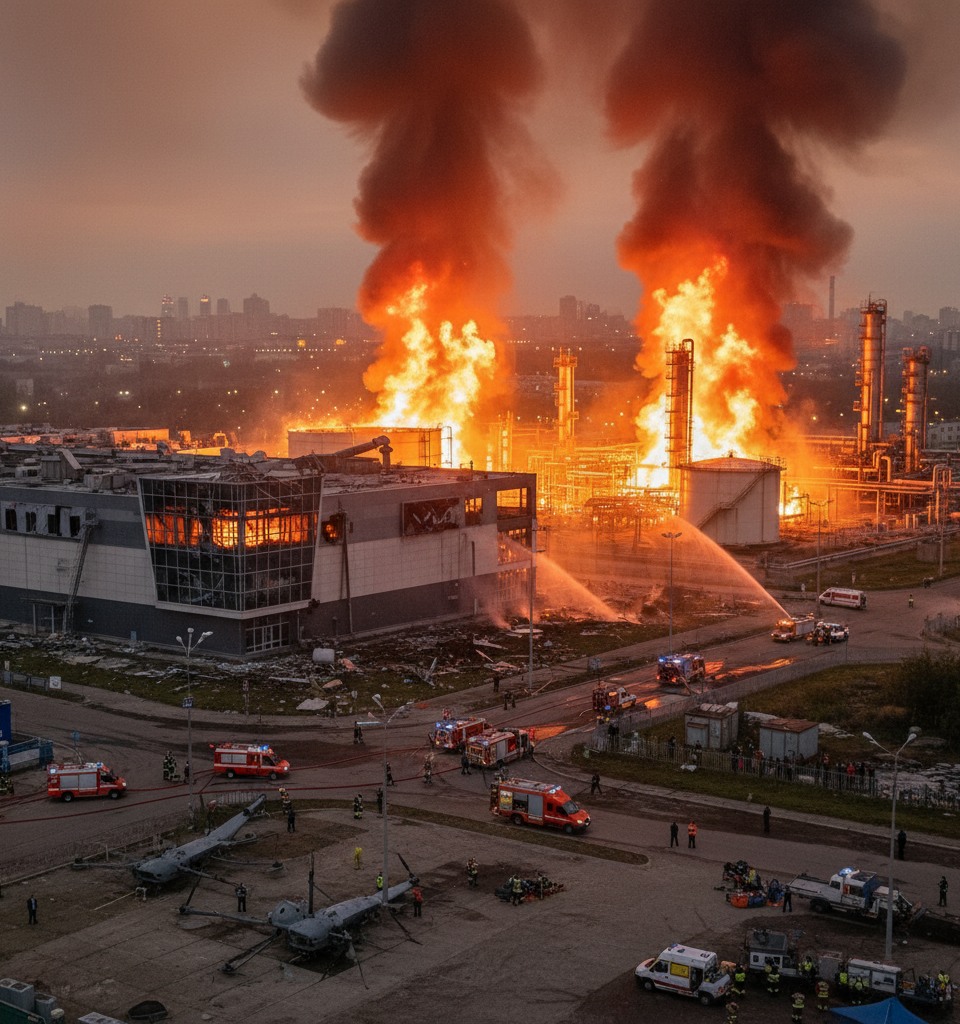
Moscow was subjected to its most extensive drone attack since the commencement of Russia's full-scale invasion of Ukraine, as nearly 200 Ukrainian unmanned aerial vehicles (UAVs) struck regions to the southeast of the Russian capital. The barrage ignited blazes at a refinery and a shopping center, marking a significant escalation in the ongoing conflict.
Escalating Conflict and Strategic Implications
The incident represents a critical development in the protracted hostilities between Russia and Ukraine, signaling an apparent shift in Kyiv's strategy to directly target infrastructure deep within Russian territory. While previous drone attacks on Russian soil have occurred, the sheer scale and apparent coordination of this assault underscore a growing capability and willingness to project power beyond the immediate front lines. This type of action often aims to disrupt logistics, damage industrial capacity, and exert psychological pressure on the adversary's civilian population and leadership.
Details of the Assault
The attack unfolded with almost 200 Ukrainian drones converging on areas located southeast of Moscow. Initial reports confirmed that a refinery, a crucial component of Russia's energy infrastructure, sustained direct hits and subsequently caught fire. Simultaneously, a shopping center in the vicinity was also engulfed in flames, indicating either a broad targeting strategy or widespread collateral damage. The precise extent of the damage to both facilities, as well as any casualties, was not immediately detailed, but the visual evidence of significant fires points to considerable impact. The sheer number of drones involved suggests a sophisticated operation, likely intended to overwhelm Russian air defense systems.
Impact on Russian Economy and Public Sentiment
Attacks on critical infrastructure, such as refineries, carry substantial economic implications. Damage to refining capacity can disrupt fuel supplies, potentially leading to price increases and impacting various sectors of the Russian economy. Furthermore, targeting commercial centers, even if indirectly, exacerbates public anxiety and could contribute to a decline in civilian morale. Such events challenge the narrative of security and stability that the Russian government has sought to maintain within its borders amidst the conflict, potentially pressuring Moscow to reallocate resources for domestic defense.
Historical Context of Drone Warfare
Drone warfare has become an increasingly prominent feature of modern conflict, and the Russia-Ukraine war has been a proving ground for its evolution. Both sides have extensively deployed UAVs for reconnaissance, targeting, and direct attacks. However, an assault of this magnitude on the Russian capital represents a qualitative escalation. Historically, such deep penetration strikes aim to demonstrate offensive capabilities, degrade enemy will, and potentially draw air defense assets away from frontline operations. This event will likely be analyzed by military strategists globally as an example of extended-range asymmetric warfare.
Future Implications and Defensive Posture
This unprecedented attack is likely to provoke a robust response from Russia, potentially in the form of intensified counter-strikes or a re-evaluation of its air defense strategies for critical civilian and industrial areas. For Ukraine, such operations, even if primarily symbolic, serve to demonstrate resilience and unconventional military prowess. Future developments could include an increased focus on hardening urban centers against drone incursions, enhanced electronic warfare capabilities to jam or intercept UAVs, and a global reassessment of the vulnerability of national capitals to drone attacks. The incident underscores the evolving nature of modern warfare, where previously distant battlefields can now extend into the heart of a nation's most protected territories.