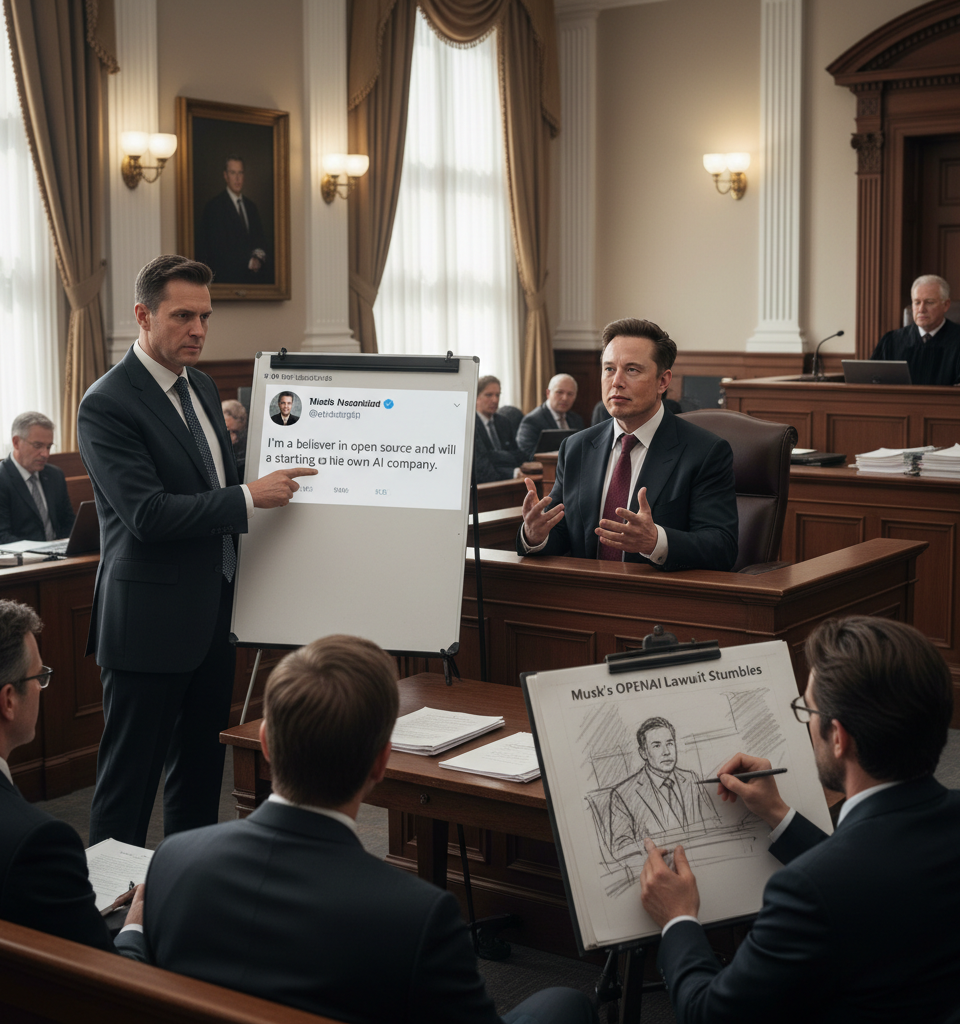
Elon Musk's ambitious legal challenge to dismantle OpenAI encountered significant headwinds during his second day of testimony in a Delaware courtroom, with his prior public statements—primarily from X (formerly Twitter)—becoming a central point of contention. The high-stakes lawsuit, initiated by Musk in February 2024, alleges that OpenAI, under its current leadership, has abandoned its foundational commitment to developing artificial general intelligence (AGI) for the benefit of humanity, instead prioritizing profit for Microsoft, its largest investor. This courtroom drama is unfolding amidst intense scrutiny of AI ethics and corporate governance within the rapidly evolving tech sector.
Musk's lawsuit seeks to compel OpenAI to return to its original non-profit charter, which he co-founded in 2015 alongside Sam Altman and others. He claims that a pivotal verbal agreement existed, ensuring that AGI development would remain open-source and free from commercial motivations. However, OpenAI has countered by stating there was no such definitive agreement beyond the initial non-profit structure, which evolved as the company sought significant funding to compete with giants like Google. The legal proceedings highlight the fundamental philosophical rift concerning the future direction of AI development: open-source and altruistic versus commercial and proprietary.
During cross-examination, OpenAI's legal team meticulously presented a series of Musk's past tweets and internal communications, many dating back to 2018. These posts reportedly indicated Musk's awareness and, in some instances, implicit approval of OpenAI's strategic shift towards a more commercial model, including attempts to secure substantial funding. One particular tweet from early 2018, shown in court, read, "OpenAI needs much more capital to compete with Google.
" Another piece of evidence presented was an email chain where Musk reportedly discussed the necessity of forming a for-profit entity to attract talent and resources. These pieces of evidence directly challenge Musk's current assertion that OpenAI's commercialization was a betrayal of its core principles, portraying him as a figure who was not only aware but potentially instrumental in advocating for the very changes he now condemns. The courtroom saw several instances where Musk appeared to struggle to reconcile his past public statements with his current legal arguments, often responding with qualifiers or memory lapses.
This legal saga carries profound implications for the AI industry, which is currently experiencing an unprecedented boom and regulatory scrutiny. A ruling in favor of Musk could force a significant restructuring at OpenAI, potentially impacting its lucrative partnership with Microsoft, a deal reportedly valued at tens of billions of dollars. Such an outcome could also set a precedent for how founding principles and verbal agreements are interpreted in rapidly scaling tech ventures. Conversely, a victory for OpenAI would solidify its current trajectory, potentially emboldening other AI companies to pursue aggressive commercialization strategies, further intensifying the 'AI race' observed globally. The case also sheds light on the challenges of balancing mission-driven innovation with the exorbitant costs of cutting-edge AI research and development.
Legal experts and industry analysts are closely monitoring the trial, emphasizing the intricate nature of intellectual property and contractual obligations in nascent technologies. "Musk’s credibility on the stand is being severely tested by his own digital footprint," noted technology law professor Dr. Evelyn Reed of Stanford University. "The defense's strategy of using tweets as direct evidence is potent, especially given Musk's prolific social media presence." Dr. Reed further suggested that the outcome could influence future founder agreements in high-tech startups, potentially leading to more stringent, legally binding frameworks regarding governance and mission. Investment analysts are particularly interested in the cascading effects on OpenAI's valuation, which was estimated at over $80 billion in early 2024, and Microsoft's AI strategy.
Looking ahead, the trial is expected to continue with testimonies from other key figures involved in OpenAI’s early days, including Sam Altman, who is anticipated to offer his perspective on the company's evolution. The judge's decision, which could take weeks or even months following the conclusion of testimony, will be a landmark ruling for the AI community. Regardless of the outcome, this lawsuit has already brought unprecedented transparency to the internal workings and strategic shifts of one of the world's most influential AI companies, sparking wider debates about the ethics, governance, and future direction of artificial intelligence development. The industry awaits a resolution that will not only shape OpenAI’s future but potentially redefine the commercialization of AGI.