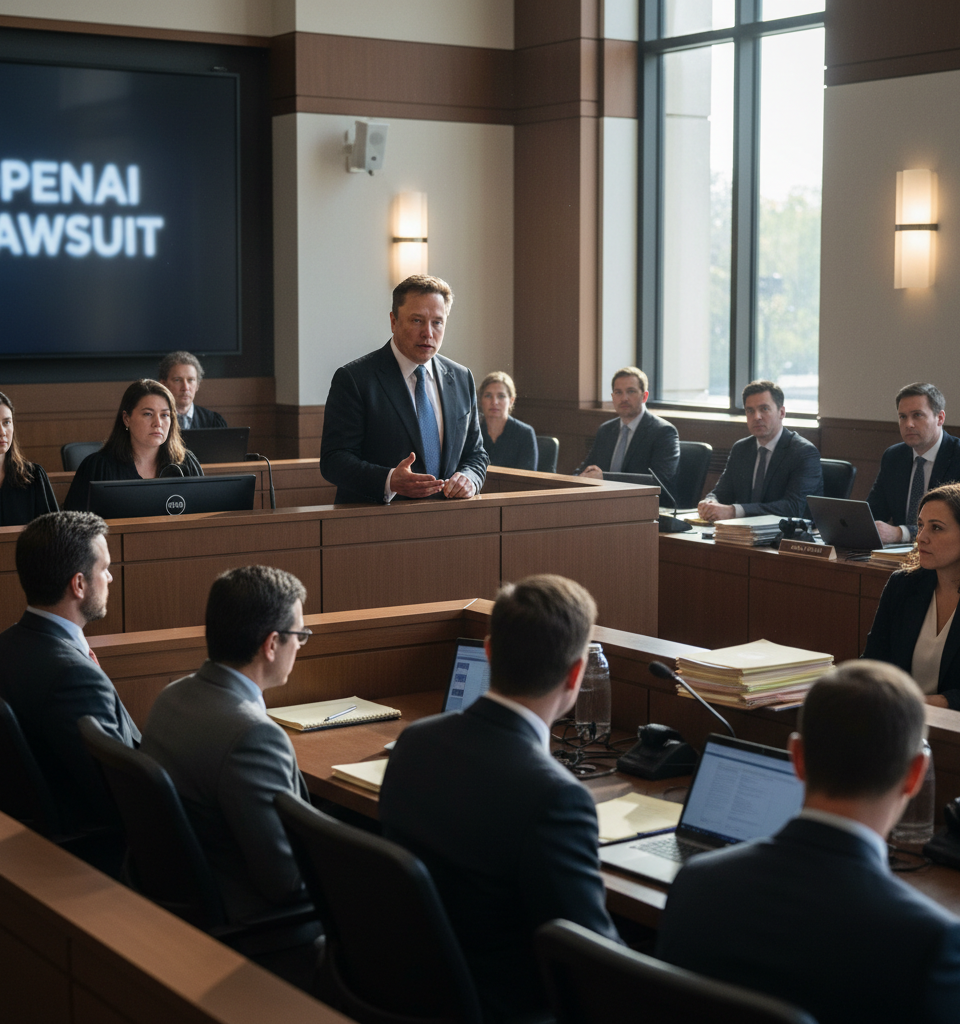
OAKLAND, Calif. — In a highly anticipated courtroom appearance, Elon Musk testified Tuesday before a federal jury, asserting that his lawsuit against OpenAI and its co-founders stems from a fundamental breach of its original non-profit mission. From the witness stand in Oakland, California, Musk unequivocally stated, “It is not okay to steal a charity, that’s my view,” distancing himself from suggestions of personal vendetta and framing the dispute as a battle over ethical AI development.
This marked his inaugural sworn testimony in the landmark case he initiated earlier this year, igniting a legal firestorm with profound implications for the burgeoning artificial intelligence sector. Musk's legal challenge traces back to OpenAI's foundational promise as a non-profit entity dedicated to open-source Artificial General Intelligence (AGI) for the benefit of humanity, rather than corporate profit. He alleges that the company, under the leadership of CEO Sam Altman and President Greg Brockman, deviated significantly from this core principle, effectively transforming into a profit-driven venture beholden to its largest investor, Microsoft.
This perceived pivot, Musk claims, constitutes a breach of an original agreement and a betrayal of the charitable intent he and other early donors, including Peter Thiel and Reid Hoffman, invested in. His complaint seeks to compel OpenAI to adhere to its founding charter and to prevent it from monetizing AGI for private gain. The genesis of OpenAI dates back to 2015 when Musk, Altman, and others co-founded the organization, pledging over $1 billion to its mission.
Musk himself contributed an estimated $44 million to the venture. The subsequent departure of Musk from OpenAI's board in 2018, citing potential conflicts of interest with Tesla's AI endeavors, preceded a critical shift in OpenAI's operational structure. In 2019, OpenAI formed a 'capped-profit' entity, OpenAI LP, to attract significant investment, notably a multi-billion-dollar commitment from Microsoft.
This move, which Musk argues fundamentally altered the organization's character, is central to his lawsuit, challenging the very legitimacy of its current commercial operations and the proprietary nature of its advanced models like GPT-4. The ramifications of this lawsuit extend far beyond the immediate parties, potentially reshaping the regulatory and ethical landscape of the AI industry. A ruling in Musk's favor could force OpenAI to open-source its proprietary technologies, fundamentally altering its business model and intellectual property strategy.
Conversely, a defeat for Musk might embolden other AI companies to pursue profit-driven models with fewer constraints, potentially accelerating the race for AGI without the ethical guardrails Musk advocates. The case also sheds light on the murky legal distinctions between non-profit intentions and commercial realities in rapidly evolving technological fields.
Expert Analysis and Industry Implications Legal and technological experts are closely monitoring the proceedings, recognizing the precedent-setting nature of the case.
"This lawsuit is less about personal animosity and more about the fundamental philosophical divide within the AI community regarding the development and control of AGI," remarked Dr. Anya Sharma, a tech policy analyst at the FutureTech Institute. "Musk's insistence on the 'charity' aspect highlights a crucial tension: can the immense power of AGI truly be developed for universal good under a profit-driven corporate structure?" Analysts at Gartner suggest that a negative outcome for OpenAI could lead to increased scrutiny from antitrust regulators and potentially trigger similar lawsuits questioning the ethical commitments of other AI research organizations, particularly those that began with non-profit charters.
Potential Outcomes and Future Developments
The immediate future holds a protracted legal battle, with OpenAI's legal team expected to vigorously defend its pivot to a capped-profit model, arguing it was necessary to secure the funding required to compete with heavily resourced tech giants in the AI race. They will likely emphasize that the non-profit entity remains the controlling general partner of the capped-profit subsidiary, theoretically maintaining its mission. The judge's decision on whether to dismiss the case or allow it to proceed to a full trial will be a critical juncture. Regardless of the legal outcome, Musk's testimony has already succeeded in forcing a public debate on the ethical governance, transparency, and commercialization of AI, issues that will undoubtedly continue to dominate headlines as AGI capabilities rapidly advance. The AI community awaits, with bated breath, to see if this legal challenge will redefine the 'open' in OpenAI.