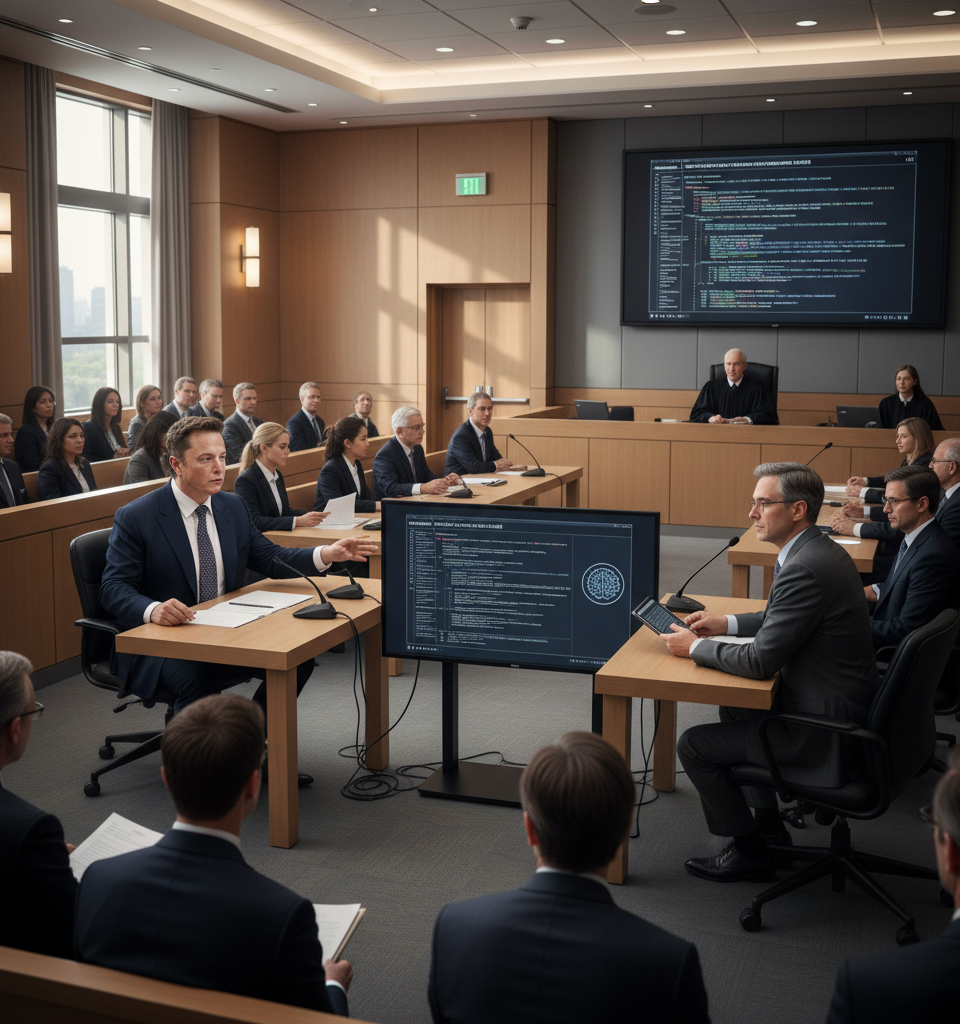
Jury selection has commenced in the landmark Musk v. Altman case, an Oakland federal court pitting technological luminaries Elon Musk and Sam Altman in a legal showdown with profound implications for the artificial intelligence sector. Nine common citizens are tasked with evaluating whether OpenAI, the developer of the transformative ChatGPT, misled its co-founder Musk by altering its foundational non-profit mission to embrace a more traditional for-profit structure.
This trial marks a critical juncture, not merely as a venue for billionaires to publicly air their grievances, but as a crucible that could fundamentally reshape the future trajectory and ethical guidelines of generative AI development.
The Genesis of a Dispute: From Non-Profit Vision to Corporate Reality
OpenAI was established in 2015 with a clear, ambitious mission: to develop artificial general intelligence (AGI) for the benefit of all humanity, explicitly as a non-profit entity. Elon Musk was a co-founder and significant early donor, contributing an estimated $44 million toward its initial funding. The original charter emphasized open-source development and a commitment to preventing corporate capture. However, in 2019, OpenAI announced a significant restructuring, creating a "capped-profit" subsidiary that subsequently attracted billions in investment, most notably from Microsoft, which poured in over $13 billion. This shift, according to Musk's lawsuit and public statements, betrayed the founding principles, morphing the organization into a vehicle for corporate profit and control, particularly from Microsoft. The lawsuit seeks to compel OpenAI to return to its open-source, non-profit roots.
Key Allegations and Courtroom Stakes
Musk's lawsuit centers on allegations of breach of contract, breach of fiduciary duty, and unfair business practices. The core argument is that OpenAI's pivot to a for-profit model effectively seized what was intended as a public good for private gain, directly benefiting its new investors and executives while alienating its non-profit roots. The lawsuit demands that OpenAI's cutting-edge AI models, including GPT-4, be returned to the public domain and that the company reverts to its original non-profit structure. OpenAI, for its part, maintains that Musk departed voluntarily in 2018 and that its current structure is necessary to attract the immense capital and talent required to compete in the extremely expensive race to develop AGI, while still retaining a non-profit oversight board.
Broader Implications for the AI Economy Beyond the immediate legal ramifications for
OpenAI, this trial carries immense weight for the entire AI industry. A ruling in Musk's favor could set a precedent for challenging the corporate structures of other AI ventures, potentially forcing a re-evaluation of how fundamental AI research is funded, governed, and commercialized. It could fuel debates over whether advanced AI should be treated as a public utility or a proprietary technology. Conversely, a ruling in favor of OpenAI could solidify the model of venture capital-backed, for-profit AI development, accelerating the concentration of AI power within a few dominant tech giants. The outcome could directly influence future regulatory approaches to AI governance and intellectual property.
Expert Commentary on the Showdown Legal and tech analysts are closely watching the proceedings.
"This isn't just about two tech titans fighting; it's about the soul of AI," states Dr. Anya Sharma, a legal scholar specializing in intellectual property. "Musk's argument hinges on the spirit of the original agreement, while OpenAI points to the practical realities of immense capital requirements. The jury's interpretation of 'for the benefit of humanity' within a corporate framework will be fascinating." Dr. Mark Jensen, an AI ethics researcher, added, "The industry needs clarity. If foundational AI models developed under a non-profit guise can be privatized without consequence, it undermines public trust and could stifle collaborative, open research initiatives."
The Road Ahead: Potential Outcomes and Future Precedents Should the jury side with Musk, the ramifications for
OpenAI could be seismic, potentially forcing a complete overhaul of its corporate structure, its agreements with Microsoft, and the licensing of its flagship technologies. This would undoubtedly trigger a cascade of legal challenges and operational difficulties. Conversely, an OpenAI victory would likely embolden other AI companies to pursue aggressive commercialization strategies, further solidifying the current landscape of private, profit-driven AI development. Regardless of the immediate verdict, the trial is expected to generate extensive public discourse on AI ethics, corporate governance, and the balance between innovation and public good. Appeals are highly probable from the losing party, meaning the legal saga could extend for years, continuing to shape public and corporate policy in the rapidly evolving field of artificial intelligence.