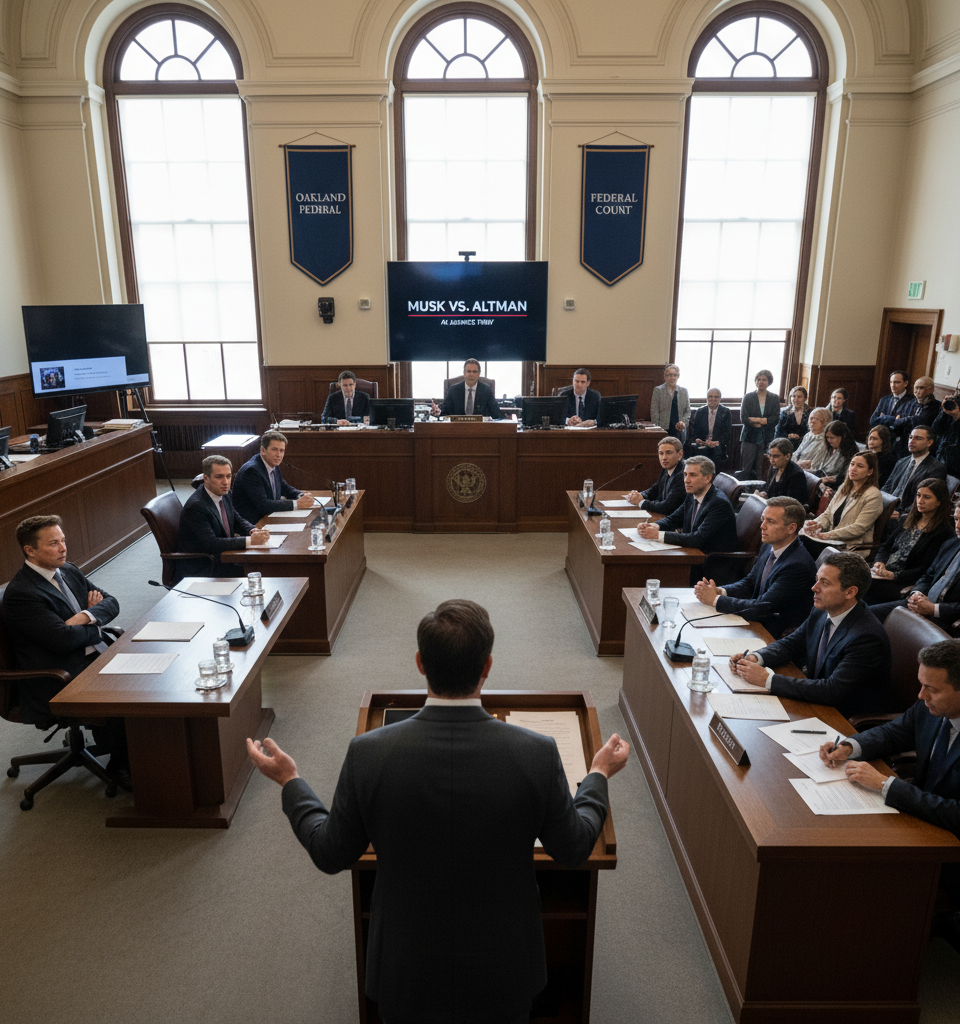
The highly anticipated trial between Elon Musk and OpenAI opened Tuesday in an Oakland federal courtroom, presenting a stark dichotomy of narratives concerning the founding and evolution of the artificial intelligence powerhouse. Steven Molo, lead counsel for Musk, painted a damning picture, accusing the defendants of "steal[ing] a charity" intended for the public good. This assertion frames the core of Musk's lawsuit, which alleges that OpenAI deviated from its original non-profit, open-source mission under its current for-profit structure and leadership, primarily Sam Altman and Greg Brockman.
The nine-person advisory jury, a key feature in this complex corporate dispute, was immediately confronted with these irreconcilable perspectives, hinting at the deeply personal and ideological clashes at play. This legal skirmish is more than a mere corporate spat; it represents a generational clash over the control and ethical direction of artificial intelligence. OpenAI, initially conceptualized as a non-profit entity dedicated to humanity's benefit, now operates a capped-profit subsidiary generating billions in revenue, with substantial investment from Microsoft.
Musk's lawsuit, filed in February 2024, specifically seeks to compel OpenAI to return to its non-profit roots, make its AI technology open source, and prevent its commercial exploitation. The outcome could significantly alter how future AI development is governed and commercialized, impacting intellectual property, corporate governance, and the very philosophy behind advanced technological innovation. Key details emerged during opening statements.
Molo emphasized Musk's foundational role and substantial financial contributions, citing an initial pledge of $1 billion and actual investments exceeding $44 million in OpenAI's early stages. He argued that without Musk's involvement, the organization would not exist. Conversely, OpenAI’s legal team, led by attorney Adam Schwartz, countered that Musk’s narrative was a fabrication driven by personal pique and a desire for control he ultimately didn't receive.
Schwartz asserted that Musk's claims misrepresented internal communications and agreements, emphasizing that Musk had resigned from OpenAI's board in 2018 after failing to secure a controlling stake and integrate the entity into Tesla. This departure, according to OpenAI, absolved them of any alleged obligations toward Musk's stated intentions for the organization. The implications for the broader AI industry are vast.
A ruling in favor of Musk could trigger a re-evaluation of the legal structures underpinning various AI research initiatives, especially those that began with non-profit ambitions but have since embraced commercial models. It could also set precedents for founder intent versus evolving corporate realities in rapidly developing tech sectors. Conversely, a victory for OpenAI would likely reinforce the current trajectory of AI commercialization, where rapid innovation is often fueled by significant private investment, potentially at the expense of open-source or purely altruistic research models.
The financial stakes are substantial, with OpenAI valued at over $80 billion in its latest tender offer, making the intellectual property and future earning potential a critical factor in this dispute. Industry experts and legal analysts are closely monitoring the proceedings. Many point to the ambiguous nature of early agreements in rapidly evolving tech startups as a central challenge for both sides. "
This case highlights the tension between ambitious founding visions and the practicalities of funding and scaling a technology company," noted technology legal expert Dr. Emily Chen from Stanford University. "The 'open source' and 'for humanity' tenets are often difficult to maintain when billions of dollars and market dominance are at stake." Other analysts suggest that Musk's legal challenge, regardless of its outcome, forces a necessary public discourse on the ethics of AI development and the responsibility of its creators, potentially swaying public opinion and regulatory scrutiny of the sector.
Looking ahead, the trial is expected to delve deeper into internal communications, financial records, and the testimonies of key figures involved in OpenAI’s genesis, including Sam Altman, Greg Brockman, and other early investors and researchers. The advisory jury's role will be to provide non-binding recommendations, with the final decision resting with the presiding judge. Regardless of the immediate verdict, this legal battle is poised to cast a long shadow over the AI landscape, influencing future governance models, funding structures, and the very narrative of how humanity's most powerful technologies are developed and deployed.
The precedent it sets could define the next decade of AI innovation, determining whether the industry leans towards open collaboration or competitive commercialization, an outcome that will resonate far beyond the confines of this single courtroom. Additional lawsuits or regulatory actions could also emerge depending on the evidence presented and the judge's final ruling, potentially reshaping the competitive dynamics of the AI market for years to come.