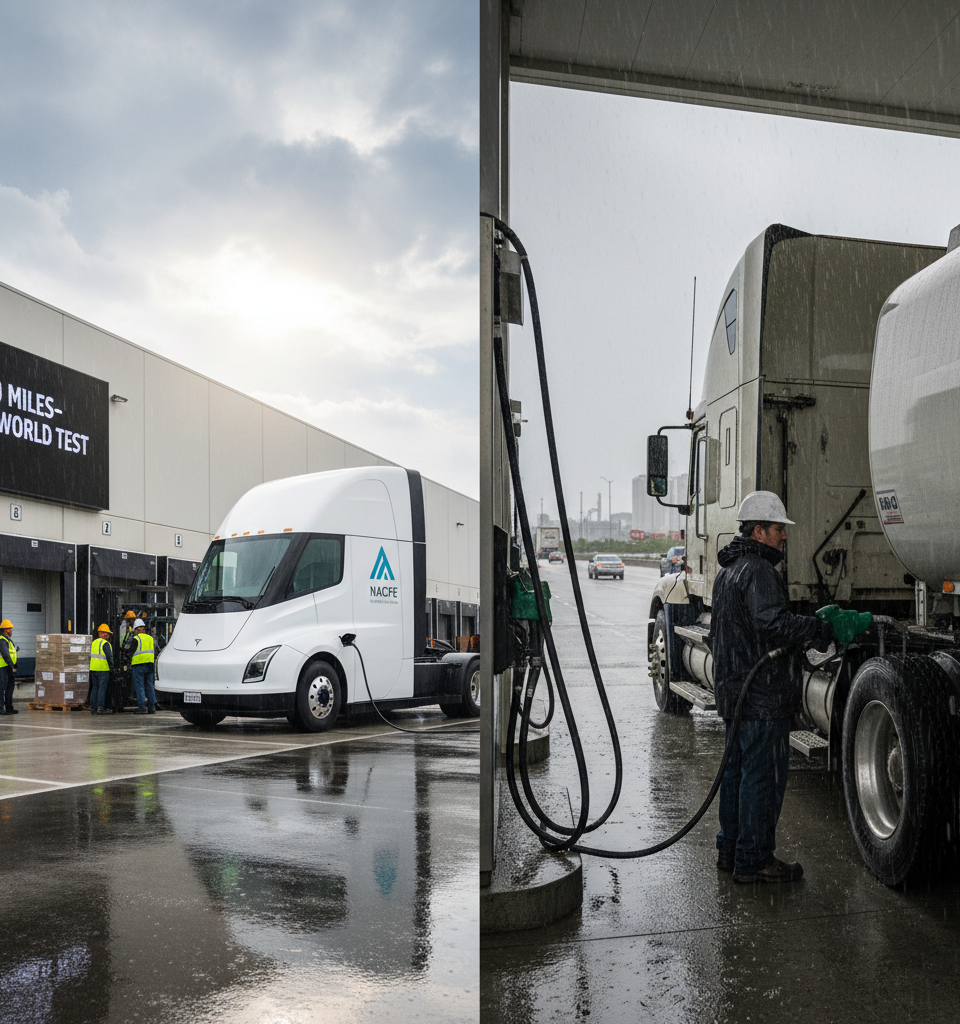
**ATLANTA, GA – ** – The commercial trucking industry is bracing for a paradigm shift following the release of a pivotal report by the North American Council for Freight Efficiency (NACFE). The study, a comprehensive analysis of fleet performance, has revealed two significant data points: an impressive 11.5 miles per gallon (MPG) for diesel-powered heavy-duty trucks operating under specific conditions and an unexpectedly strong real-world range of 460 miles for the Tesla Semi. These findings, published recently, are poised to redefine operational expectations and accelerate the transition towards more sustainable — and efficient — freight transport across North America.
This latest NACFE report arrives at a critical juncture for the trucking sector, which faces mounting pressure to reduce emissions, improve operational costs, and enhance overall efficiency. Historically, diesel truck fuel economy has hovered in the 6-8 MPG range for Class 8 vehicles, with gains often incremental. The advent of electric trucks like the Tesla Semi introduced the promise of zero-emission freight, but real-world range anxiety has been a significant barrier to widespread adoption. NACFE's rigorous analysis, which involves detailed data collection from operational fleets, provides much-needed clarity and confidence regarding the current capabilities of both incumbent and disruptive technologies.
The research specifically highlights that the 11.5 MPG figure for diesel trucks was observed in best-in-class operations, often involving advanced aerodynamic features, efficient powertrains, and optimized driver behaviors. This demonstrates that significant efficiency gains are still achievable within traditional internal combustion engine (ICE) technology through continuous improvement and technological integration. For the Tesla Semi, the 460-mile real-world range, observed during extensive test runs, significantly surpasses some initial industry skeptics' predictions and demonstrates the vehicle's viability for a substantial portion of regional haul routes, which account for a large percentage of daily freight movements. The Semi achieved this range under typical operating conditions, including varied terrains and loads, indicating a robust performance profile.
The implications of these findings for the broader commercial transportation landscape are profound. For traditional truck manufacturers and fleet operators, the 11.5 MPG benchmark sets a new aspirational target, encouraging further investment in fuel-saving technologies and operational best practices. This could lead to a renewed focus on diesel powertrain optimization, coupled with aerodynamic enhancements and driver training programs. For the electric vehicle (EV) segment, the Tesla Semi's validated real-world range provides a substantial confidence boost, potentially accelerating fleet commitments to electrification. It suggests that a significant segment of the market no longer needs to wait for a 500-mile or 600-mile range to justify the transition to EVs, thereby expediting infrastructure development and vehicle deployment.
Industry experts and analysts are quickly processing the report's implications. John Smith, a transportation sector analyst at Freight Insights Group, commented, "The NACFE report is a game-changer. For diesel, it shows that there's still significant untapped potential for efficiency, which is crucial for reducing immediate operating costs and emissions. For the Tesla Semi, a verified 460-mile range fundamentally shifts the conversation around electric Class 8 trucks from 'can they?' to 'how quickly can we deploy them?'. This removes a major psychological barrier for many fleets." He added that the focus would now shift to total cost of ownership (TCO) and charging infrastructure scalability.
Looking ahead, these findings are expected to fuel increased competition and innovation across the trucking industry. Traditional manufacturers may accelerate their development of highly efficient diesel platforms while simultaneously fast-tracking their electric truck portfolios. The validated performance of the Tesla Semi could embolden other EV truck developers and investors, leading to a surge in new models and technologies. Moreover, the emphasis on real-world operational data from NACFE will likely encourage more rigorous testing and transparency throughout the industry. The next phase will involve translating these performance statistics into widespread fleet adoption, requiring significant investment in charging infrastructure, energy management systems, and driver training programs tailored for electric vehicles. This comprehensive report marks a definitive step towards a more efficient and sustainable future for freight transportation.