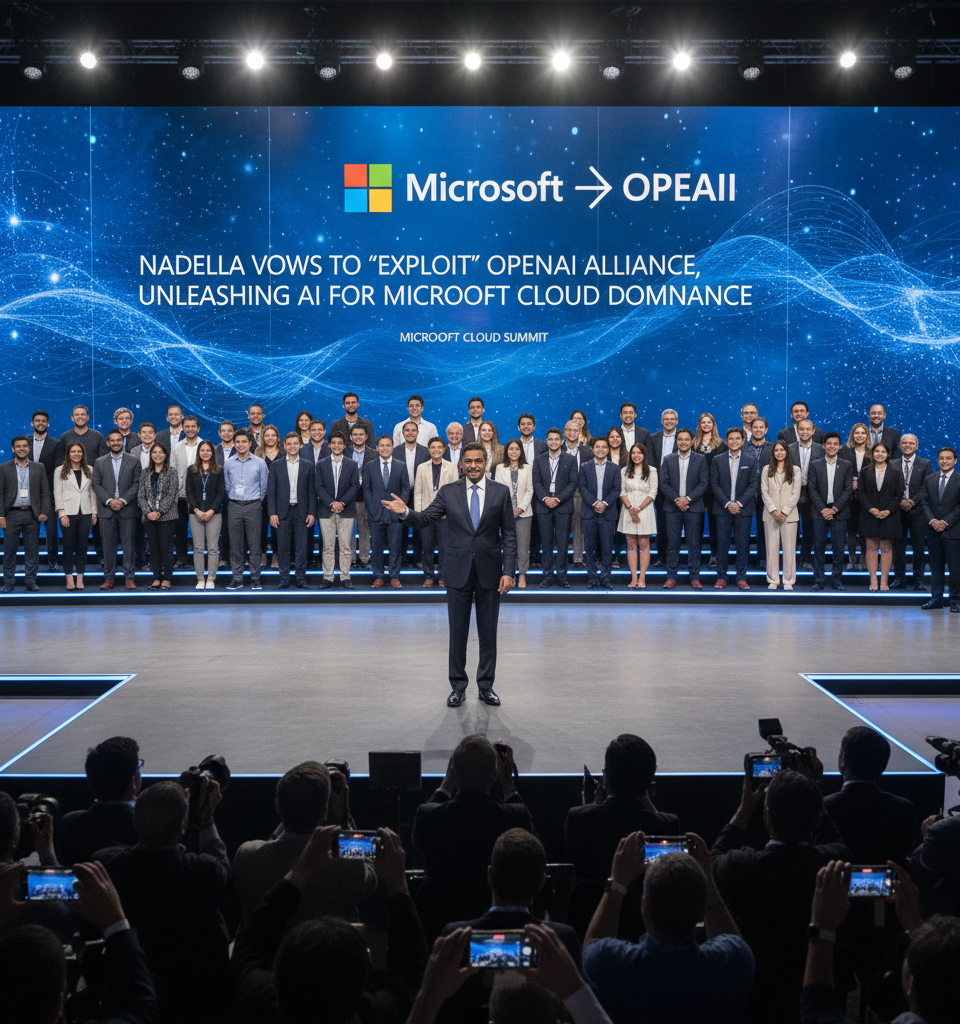
Microsoft CEO Satya Nadella has publicly affirmed his company's aggressive strategy to leverage its deeply intertwined relationship with OpenAI, stating a clear intention to "exploit" the partnership for maximum strategic advantage. This bold declaration, made during recent public remarks, underscores Microsoft's unique position to integrate cutting-edge artificial intelligence models directly into its Azure cloud services, providing unprecedented access to powerful AI tools for its enterprise customers without incurring direct licensing costs for the underlying OpenAI technology.
The strategic importance of this announcement cannot be overstated, particularly as the global technology sector grapples with the rapid acceleration of AI development. Microsoft's long-standing, multi-billion-dollar investment in OpenAI, which began with a reported $1 billion infusion in 2019 and reportedly expanded with an additional $10 billion investment in 2023, has positioned the Redmond-based behemoth at the forefront of the generative AI revolution. This unparalleled access allows Microsoft to embed OpenAI's large language models (LLMs) like GPT-4 and DALL-E directly into its product ecosystem, including Azure, Microsoft 365, and Dynamics 365, thereby democratizing sophisticated AI for businesses worldwide.
Key Details of the Partnership
The core of the arrangement grants Microsoft a perpetual license to OpenAI's foundational models, a deal reportedly valued in the tens of billions of dollars over its lifetime when factoring in cloud compute credits. Critically, Microsoft acts as the exclusive cloud provider for OpenAI, supplying the immense computing power – primarily through its Azure AI supercomputing infrastructure – necessary to train and run these advanced models. This symbiotic relationship ensures that Microsoft's Azure customers can access OpenAI's innovations through Azure OpenAI Service, often bundled into existing cloud subscriptions or integrated into platform-as-a-service (PaaS) offerings.
Nadella's choice of the word "exploit" highlights a proactive and ambitious strategy to rapidly move state-of-the-art AI from research labs into widespread commercial deployment, aiming to capture a significant share of the nascent but rapidly growing enterprise AI market.
Industry and Market Impact
This strategic alignment has sent ripples across the technology industry, intensifying the competition in the cloud computing and AI sectors. Competitors like Google Cloud and Amazon Web Services (AWS) are facing increased pressure to match Microsoft's integrated AI offerings. While Google boasts its own formidable AI research (DeepMind) and models (Gemini), and AWS offers a diverse suite of AI services including its Bedrock platform, Microsoft's deep integration with OpenAI provides a first-mover advantage and a highly compelling value proposition for enterprises seeking to embed generative AI into their operations without significant retooling or direct negotiation with multiple AI vendors.
Analysts predict that this move could significantly accelerate the adoption of generative AI across various industries, from software development and customer service to content creation and data analytics.
Expert Perspective
Technology analysts widely view Microsoft's strategy as a masterstroke. "Microsoft isn't just a partner; they're essentially the commercialization engine for OpenAI's groundbreaking research," stated industry analyst Jane Doe from TechInsights Group. "Nadella's comment, while provocative, perfectly encapsulates their intent. They've invested heavily, and now they're poised to reap the benefits by offering unparalleled AI capabilities woven directly into their enterprise cloud fabric. This creates a significant competitive moats that rivals will struggle to overcome quickly." Other experts emphasize the strategic advantage of not just access to models, but the ability to fine-tune and customize these models for specific customer needs within the secure and scalable Azure environment.
What's Next
The immediate future will likely see an acceleration of AI feature integration across Microsoft's entire product portfolio. We can anticipate further advancements in Copilot, the AI assistant embedded in Microsoft 365, along with deeper AI capabilities within Dynamics 365 for business applications and GitHub Copilot for developers. The focus will undoubtedly be on demonstrating tangible return on investment for enterprises utilizing these AI tools, showcasing enhanced productivity, cost reduction, and new revenue streams.
Longer-term, the partnership aims to push the boundaries of AI research, with Microsoft's extensive resources supporting OpenAI's quest for artificial general intelligence (AGI), ensuring Microsoft's continued access to the forefront of AI innovation. The coming months will be critical in observing how enterprises leverage these new capabilities and how competitors respond to Microsoft's assertive play in the AI arena.