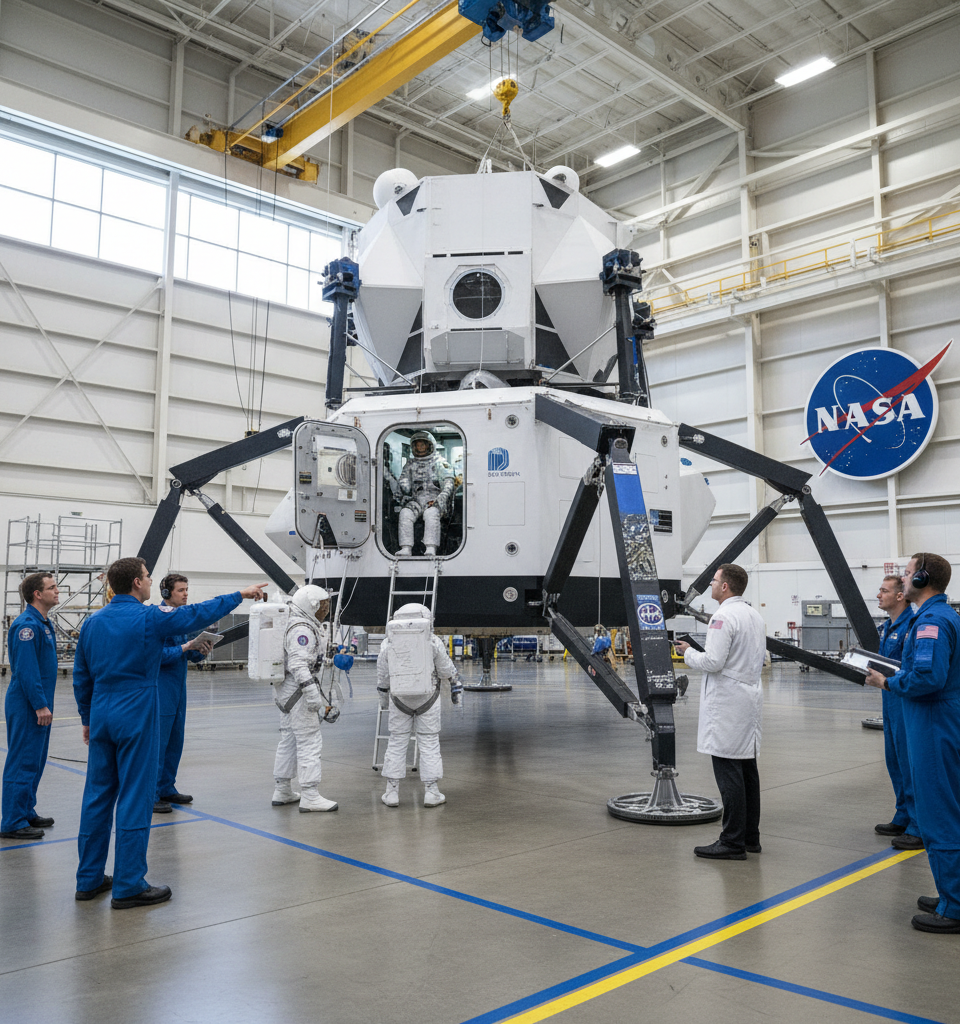
NASA has begun key training exercises with a full-scale engineering mockup of Blue Origin's Blue Moon human landing system, a critical step in preparing astronauts for a potential return to the Moon's surface as early as 2028. The comprehensive training, conducted at NASA's Johnson Space Center in Houston, Texas, involves simulating various mission scenarios, including crew entry and exit procedures, habitation operations, and emergency protocols, ensuring future lunar explorers are well-versed with the proposed lander's capabilities and limitations.
Context and Background
This development is central to NASA's Artemis Program, which aims to establish a sustainable human presence on the Moon and utilize it as a stepping stone for future missions to Mars. After decades since the Apollo missions, the U.S. space agency is leveraging commercial partnerships to accelerate development and reduce costs, fostering a robust lunar economy. Blue Origin, alongside SpaceX, secured a multi-billion dollar contract under the Human Landing System (HLS) program to develop and deliver landers capable of transporting astronauts to the lunar south pole, an area of significant scientific interest due to its potential water ice reserves.
Key Details
The training involves a high-fidelity mockup of the Blue Moon lander, designed to replicate the actual flight hardware's interior volume, control interfaces, and crew accommodations. Astronauts and support personnel are reportedly participating in multiple sessions, evaluating ergonomics, habitability, and operational efficiency. The Blue Moon lander, derived from Blue Origin's BE-7 engine technology, is envisioned as a multi-stage vehicle capable of delivering significant cargo and a crew of up to four astronauts to the lunar surface. While specific financial details of this prototype training phase are not publicly itemized, Blue Origin's initial HLS award was valued at approximately $3.4 billion, underscoring the substantial investment in this critical component of the Artemis architecture.
Industry and Market Impact
The progress in the Blue Moon lander's development and associated training signifies a maturing landscape for commercial space exploration. This public-private partnership model not only diversifies the supply chain for critical space infrastructure but also injects private capital and innovation into traditionally government-led endeavors. Success in the HLS program could solidify Blue Origin's position as a dominant player in the lunar economy, potentially attracting further investment and spurring competition among other aerospace firms vying for future contracts related to lunar development, resource utilization, and deep-space travel. The emphasis on reusability and scalability in these commercial designs is a fundamental shift from previous space programs.
Expert Perspective
Space industry analysts view this milestone as a crucial risk reduction step. "Testing with full-scale mockups allows NASA to identify potential design flaws or operational challenges long before flight hardware is assembled," commented Dr. Eleanor Vance, an astrodynamics expert and former NASA engineer. "It's about ensuring crew safety and mission success, optimizing everything from the placement of controls to the flow of movement within a confined space. This hands-on validation is indispensable, especially for long-duration stays envisioned for the Artemis program." The rigorous feedback from astronauts directly influences subsequent modifications to the lander's design, ensuring it meets functional and ergonomic requirements under mission constraints.
What's Next
Following the completion of these initial training exercises, insights gained will feed directly into the refinement of Blue Origin's Blue Moon design. NASA will continue to monitor the development progress of both Blue Origin and SpaceX's Starship HLS variant, slated for the Artemis III and follow-on missions, respectively. Future milestones include further integrated system tests, uncrewed lunar test flights, and ultimately, the selection of which lander will convey the first human crew to the Moon's south pole under the Artemis III banner. The journey to a sustainable lunar presence is long, but these iterative steps in partnership with private industry are paving the way for humanity's next giant leap.