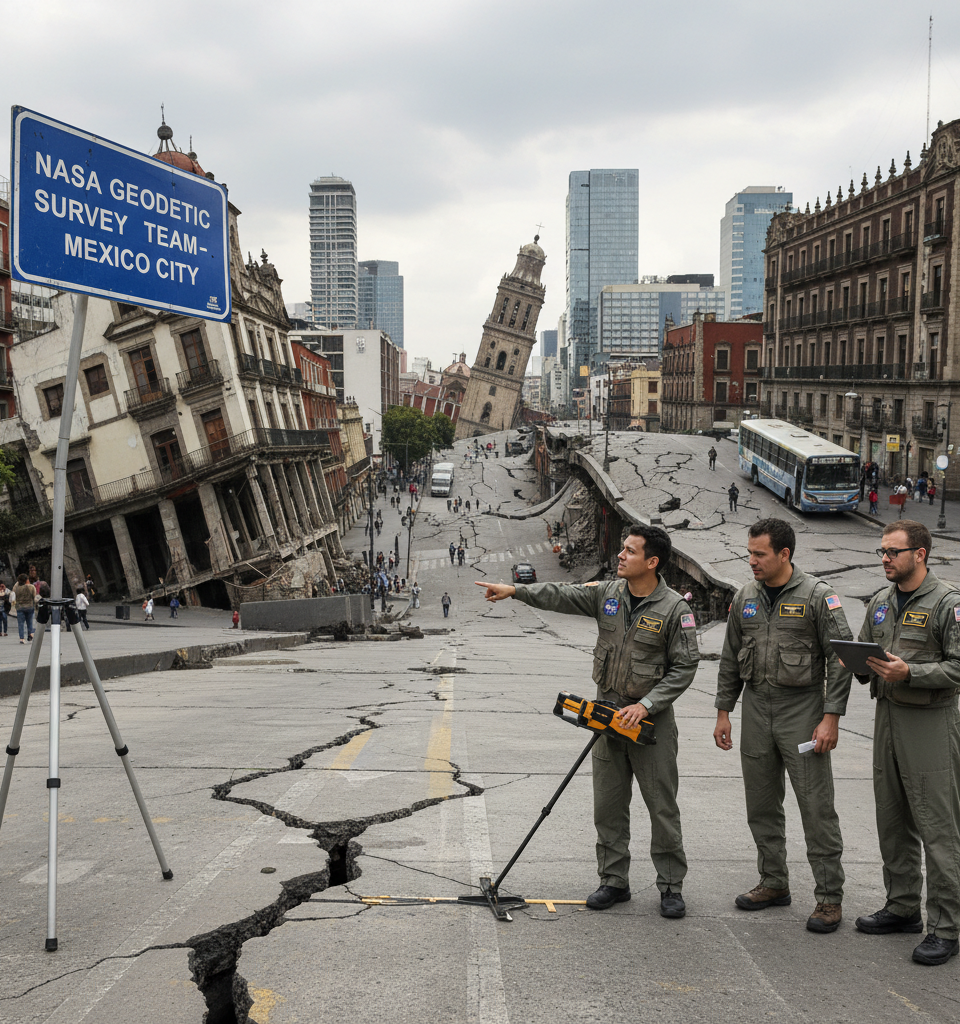
Mexico City, a megalopolis built precariously atop ancient lakebeds, is experiencing an accelerated and alarmingly uneven rate of subsidence, with newly released data from a powerful NASA satellite indicating that certain districts are sinking by as much as 2 centimeters per month. This critical development, unveiled through advanced satellite imagery and analysis, highlights a profound environmental and urban planning challenge facing the vast capital, home to over 20 million residents.
Historical Context and Underlying Causes
The phenomenon of Mexico City's sinking is not new; it dates back centuries to colonial times when Spanish conquerors drained the extensive lake system upon which the Aztec capital of Tenochtitlan was built. However, the modern challenge is exacerbated by over-extraction of groundwater to meet the demands of its burgeoning population. As water is pumped from the aquifer beneath the city, the clay-rich soils compact, leading to irreversible subsidence. This process undermines the city's foundational stability, threatening structures, infrastructure, and public safety. Previous studies have indicated an overall sinking rate, but the precision and detail offered by NASA's latest mapping reveal a more granular, and thus more concerning, picture of localized, rapid descent.
Key Data and Specifics
The new NASA map, utilizing Synthetic Aperture Radar (SAR) interferometry, provides centimeter-level precision in detecting ground deformation. It specifically identifies areas, primarily in the eastern and central parts of the city, that are experiencing the most rapid rates of subsidence. While the average sinking rate across the city is often cited at around 10-15 centimeters per year, the revelation that specific locales are dropping at 2 centimeters per month – equivalent to nearly 24 centimeters annually – represents a critical acceleration. This uneven sinking creates significant stress on buildings and utilities, leading to widespread damage, increased seismic vulnerability, and the constant need for costly repairs. Experts point to variations in underlying soil composition and localized groundwater pumping as primary drivers for these differential rates.
Infrastructure and Economic Ramifications
The uneven sinking has profound practical implications for Mexico City’s infrastructure and economy. Underground utility lines – water, sewage, gas, and electricity – are exceptionally vulnerable to rupture, leading to massive leaks, system failures, and potential environmental hazards. Roadways and elevated structures, including the city's extensive metro system, suffer from cracks, misalignments, and structural fatigue, necessitating continuous maintenance and posing safety risks.
Economically, this translates into billions of dollars in repair costs annually, property devaluation in affected areas, and disruptions to daily commerce and transportation. The city's aging water infrastructure, already prone to significant leaks, is further compromised, with some estimates suggesting up to 40% of potable water is lost before reaching consumers due to leaks exacerbated by ground movement.
Expert Perspectives and Warnings
Geologists and urban planners have consistently warned about the escalating crisis. Dr. Elena Gomez, a leading geophysicist specializing in urban subsidence, stated, "This NASA data is not just confirming what we know; it's providing the irrefutable, high-resolution evidence needed to drive policy change. The differential sinking is creating dangerous stress points that could lead to catastrophic failures if not addressed proactively." Other experts emphasize the long-term, irreversible nature of aquifer compaction once water is extracted, underscoring that while mitigation efforts are crucial, the city will continue to sink, albeit hopefully at a slower, more controlled pace with careful management.
Addressing the Crisis and Future Outlook
In response to this persistent challenge, Mexico City authorities have initiated several projects aimed at sustainable water management, including increased rainwater harvesting, wastewater treatment plants to reduce reliance on groundwater, and exploration of alternative water sources. There are also ongoing efforts to map and reinforce critical infrastructure in high-risk areas. However, the scale of the problem demands a more aggressive and integrated approach, potentially including mandated conservation efforts, development of resilient building codes, and international collaboration for technological solutions.
The future stability of Mexico City hinges on its ability to drastically reduce its dependence on the aquifer and implement robust engineering solutions to cope with continued ground deformation, ensuring the safety and sustainability of this vibrant urban center for generations to come.