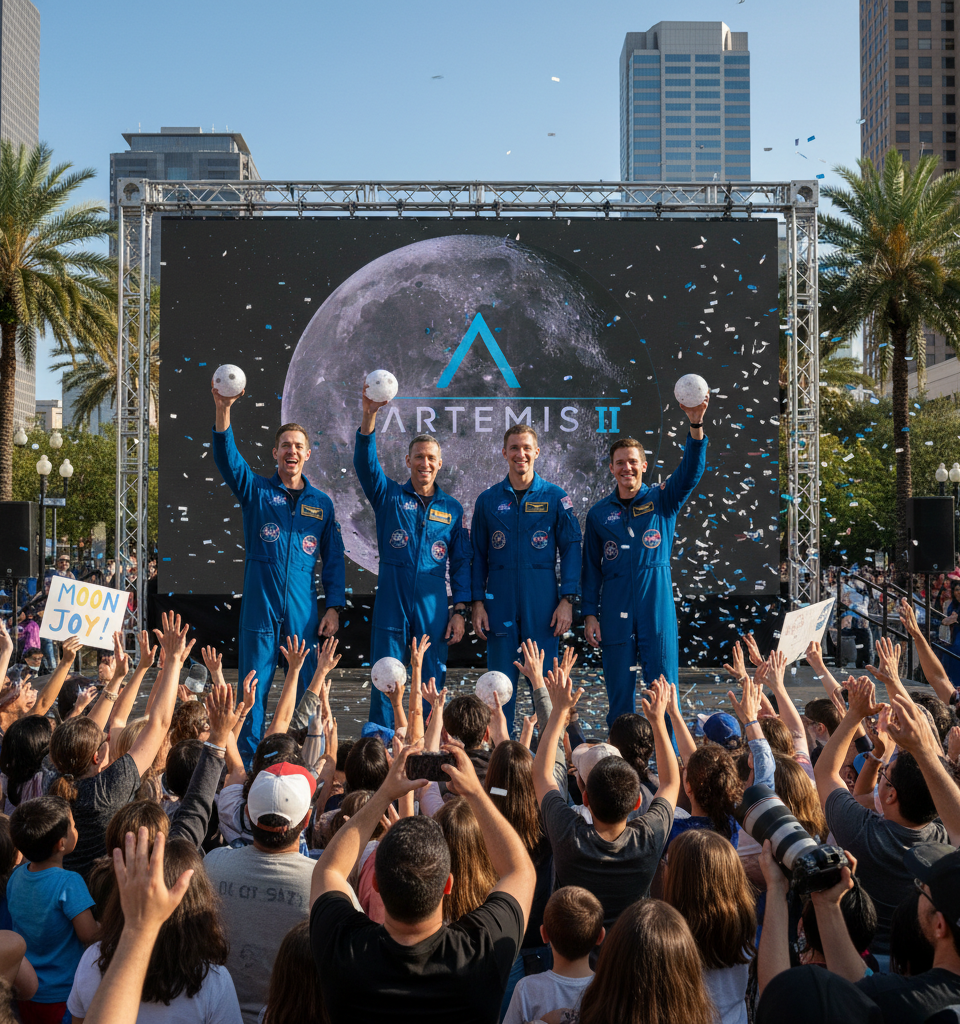
Amidst the rigorous preparations for humanity's return to the Moon, the astronauts of NASA's Artemis II mission are distinguishing themselves not merely through their scientific acumen but also through their palpable enthusiasm. Unlike the often-perceived dryness of scientific discourse, the crew has been demonstrably successful in conveying a sense of adventure and personal investment, resonating deeply with both mission control personnel and the global public.
This deliberate cultivation of what has been dubbed 'Moon joy' signals a strategic evolution in how space agencies communicate their grand endeavors. By personifying the mission, the astronauts are transforming a complex engineering and scientific undertaking into a more relatable human narrative. This approach is critical for maintaining public interest and securing sustained support for ambitious, long-duration space programs like Artemis, which require significant public funding and engagement over many years.
Shifting the Narrative: Emotion in Exploration
The traditional perception of space exploration, often characterized by technical jargon and a focus on data, can inadvertently distance the public. However, the Artemis II crew, comprising individuals selected for their diverse backgrounds and communication skills, appears to be actively challenging this stereotype. Their interactions, whether during public appearances, interviews, or internal briefings, are reportedly infused with a genuine excitement that transcends mere procedural updates. This emotional authenticity is proving to be a powerful tool in demystifying the mission and making the unfathomable journey to the Moon feel more immediate and accessible.
This shift is particularly pertinent in the current era, where public attention spans are increasingly fragmented. The ability of the astronauts to articulate their personal connections to the mission – their awe, their anticipation, and even the challenges they foresee – creates a narrative arc that viewers and listeners can emotionally invest in. This personal touch provides a crucial counterpoint to the mission’s inherent technical complexities, allowing a broader audience to connect with the aspirational goals of lunar exploration.
Broader Implications for Space Advocacy
The conscious effort by the Artemis II crew to inject personality and emotion into their public outreach has significant implications beyond this singular mission. It sets a new precedent for future endeavors, suggesting that effective communication in space exploration will increasingly hinge on humanizing the science. This strategy could be instrumental in fostering a new generation of scientists, engineers, and enthusiasts, by illustrating that the pursuit of knowledge is not devoid of passion or wonder.
Furthermore, this approach contributes to the broader objective of public buy-in for long-term space exploration plans, including eventual missions to Mars. When the public feels a personal connection to the astronauts and their journey, it translates into enhanced support for the significant financial and human resources required to achieve these monumental goals. The current crew's ability to generate this emotional resonance could therefore serve as a powerful blueprint for future space expeditions, demonstrating how engagement can be as vital as technological prowess.
The Strategic Value of Authenticity
By emphasizing the human element, the astronauts are not just sharing their journey; they are actively shaping public perception of space exploration itself. This authentic expressiveness helps to bridge the gap between advanced scientific concepts and everyday understanding. It underscores that while the journey is technically demanding, it is fundamentally a human endeavor driven by curiosity, courage, and a collective desire to push the boundaries of what is possible. The impact of this approach is likely to be multifaceted, ranging from increased STEM engagement among younger audiences to solidified public and political support for NASA's ambitious future trajectory.
Looking ahead, the success of this communicative strategy will likely be measured not only by the scientific achievements of Artemis II but also by the sustained public engagement it manages to foster. The ‘Moon joy’ generated by the crew serves as a powerful reminder that the human face of science can be its most compelling advocate, ensuring that the wonder of space exploration continues to captivate and inspire audiences worldwide.