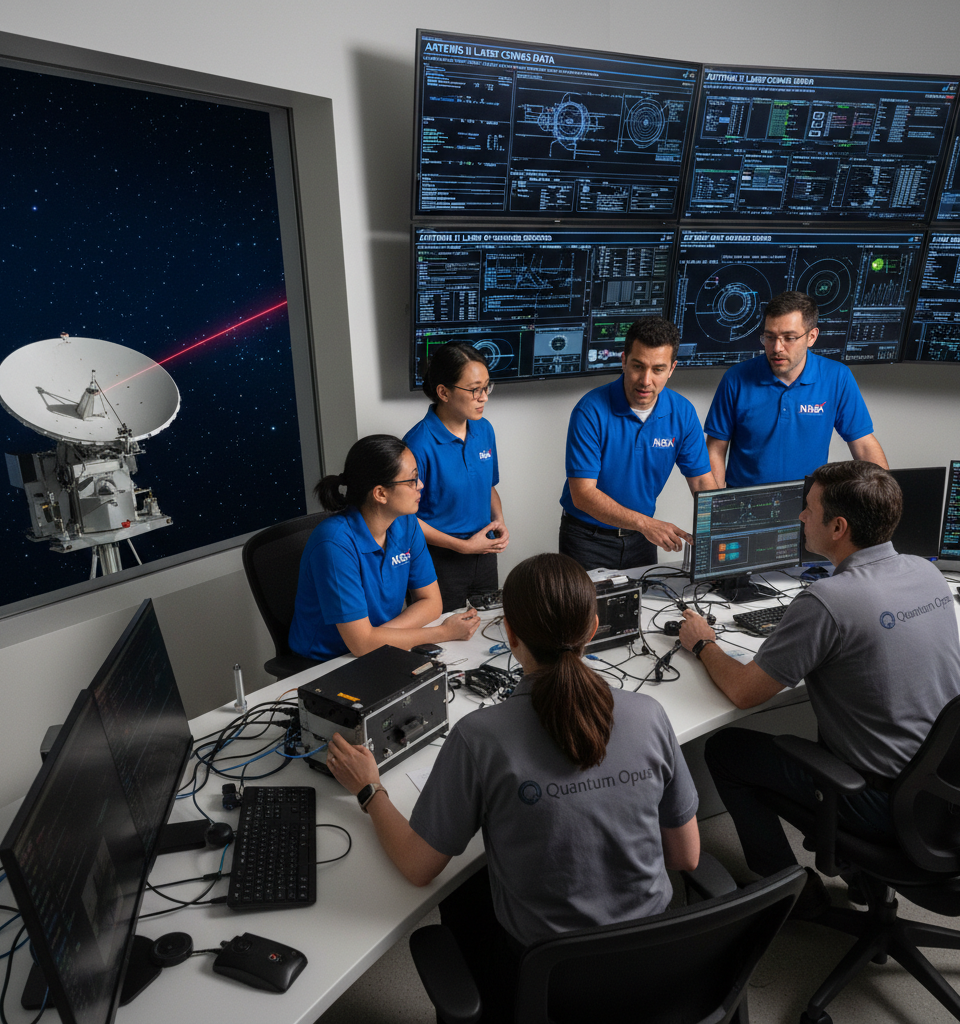
The Dawn of a New Communication Era
The successful demonstration of scalable space-to-Earth laser communications represents a paradigm shift in extraterrestrial data transfer. Historically, deep-space missions have relied on radio frequency (RF) communications, which, while reliable, are limited in bandwidth and susceptible to interference and signal degradation over vast distances. Optical communications, or laser communications, offer an exponential increase in data transfer rates – potentially 10 to 100 times faster than traditional RF systems – enabling the transmission of high-definition imagery, streaming video, and complex scientific datasets in unprecedented volumes. This capability is paramount for missions like Artemis, which aim to return humans to the Moon and establish a sustained presence, requiring robust and rapid data exchange.
Key Technological Breakthroughs and Collaborative Efforts At the heart of this achievement is the innovative integration of advanced photon detection. Observable
Space, known for its expertise in distributed quantum sensing architectures, played a crucial role in designing the data capture and processing framework. Quantum Opus, a leader in superconducting nanowire single-photon detectors (SNSPDs), provided the ultra-sensitive detectors capable of discerning faint laser signals transmitted across vast distances. The demonstration involved the successful reception of laser signals, modulated with data packets, proving the efficacy of their combined technological approach. While specific data rates for this pre-Artemis II test were not disclosed, initial projections suggest multi-gigabit per second capabilities, a substantial leap from megabit rates common in RF systems.
Impact on the Commercial Space and Satellite Industry
This validation has profound implications for the broader space industry, particularly for commercial satellite operators and next-generation internet constellations. The ability to transmit vast amounts of data at high speeds can unlock new business models for Earth observation, scientific research, and global internet connectivity. Companies like SpaceX's Starlink and Amazon's Project Kuiper, while primarily operating in low-Earth orbit, could eventually leverage similar optical communication advancements for enhanced inter-satellite links and ground-to-satellite data throughput. Furthermore, it accelerates the development of a 'space internet' infrastructure, where satellites communicate with each other via laser links, forming a highly interconnected and resilient network.
Expert Perspectives on Future Possibilities
Industry analysts are quick to highlight the transformative potential. Dr. Evelyn Reed, a leading aerospace communication expert, commented, "This isn't just an incremental improvement; it's a foundational shift. The validated scalability means we can confidently plan for Mars missions and beyond, knowing that high-definition video feeds, complex telemedicine data, and real-time scientific telemetry are within reach. It drastically reduces the latency and bandwidth bottlenecks that have plagued deep-space exploration." She added, "The collaboration between specialized firms like Observable Space and Quantum Opus exemplifies the innovative spirit required to tackle these grand challenges, pushing the boundaries of what's technologically feasible."
The Road Ahead for Artemis and Beyond
Looking forward, the successful implementation of laser communications on Artemis II will serve as a crucial testbed for future deep-space missions. NASA's comprehensive plan includes integrating higher-power optical terminals on subsequent Artemis missions, with the ultimate goal of establishing a robust lunar communication network. Beyond the Moon, the technology is critical for NASA's 'Moon to Mars' initiative, where the vast distances to Mars necessitate ultra-efficient and high-capacity communication channels. This includes planned missions like the Mars Ice Mapper and future human missions, which will rely heavily on gigabit-per-second communication links to transmit scientific data, operational commands, and even real-time video conferencing for astronauts. The validated technology from this pre-Artemis II effort sets a firm foundation for an era of unprecedented data flow from the cosmos.