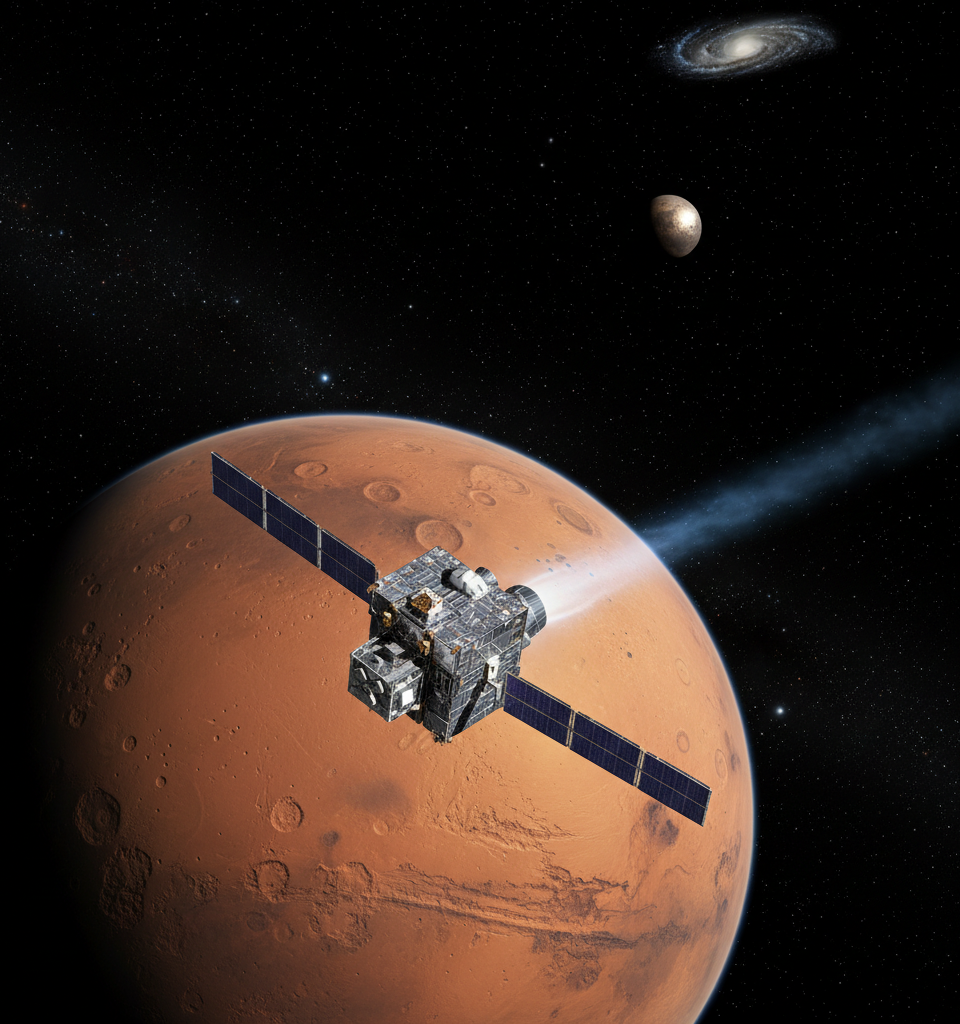
The National Aeronautics and Space Administration (NASA) announced this week that its Psyche spacecraft successfully executed a pivotal Mars gravity assist, utilizing the Red Planet's gravitational pull to slingshot itself towards its primary target: the metal-rich asteroid designated 16 Psyche. This critical maneuver, performed approximately 104 million miles (168 million kilometers) from Earth, imparted a significant speed boost and adjusted the probe's trajectory, setting it firmly on course for an expected arrival in August 2029.
A Deep Dive into Planetary Formation
The Psyche mission holds profound implications for humanity's understanding of planetary formation. Scientists hypothesize that asteroid 16 Psyche is the exposed nickel-iron core of an early protoplanet, stripped of its rocky outer layers by ancient, violent collisions in the solar system. Studying such an object firsthand could provide invaluable data on how terrestrial planets, including Earth, developed their own metallic cores. Currently, our understanding of planetary cores is largely based on seismic data and theoretical models; the Psyche mission offers a rare opportunity for direct observation and analysis of a primitive planetary core.
Mission Trajectory and Key Milestones
Launched on October 13, 2023, from NASA's Kennedy Space Center aboard a SpaceX Falcon Heavy rocket, Psyche embarked on a nearly six-year, 2.2-billion-mile (3.6-billion-kilometer) journey. The Mars flyby was a pre-planned, essential component of its navigation strategy, leveraging celestial mechanics to conserve fuel and accelerate the spacecraft. During the assist, Psyche passed within approximately 2,977 miles (4,792 kilometers) of the Martian surface, achieving its optimal trajectory change. The spacecraft is powered by solar electric propulsion, using Hall thrusters that ionize and accelerate xenon gas to generate a gentle but continuous thrust, making these gravity assists even more vital for significant velocity changes.
Economic and Scientific Potential
The scientific impact of the Psyche mission extends beyond planetary science. The asteroid 16 Psyche is estimated to be approximately 140 miles (226 kilometers) in diameter and, if it is indeed a pure metal core, could contain trillions of dollars worth of precious metals like nickel, iron, and potentially even gold or platinum group elements. While current technology and economic models make asteroid mining unfeasible, the mission will provide unprecedented data on the composition and structure of such bodies. This information could eventually inform future endeavors in space resource utilization, sparking significant interest within burgeoning space commercialization sectors and long-term industrial planning.
Expert Perspectives on Core Origins
Leading planetary scientists view the Psyche mission as a potential paradigm shift. Dr. Lindy Elkins-Tanton, Principal Investigator for the Psyche mission from Arizona State University, has frequently emphasized that "16 Psyche is the only way that humans will ever visit a core. We can't go to Earth's core; we can't go to Mars's core. We can only go to the core of a protoplanet that has exposed itself." Her team believes that insights gained from Psyche will illuminate early solar system processes, particularly the differentiation of planetary bodies into distinct layers of core, mantle, and crust. This comparative planetology data will be invaluable for refining models of planetary evolution across our galaxy.
The Road Ahead: Deep Space and Arrival
With the successful Mars gravity assist complete, Psyche now enters the long cruise phase of its mission. Over the next five years, the spacecraft will continue its deep-space traversal, relying on its solar electric propulsion system for fine-tuning its trajectory. Upon arrival in August 2029, Psyche will spend at least 21 months orbiting the asteroid, employing a sophisticated suite of instruments.
These include a magnetometer to detect any remnant magnetic field, a multispectral imager to map its surface and composition, and a gamma-ray and neutron spectrometer to determine its elemental makeup. The data collected will help confirm its core hypothesis and unveil the mysteries of its formation, promising to reshape our understanding of the early solar system. 2 billion, including launch costs and operations, making each key milestone critically important.
Broader Implications for Space Exploration
The success of the Psyche mission also underscores NASA's increasing reliance on sophisticated autonomous navigation and deep-space communication technologies. Such long-duration missions to distant metallic bodies push the boundaries of engineering and robotics, developing capabilities that will be crucial for future human missions to Mars and beyond. The technical prowess demonstrated by the mission team in executing precise gravitational maneuvers contributes significantly to the agency's broader strategy for robotic exploration of the solar system, fostering innovation across multiple scientific and engineering disciplines. This mission is a testament to sustained investment in fundamental space science.