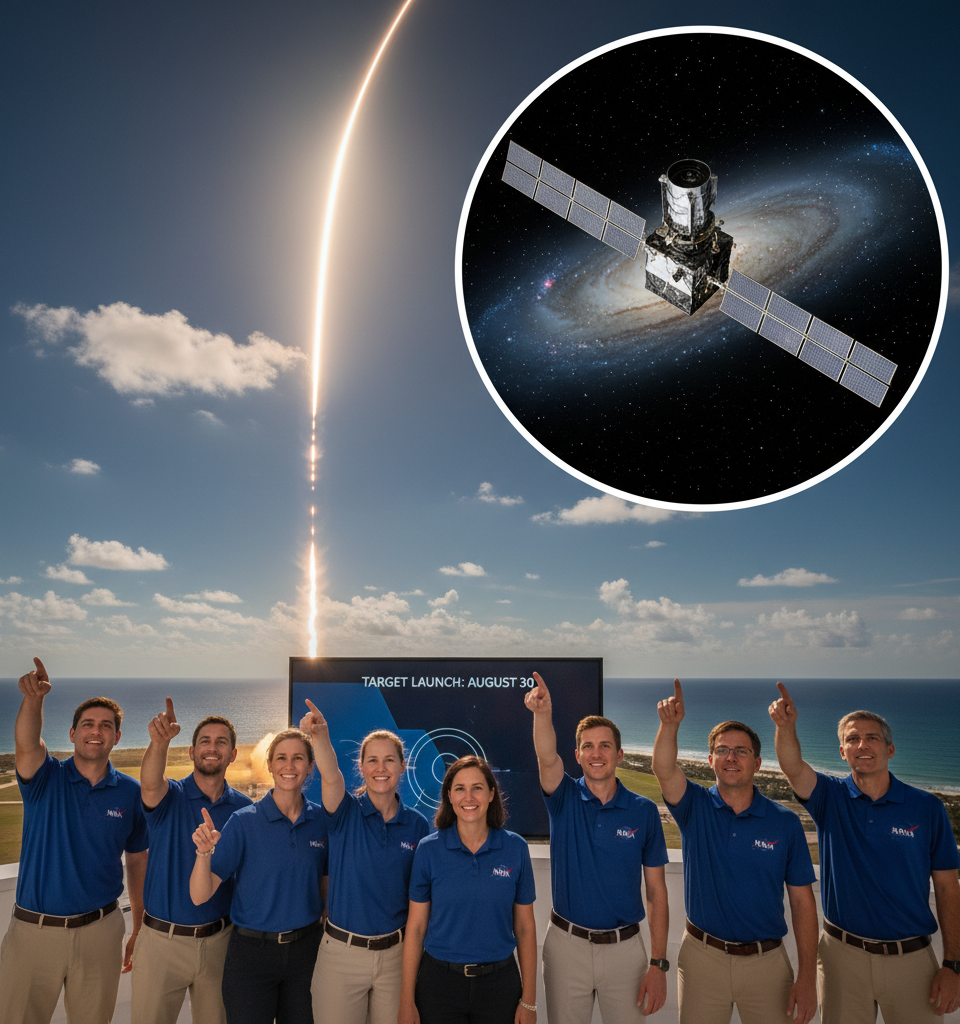
NASA has set an August 30 target date for the launch of its groundbreaking Nancy Grace Roman Space Telescope. This highly anticipated mission is poised to offer astronomers an unprecedented vista of the universe, dramatically expanding our ability to observe distant galaxies, exoplanets, and the mysteries of dark energy and dark matter. The launch marks a pivotal moment for astronomical research, promising to unlock new insights into cosmic evolution.
Context and Significance
The Roman Space Telescope represents a significant leap forward in space-based observation. Named after Nancy Grace Roman, NASA’s first chief astronomer and a driving force behind the Hubble Space Telescope, this mission builds upon decades of advancements in optical technology. Its primary mirror, with a diameter of 2.4 meters, is the same size as Hubble's, but its innovative design allows for an extraordinarily wide field of view. This design choice is crucial for its ambitious scientific goals, enabling it to survey vast swathes of the sky with remarkable efficiency. The mission's focus on wide-field imaging distinguishes it from previous observatories, many of which are designed for high-resolution observations of smaller cosmic regions. This complementary approach will provide a broader context for the detailed observations made by instruments like the James Webb Space Telescope.
Key Capabilities and Scientific Goals
The most striking feature of the Nancy Grace Roman Space Telescope is its field of view, which is 100 times greater than that of the venerable Hubble Space Telescope. This expansive observational capacity will allow Roman to undertake large-scale surveys of the universe, collecting data on billions of galaxies over its five-year primary mission. Among its key scientific objectives are the investigation of dark energy and dark matter – the mysterious components that constitute approximately 95% of the cosmos but remain largely invisible and poorly understood.
By precisely measuring the distances and distributions of galaxies, Roman will map the large-scale structure of the universe, providing critical data to test competing theories about the nature of dark energy and the expansion of the universe. Additionally, the telescope will conduct a substantial exoplanet hunting campaign using the microlensing technique, enabling the discovery of potentially thousands of new exoplanets, including those with masses comparable to Earth, beyond the solar system.
Impact on Astronomical Research
The launch of the Roman Space Telescope is expected to usher in a new era of discoveries in astrophysics and cosmology. Its wide-field capabilities will allow for comprehensive surveys that were previously impossible, creating vast new datasets that will take years to fully analyze. This influx of data will likely lead to unforeseen discoveries and refine our understanding of cosmic phenomena.
For instance, its ability to observe numerous supernovae – exploding stars used as 'standard candles' to measure cosmic distances – will offer crucial data for charting the universe's expansion history. Furthermore, its exoplanet census will provide statistical insights into the prevalence and characteristics of planetary systems around other stars, offering clues about the potential for life beyond Earth. The telescope's broad observational power will allow it to identify rare objects and events across the universe, providing targets for more detailed follow-up observations by other ground-based and space-based observatories.
Collaboration and Technological Advancement
The development of the Nancy Grace Roman Space Telescope has been a monumental undertaking, involving extensive collaboration between NASA, international partners, and numerous academic institutions. The telescope incorporates cutting-edge technologies, including its advanced Wide Field Instrument (WFI) and a Coronagraph Instrument (CGI) designed to directly image exoplanets by blocking the glare of their host stars. While the primary mission will focus on the wide-field surveys, the CGI serves as a crucial technology demonstration for future missions aimed at directly characterizing potentially habitable exoplanets. The successful deployment and operation of Roman will validate these technological advancements, paving the way for even more ambitious space exploration endeavors in the decades to come.
Looking Ahead
Following its August 30 launch, the Roman Space Telescope will undergo a commissioning phase to ensure all instruments are functioning optimally before commencing its scientific operations. The initial data releases are highly anticipated by the scientific community, eager to explore the unprecedented views the telescope will provide. Over its operational lifetime, Roman is expected to generate a wealth of data that will fuel research for generations, helping to answer some of the most profound questions about our universe. Its legacy will likely be defined by not only the answers it provides regarding dark energy and exoplanets but also by the entirely new questions it uncovers, pushing the boundaries of human knowledge further than ever before.