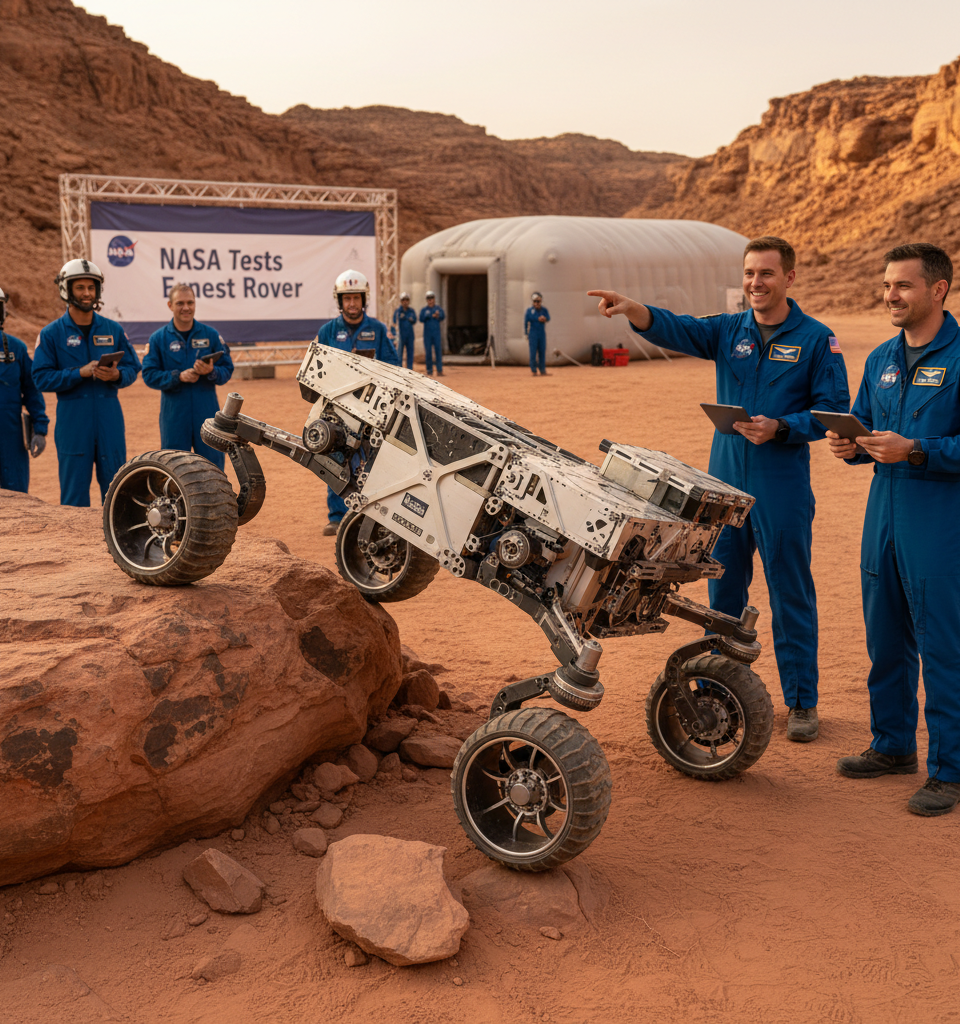
NASA is actively conducting tests on its Ernest prototype rover, a groundbreaking development poised to revolutionize planetary exploration by offering significantly enhanced speed and obstacle-climbing capabilities. The tests, details of which were shared by the space agency, highlight a strategic pivot towards more dynamic and efficient robotic reconnaissance missions across celestial bodies.
Advancing Robotic Exploration
The development of the Ernest rover signals a crucial step in NASA's long-term vision for automated exploration. For decades, planetary rovers have been instrumental in gathering invaluable scientific data from distant worlds, from Mars to the Moon. However, traditional designs, while robust, have often been constrained by speed and maneuverability, particularly across uneven and unpredictable landscapes. The agency's investment in prototypes like Ernest underscores a push to overcome these limitations, enabling future missions to cover more ground, access previously unreachable areas, and respond more dynamically to scientific opportunities encountered in real-time.
Ernest's Unique Capabilities Unveiled
Recent footage released by NASA provides a compelling look at Ernest in action, demonstrating its two most notable features: increased driving speed and an innovative obstacle-climbing mechanism. Unlike conventional rovers that rely on slow, deliberate movements over rough terrain, Ernest is engineered for greater velocity, potentially drastically reducing the time required to traverse vast Martian plains or lunar regolith. Crucially, the prototype's ability to lift its wheels over obstacles marks a significant departure from standard designs. This unique articulation allows Ernest to adapt its form to negotiate rocks, craters, and other impediments that would typically halt or significantly delay less agile vehicles, thereby expanding accessible exploration zones.
Impact on Future Missions
The successful integration of Ernest's design principles into future generations of planetary rovers could dramatically alter the scope and ambition of NASA's exploratory endeavors. Faster traversals mean more scientific targets can be investigated during a mission's operational lifetime, while enhanced obstacle negotiation capabilities open up previously inaccessible regions, such as steep crater rims or deeply eroded canyons, which often hold the most compelling geological and astrobiological secrets. This technological leap could accelerate significant discoveries, providing data crucial for understanding planetary formation, the potential for extraterrestrial life, and future human habitability.
Engineering for Extraterrestrial Challenges
Designing a rover capable of operating in the extreme environments of other planets presents immense engineering challenges. Factors such as vacuum, radiation, extreme temperature fluctuations, and fine, abrasive dust must be meticulously accounted for. Ernest's development reflects years of research into advanced materials, robotics, and artificial intelligence to create a system that is not only agile but also resilient under such harsh conditions. The tests being conducted are not just about demonstrating mobility but also about stress-testing hardware and software under simulated extraterrestrial stresses to ensure operational longevity and reliability.
The Road Ahead for Planetary Rovers
While Ernest is still in its prototype phase, the insights gained from these tests will be instrumental in informing the design of NASA's next generation of operational rovers. The agency's continued focus on developing more autonomous, adaptable, and efficient exploration vehicles aligns with broader trends in space exploration, which increasingly emphasize capabilities for independent decision-making and robust performance far from Earth. The ultimate goal is to enable missions that can achieve ambitious scientific objectives with greater independence and resilience, paving the way for both advanced robotic exploration and eventual human missions to the Moon and Mars.