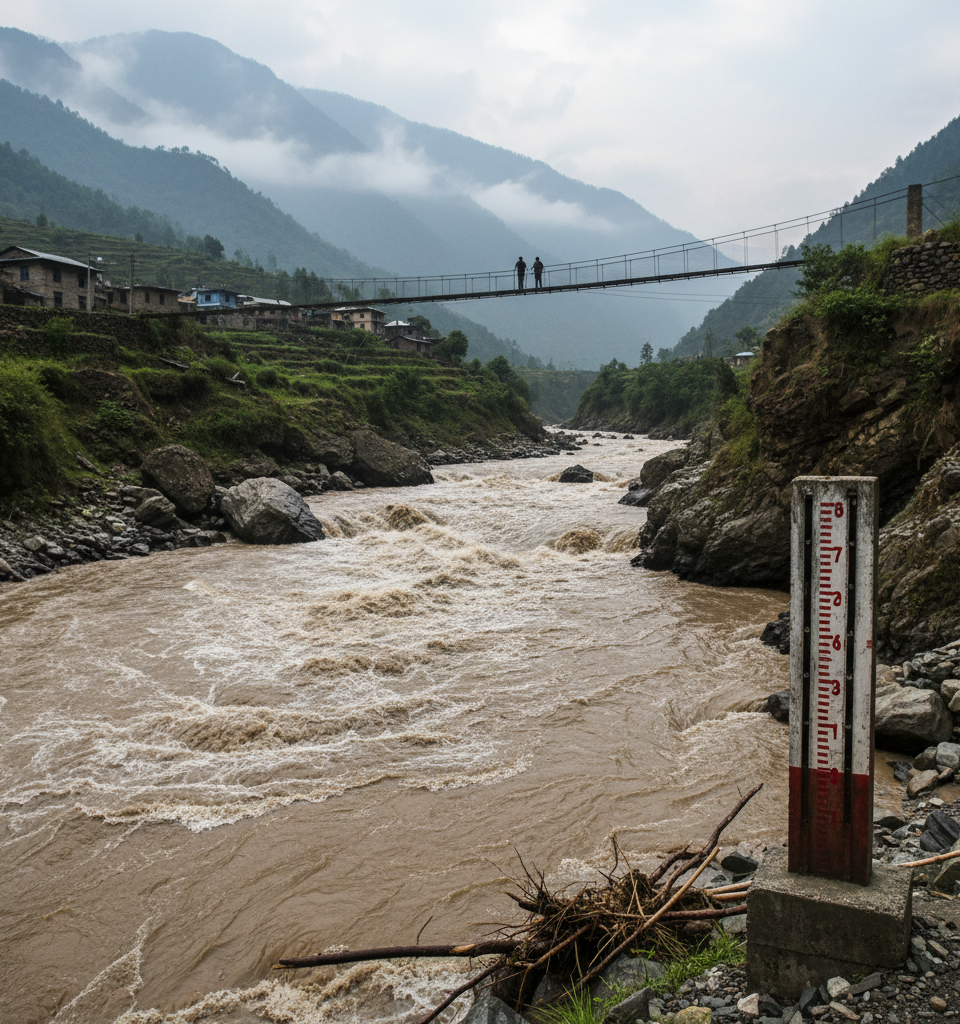
The rapid pace of Nepal's flash floods likely overwhelmed the country's conventional early warning systems, according to insights from scientists and disaster response researchers. This incident underscores critical infrastructure vulnerabilities in managing extreme weather events, which could lead to significant human and economic costs for nations with similar geographical challenges and traditional monitoring approaches.
Kathmandu, Nepal – A post-event analysis by scientists and disaster response researchers indicates that the extraordinary speed of recent flash floods in Nepal was a critical factor in the efficacy of the nation's early warning system. Experts suggest the conventional network of river gauges, upon which the system primarily relies in this remote region, was likely unable to provide sufficient lead time for effective mitigation and evacuation efforts.
System Limitations in Remote Terrains
Nepal's geography, characterized by its steep Himalayan slopes and complex river systems, makes it particularly susceptible to flash floods. These events are distinct from typical riverine floods, often occurring with little to no warning as heavy rainfall rapidly translates into surging waters in narrow valleys and gorges. The existing early warning infrastructure, while foundational, is built around a network of river gauges that measure water levels at specific points. For flash floods, especially those originating high in the mountains or from glacial lake outburst floods (GLOFs), the time between detection and impact can be minutes, rendering conventional, point-based monitoring potentially inadequate.
The Challenge of Rapid Onset Events
Disaster response researchers highlighted that the inherent lag in data collection and dissemination from these traditional gauges may have been a significant drawback. In scenarios where water levels rise from normal to dangerous in a very short span, the data processing and alert transmission cycle could simply be too slow. This limitation is particularly acute in remote areas where communication infrastructure can be sparse or unreliable, further delaying warnings to vulnerable communities located downstream.
Broader Implications for Disaster Preparedness
The findings have broader implications for disaster preparedness strategies in other mountainous and flood-prone regions globally. Many developing nations rely on similar conventional warning systems due to cost-effectiveness and ease of maintenance. However, as climate change potentially intensifies the frequency and severity of extreme weather events, the need for more advanced, real-time monitoring technologies becomes increasingly urgent. These could include satellite-based rainfall estimates, radar systems, or drone surveillance to augment ground-based sensors.
Expert Perspectives on Future Enhancements
Experts suggest that future enhancements to flood warning systems in Nepal and similar regions would need to incorporate technologies capable of detecting precursor events with greater speed and accuracy. This could involve integrating hydrological models with weather forecasts, deploying acoustic sensors for debris flow detection, or investing in community-based early warning systems that leverage local knowledge and immediate communication channels. The goal would be to create a multi-layered, redundant system that can withstand the operational challenges posed by fast-developing natural hazards.
The Path Forward: Resilience and Innovation
Moving forward, the focus for Nepal's disaster management agencies, with international support, will likely shift towards developing more resilient and technologically advanced warning mechanisms. This involves not only upgrading hardware but also improving data analytics, refining prediction models, and enhancing public awareness and evacuation protocols. The incident serves as a stark reminder that while conventional systems are valuable, they must evolve to match the increasing intensity and unpredictability of natural disasters in a changing climate, especially when dealing with the extraordinary speed of flash flood events.