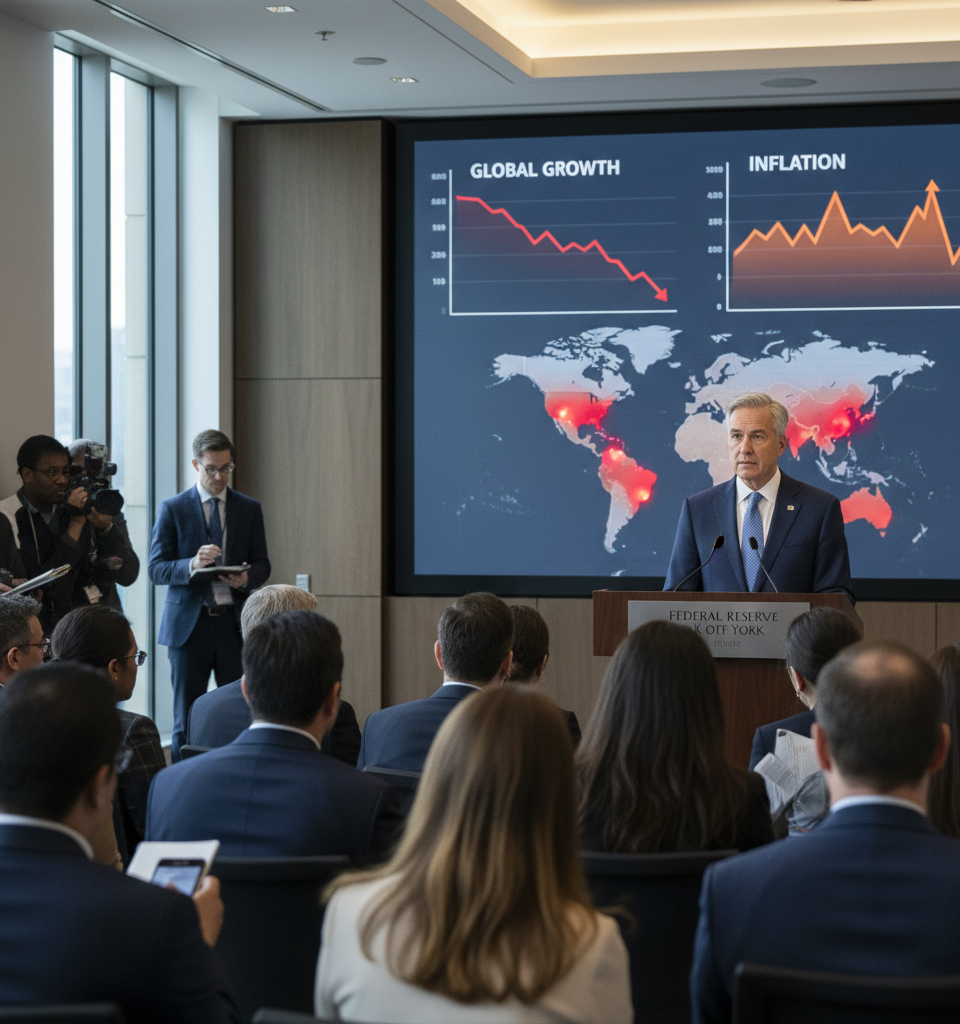
New York Federal Reserve President John C. Williams today voiced serious apprehension regarding the protracted international conflict, predicting it will likely exert a detrimental influence on global economic expansion and exacerbate inflationary trends. Speaking on the current geopolitical landscape, Williams underscored that the conflict has "intensified the uncertainty" pervading both national and regional economic outlooks. His remarks highlight a growing concern among central bankers about external shocks derailing meticulously crafted economic recovery plans and inflation containment strategies.
Intensified Uncertainty and Economic Headwinds
Williams' assessment comes at a critical juncture, as economies worldwide grapple with persistent inflation and uneven growth trajectories in the wake of recent global disruptions. The conflict, while geographically distant for many, has sent ripples through intricate global supply chains, commodity markets, and investor sentiment. This cascade of effects directly contributes to the uncertainty Williams articulated, making economic forecasting and policy calibration considerably more complex. The Federal Reserve, like many central banks, has been navigating a delicate balance between curbing inflation through interest rate hikes and avoiding a significant economic downturn. The added layer of conflict-induced instability complicates this task, potentially necessitating a re-evaluation of current monetary policy stances.
Potential for Slower Growth and Aggravated Inflation
The dual threat of slower growth and aggravated inflation, often termed stagflationary pressures, represents a significant challenge. Slower growth could lead to reduced business investment, job creation, and overall economic activity. Simultaneously, if the conflict continues to disrupt critical supply lines, particularly in energy and food sectors, it could push consumer prices higher, eroding purchasing power and potentially triggering wage-price spirals. Williams' statement serves as a stark reminder that geopolitical events are not isolated incidents but integral factors shaping the global economic environment, capable of undermining hard-won economic stability.
The implications of Williams' concerns extend beyond national borders. The interconnectedness of modern economies means that disruptions originating in one region can quickly propagate, impacting trade partners, financial markets, and energy consumers globally. For instance, disruptions in key commodity-producing regions due to conflict could lead to sustained higher energy and food costs, placing additional strain on households and businesses already contending with elevated living expenses. This global ripple effect underscores the urgency of addressing the sources of instability.
Broader Economic and Market Impacts
Financial markets have already demonstrated sensitivity to geopolitical developments. Periods of increased conflict often correlate with heightened volatility in equity markets, a flight to safe-haven assets, and fluctuations in currency valuations. Businesses reliant on international trade or with significant global supply chain exposure are particularly vulnerable to these disruptions. The intensified uncertainty cited by Williams can lead to delayed investment decisions, reduced hiring, and a general retrenchment in economic activity as companies adopt a more cautious approach in an unpredictable environment. This conservative stance, while pragmatic for individual firms, can collectively slow aggregate economic growth.
Looking ahead, the trajectory of the conflict will be a pivotal determinant of economic outcomes. Should the conflict de-escalate, some of the immediate inflationary pressures and supply chain bottlenecks might abate, potentially easing the path for economic recovery. Conversely, any intensification or prolonged duration of hostilities could entrench higher inflation and depress growth prospects further, leading to a more challenging economic climate than currently anticipated. Central banks and policymakers will need to remain agile and adaptable, ready to adjust their strategies in response to evolving geopolitical realities.
What Lies Ahead for Monetary Policy
Williams' remarks suggest that the Federal Reserve, along with other central banks, is closely monitoring the conflict's economic fallout. While he did not specify policy responses, his emphasis on intensified uncertainty implies that the path for monetary policy may become less clear-cut. Policymakers might face increased pressure to balance the imperative of curbing inflation with the need to avoid exacerbating a potential economic slowdown. This delicate balancing act will likely dominate discussions at upcoming Federal Open Market Committee (FOMC) meetings. The central bank's communication will be vital in guiding market expectations and mitigating further economic instability in the face of these complex global challenges.