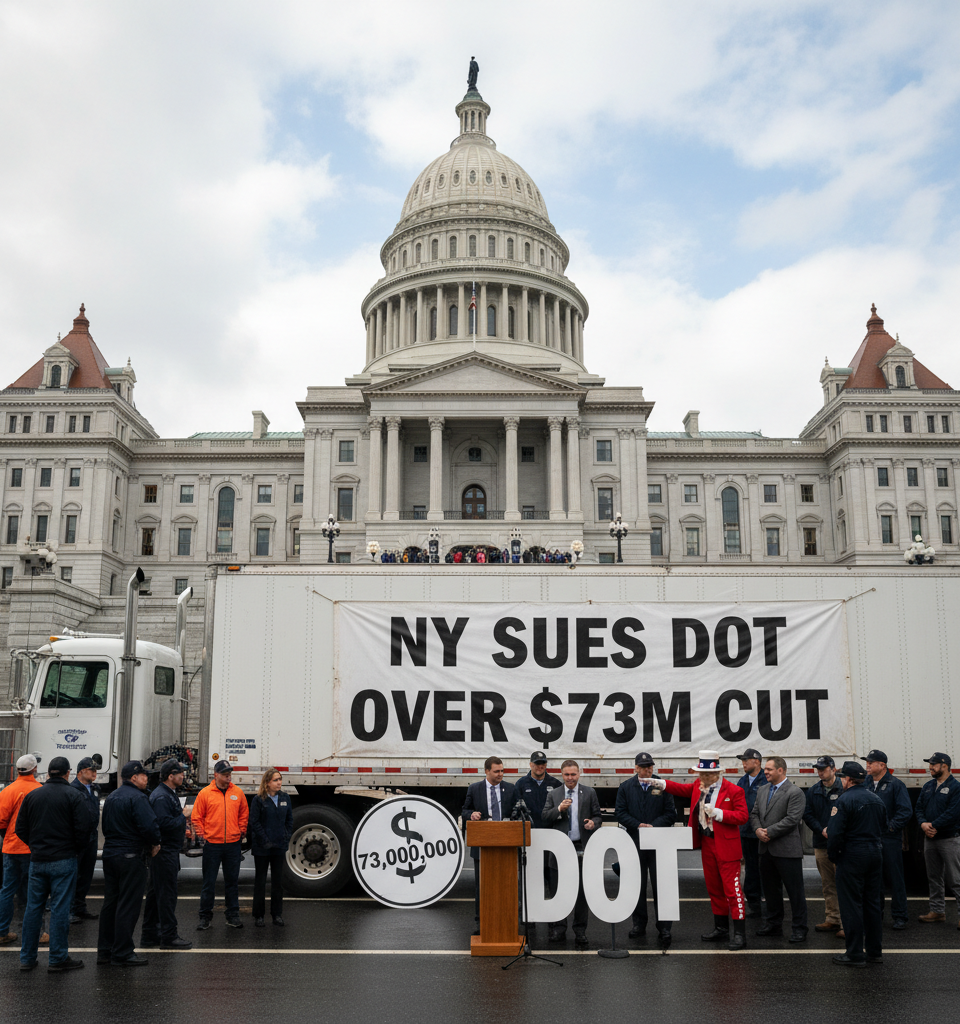
S. Department of Transportation (DOT), challenging a contentious ruling that resulted in a staggering $73 million reduction in federal highway funding. Filed recently in federal court, the lawsuit contends that the DOT's interpretation of regulations concerning the issuance of Commercial Driver's Licenses (CDLs) to non-domiciled individuals is incorrect and unfairly penalizes the state.
This legal action underscores a significant escalation in a long-standing disagreement between state and federal authorities over driver licensing protocols crucial for interstate commerce.
Context and Background of the Dispute At the heart of the dispute is the
DOT's insistence that states must only issue CDLs to individuals who demonstrate domicile within that state. New York, however, has historically issued CDLs to certain non-domiciled residents, particularly those who may live in an adjacent country (like Canada) but primarily operate commercial vehicles within New York. The federal government, through the Federal Motor Carrier Safety Administration (FMCSA) and under the authority of the DOT, argues that the state's practice violates the Commercial Motor Vehicle Safety Act of 1986. This act was designed to ensure that each commercial driver has only one license and that all states adhere to uniform licensing standards, thereby enhancing highway safety. The contested funding, amounting to 5% of New York’s total federal highway aid, represents a substantial blow to the state's infrastructure budget.
Key Legal and Financial Specifics
The lawsuit argues that the DOT's interpretation is overly rigid and fails to account for practical cross-border operational realities. New York officials contend that their licensing process includes rigorous testing and background checks, ensuring that even non-domiciled CDL holders meet all safety standards. The $73 million funding cut was implemented after years of warnings and advisories from the FMCSA, culminating in a final ruling that New York alleges was arbitrary and capricious. Governor Kathy Hochul's administration has emphasized that the state's intent is to ensure safe roads without unfairly restricting economic activity, particularly in border regions. The legal filing seeks an injunction to restore the funding and a judicial review of the DOT's regulatory interpretation.
Industry-Wide Impact and Implications
This dispute carries significant implications beyond New York's borders. Should the DOT's ruling stand, other states with similar cross-border dynamics could face similar funding penalties. The trucking industry, already grappling with driver shortages and complex regulatory landscapes, watches closely. Companies that rely on cross-border transport, particularly those operating near the Canadian and Mexican borders, could face increased operational hurdles if licensing rules become more fragmented or restrictive. Industry associations have expressed concerns that stricter enforcement could inadvertently exacerbate supply chain issues by limiting the available pool of qualified drivers, even if they meet safety requirements.
Expert Perspectives on the Standoff
Legal experts and transportation policy analysts are divided on the merits of New York's challenge. "While the DOT's intent is to ensure uniformity and safety under federal law, there's always a question of how flexible those interpretations can be for unique geopolitical situations," stated Dr. Eleanor Vance, a professor of transportation law at Syracuse University. "New York's argument will likely hinge on whether they can demonstrate that their process for non-domiciled CDLs is equivalent in safety standards to a domiciled license, without undermining the 'one driver, one license' principle." Others point out that the federal government has a strong interest in upholding the integrity of the national CDL program to prevent potential loopholes that could compromise safety nationwide.
The Road Ahead: Potential Outcomes and Developments
The immediate future will see legal arguments unfold in federal court, with both sides presenting their case. A ruling in New York's favor could set a precedent requiring the DOT to adopt a more nuanced approach to CDL regulations, potentially leading to revised guidelines for all states. Conversely, a victory for the DOT would reinforce federal authority over state-level licensing, possibly prompting New York and other affected states to either alter their practices or continue to operate with reduced federal funding. The outcome will have lasting effects on state-federal relations in transportation, driver licensing policies, and undoubtedly, the flow of commerce across U.S. borders. Stakeholders anticipate a lengthy legal battle, the resolution of which could take months or even years, influencing future infrastructure projects and the broader regulatory environment for commercial transportation.