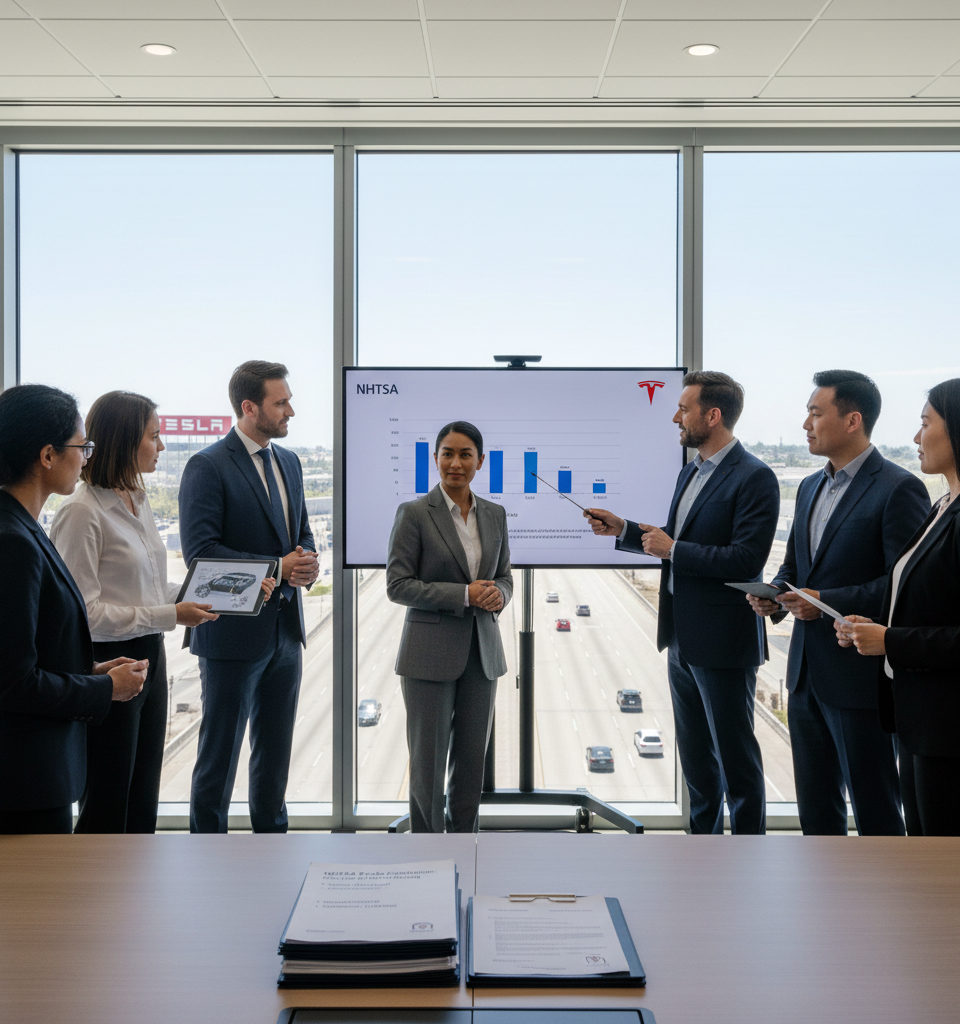
Washington D.C. — The National Highway Traffic Safety Administration (NHTSA) has officially closed its in-depth investigation into Tesla's advanced remote parking feature, commonly known as 'Smart Summon.' After a comprehensive analysis launched in 2021, the federal safety watchdog concluded that the technology, which allows Tesla owners to remotely maneuver their vehicles in tight spaces, exhibited a remarkably low incident rate and, crucially, no reported injuries. The decision, announced this week, acknowledges Tesla's proactive efforts in deploying multiple software updates aimed at bolstering the system's safety protocols and driver awareness.
The Genesis of the Inquiry and Broader Context
NHTSA initiated its preliminary evaluation (PE21-020) following a surge of public complaints and media reports concerning alleged incidents involving the Smart Summon feature. Introduced in 2019 as part of Tesla's Full Self-Driving (FSD) package, this functionality allows a vehicle to navigate complex parking scenarios and call itself to the owner from a short distance, ostensibly enhancing convenience and accessibility. The federal probe underscored the increasing scrutiny faced by advanced driver-assistance systems (ADAS) across the automotive industry, as regulators grapple with the nascent challenges of defining safety standards for increasingly autonomous vehicles.
Key Findings: Low Incident Rate, No Injuries, and Software Interventions
According to NHTSA's official closure report, the investigation reviewed 12,043 complaints related to Smart Summon incidents between January 2019 and February 2023. This figure represents a tiny fraction of the approximately 540,000 unique Smart Summon events recorded by Tesla during the same period, indicating an incident rate well below 1%. Crucially, NHTSA emphasized that despite these numerous complaints, not a single one involved reported injuries. The agency also noted that Tesla had implemented several over-the-air (OTA) software updates, including enhancements in September 2020 and September 2022, which introduced improved object detection, pathway planning, and clearer user interface warnings regarding the system's limitations and the driver's responsibility for continuous monitoring. These updates were cited as significant factors in mitigating potential risks.
Industry Implications and the ADAS Regulatory Landscape
NHTSA's decision sends a complex signal to the broader automotive industry, which is heavily invested in developing and deploying ADAS technologies. While it validates Tesla's efforts in iterative software improvements, it also underscores the intensive regulatory oversight such systems will continue to face. Other automakers with similar remote parking or driver-assist features, such as BMW's Remote Control Parking or Mercedes-Benz's Parking Pilot, will likely observe this outcome closely. The ongoing challenge for regulators is to balance fostering innovation in automotive safety with ensuring adequate consumer protection, particularly as vehicles become more complex and rely on artificial intelligence.
Expert Perspectives on the Outcome
Automotive safety experts have offered mixed reactions. Dr. Sarah Jenkins, a professor of autonomous systems at MIT, commented, "NHTSA's conclusion, particularly the lack of reported injuries, is a testament to the fact that while ADAS isn't perfect, its current iterations are largely proving safe within their operational design domains. However, the sheer volume of complaints suggests a persistent challenge in managing user expectations and ensuring clear understanding of system limitations." Conversely, consumer advocacy groups voiced concerns that closing the investigation might reduce pressure on Tesla to further refine the system, arguing that even non-injury incidents can erode public trust in advanced features. They advocate for more stringent reporting requirements for ADAS-related occurrences.
What Lies Ahead: Continuous Monitoring and Evolving ADAS Standards
While this specific investigation into Smart Summon is closed, NHTSA explicitly states that it retains the authority to reopen the probe or launch new investigations if additional data or safety concerns emerge. This reflects the agency's commitment to continuous monitoring of ADAS performance. For Tesla, the decision allows it to continue developing and deploying its FSD suite, though it will undoubtedly remain under intense scrutiny for all its autonomous capabilities. The broader future will see an ongoing evolution of ADAS regulatory frameworks, potentially including more standardized testing protocols and clearer definitions for different levels of automation, as the industry moves closer to fully autonomous vehicles.
Tesla's Stance and Future Development
Tesla has consistently maintained that its Smart Summon feature is safe when used as intended, with the driver remaining attentive and ready to intervene. While the company has not issued a specific statement regarding NHTSA's closure, its past actions, including the consistent delivery of OTA updates, demonstrate a commitment to enhancing its ADAS offerings. Further developments in the FSD beta program, which includes refined Smart Summon capabilities, are anticipated to integrate lessons learned from real-world data and regulatory scrutiny, signaling a continuous cycle of improvement in this rapidly evolving sector.