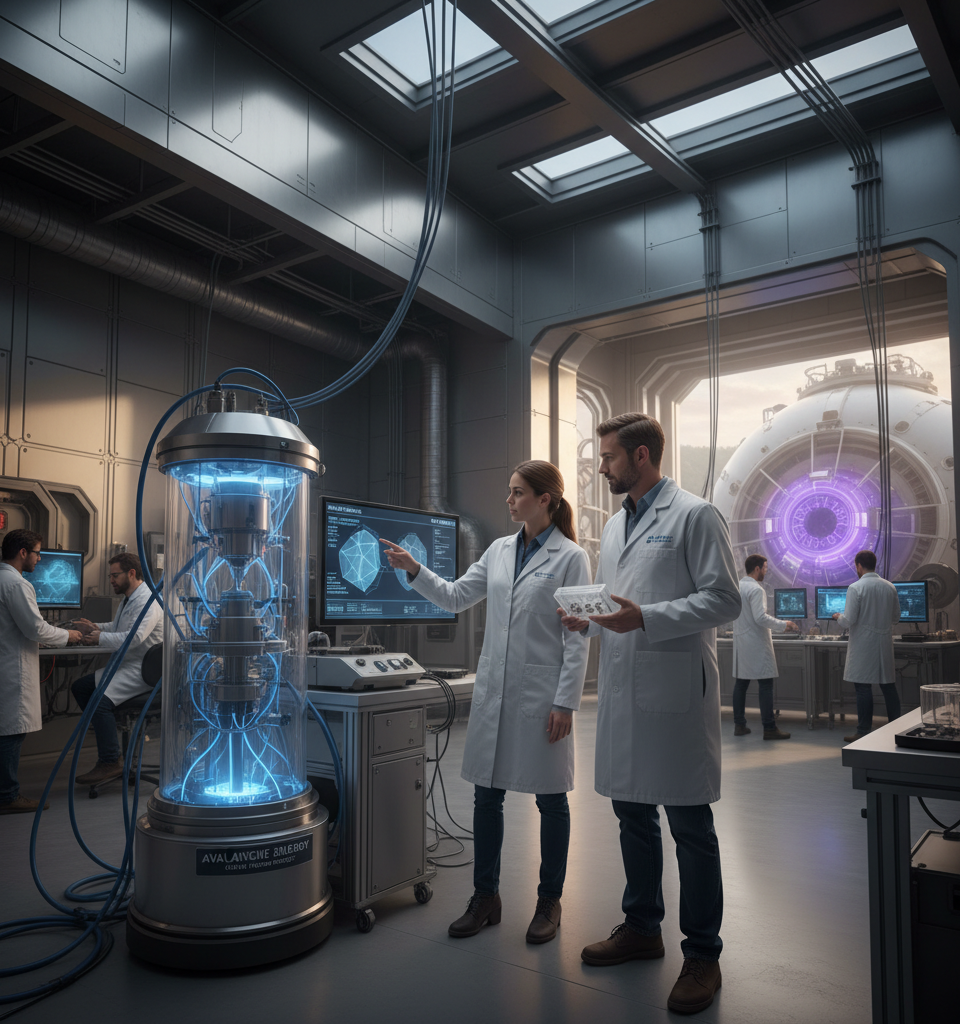
Cambridge, MA – In a development poised to significantly impact the quest for sustainable energy, Avalanche Energy, in collaboration with the Defense Advanced Research Projects Agency (DARPA), is spearheading a groundbreaking project focused on a new generation of materials. These materials are engineered to directly convert the intense, damaging radiation emitted by fusion reactions into usable electricity, bypassing traditional heat-to-electricity conversion methods. This innovative approach, often termed “nuclear batteries” in various contexts, represents a crucial step towards making fusion power not only viable but also economically attractive by improving efficiency and reducing reliance on complex thermal cycles.
The Urgent Need for Fusion's Promise
The pursuit of fusion power, which mimics the energy-producing processes of the sun, has been an ambitious scientific endeavor for decades. Unlike nuclear fission, fusion promises abundant, clean energy with minimal long-lived radioactive waste. However, one of the persistent challenges has been efficiently extracting energy from the high-energy particles produced within fusion reactors. Current concepts often rely on heating water to generate steam, a process that is both inefficient and requires massive, complex infrastructure. The DARPA-backed project directly addresses this bottleneck, offering a potential paradigm shift in energy conversion that could dramatically reduce the size and cost of fusion power plants, thereby accelerating their commercialization.
Breakthrough Materials and Direct Conversion
The core of Avalanche Energy's work lies in developing advanced semiconductor materials capable of acting as direct energy converters. These materials are designed to withstand the extreme radiation environment of a fusion reactor while efficiently absorbing high-energy particles and generating an electric current. While specific material compositions remain proprietary due to the nature of the DARPA contract, the concept draws parallels with radioisotope thermoelectric generators (RTGs) used in spacecraft, but scaled and optimized for much higher energy flux and specific radiation types. Early prototypes and simulations indicate a potential for upwards of 40-50% direct energy conversion efficiency, a substantial improvement over the 30-35% typically achieved through steam cycles in fission plants, let alone the complexities of extracting heat from fusion.
Reshaping the Fusion Landscape
Should this technology prove successful at scale, its impact on the nascent fusion industry would be profound. By simplifying energy extraction, nuclear batteries could enable more compact and modular fusion reactor designs, reducing capital expenditure and shortening construction timelines. This could address one of the most significant barriers to fusion's commercial viability: the immense initial investment. Furthermore, improved efficiency means less energy is wasted, pushing fusion power closer to a positive net energy gain, where more energy is produced than consumed to initiate the reaction. The ability to directly convert fusion products into electricity could also open avenues for novel reactor geometries and fuel cycles, expanding design possibilities far beyond current tokamak and stellarator concepts.
Expert Insights on a Game-Changing Technology
Industry analysts and fusion scientists are keenly watching these developments. Dr. Elena Petrova, a senior researcher at the International Fusion Energy Council, commented, "The direct conversion of fusion products into electricity has long been a holy grail for the community. If Avalanche Energy and DARPA can demonstrate a robust, scalable material solution, it would be a true game-changer, potentially shaving years, if not decades, off the timeline for commercial fusion power." She added, "The challenges are immense, from radiation hardness to sheer power handling, but the potential rewards are equally monumental, promising gigawatts of carbon-free power." The investment community is also taking notice, with several venture capital firms in the deep-tech space beginning to earmark funds for technologies that can bridge the gap between scientific fusion breakthroughs and practical power generation.
The Path Ahead: Validation and Scale-Up
The immediate next steps for Avalanche Energy involve rigorous testing and validation of their advanced materials under simulated fusion conditions. This includes irradiation experiments at specialized facilities and the development of scaled-down prototypes to demonstrate sustained power generation. Initial funding from DARPA to Avalanche is reportedly in the low eight-figure range, underscoring the strategic importance placed on this project. Success in these early stages would likely unlock significantly larger investment for scaling production and integrating the technology into experimental fusion devices. The long-term vision includes the potential licensing of this technology to major fusion developers and energy companies, positioning these nuclear batteries as a ubiquitous component in future fusion power plants, driving an energy revolution for the 21st century and beyond.