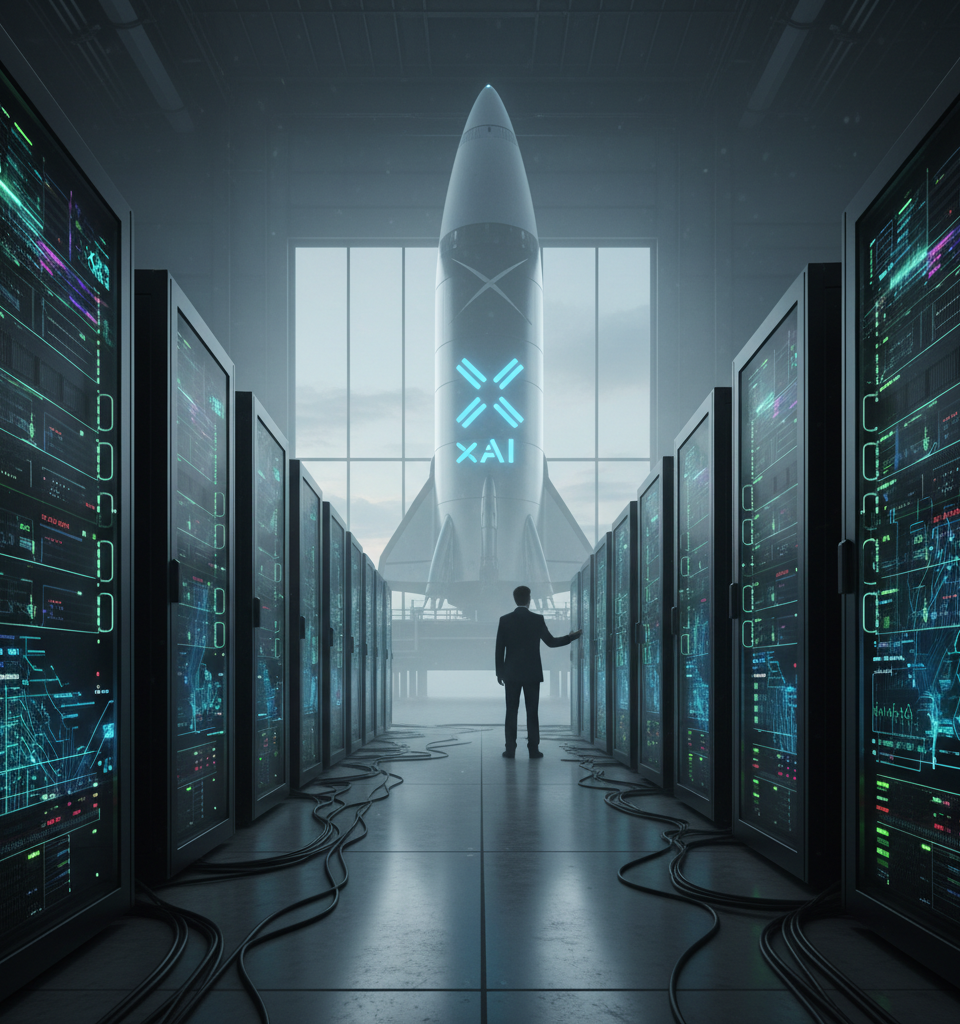
For businesses navigating the complexities of global expansion and cross-border trade, this significant inter-company investment underscores the shifting landscapes of technological infrastructure and supply chain dependencies. The nexus between AI and aerospace, as exemplified by this stake, signals critical advancements in areas like satellite internet and advanced logistics, which are increasingly foundational to efficient international operations and market access.
Technology behemoth Nvidia has formally unveiled a substantial financial interest in the privately held aerospace enterprise, SpaceX. The disclosed stake, valued at approximately $21 billion, was recorded as of the conclusion of the second quarter. This significant holding was secured indirectly through Nvidia's strategic investment in the artificial intelligence startup xAI.
Context and Strategic Alignment
Nvidia, a leading designer of graphics processing units (GPUs) and AI computing platforms, has been at the forefront of the artificial intelligence revolution. Their involvement in xAI, an AI company founded by Elon Musk, positions them within an ecosystem that naturally extends to Musk's other ventures, including SpaceX. This cross-sector investment highlights the increasing integration of AI capabilities across diverse industries, from advanced computing to space technology and satellite communications. The financial disclosure comes at a time when major technology firms are actively seeking new avenues for growth and diversification, often through strategic investments in high-potential, disruptive startups.
Investment Details and Valuation
The $21 billion valuation of Nvidia's stake in SpaceX represents a considerable portion of its investment portfolio and a significant endorsement of SpaceX's long-term prospects. This valuation was determined as of the close of the second quarter, providing a snapshot of Nvidia's financial position at that time. The indirect nature of the investment—through xAI—suggests a multi-layered strategic play, leveraging the growth potential of AI while gaining exposure to the burgeoning space economy. While specific details regarding the mechanics of the stake acquisition via xAI were not immediately elaborated upon, the disclosure itself confirms a material financial commitment.
Industry and Market Implications
This development sends a clear signal to the market regarding the perceived value and future trajectory of space technology, particularly companies like SpaceX that are innovating in areas such as reusable rockets, satellite internet (Starlink), and space exploration. For Nvidia, the investment could represent a strategic hedge or a foundational step toward deeper collaborations in AI-powered space applications. The intertwining of AI leaders like Nvidia with space pioneers like SpaceX suggests a future where advanced computing power will be critical for managing vast satellite networks, processing orbital data, and enabling autonomous space operations. Competitors in both the AI and aerospace sectors will undoubtedly be watching closely for further implications of such a substantial cross-industry tie-up.
Future Outlook and Potential Synergies
The disclosed stake opens up numerous possibilities for future synergy between Nvidia's AI expertise and SpaceX's aerospace ambitions. AI is increasingly vital for optimizing rocket launches, managing satellite constellations, and developing sophisticated autonomous systems for space missions. Nvidia's powerful GPUs are the backbone for much of the world's AI development, making their involvement a potential accelerant for SpaceX's technological advancements.
While the immediate financial details of the investment have been confirmed, the broader strategic partnership and collaborative ventures that could arise from this significant stake remain subjects of ongoing market speculation. The long-term implications for both companies, and indeed for the sectors they represent, are expected to be substantial, influencing technological development and market competition in both AI and space exploration for years to come.