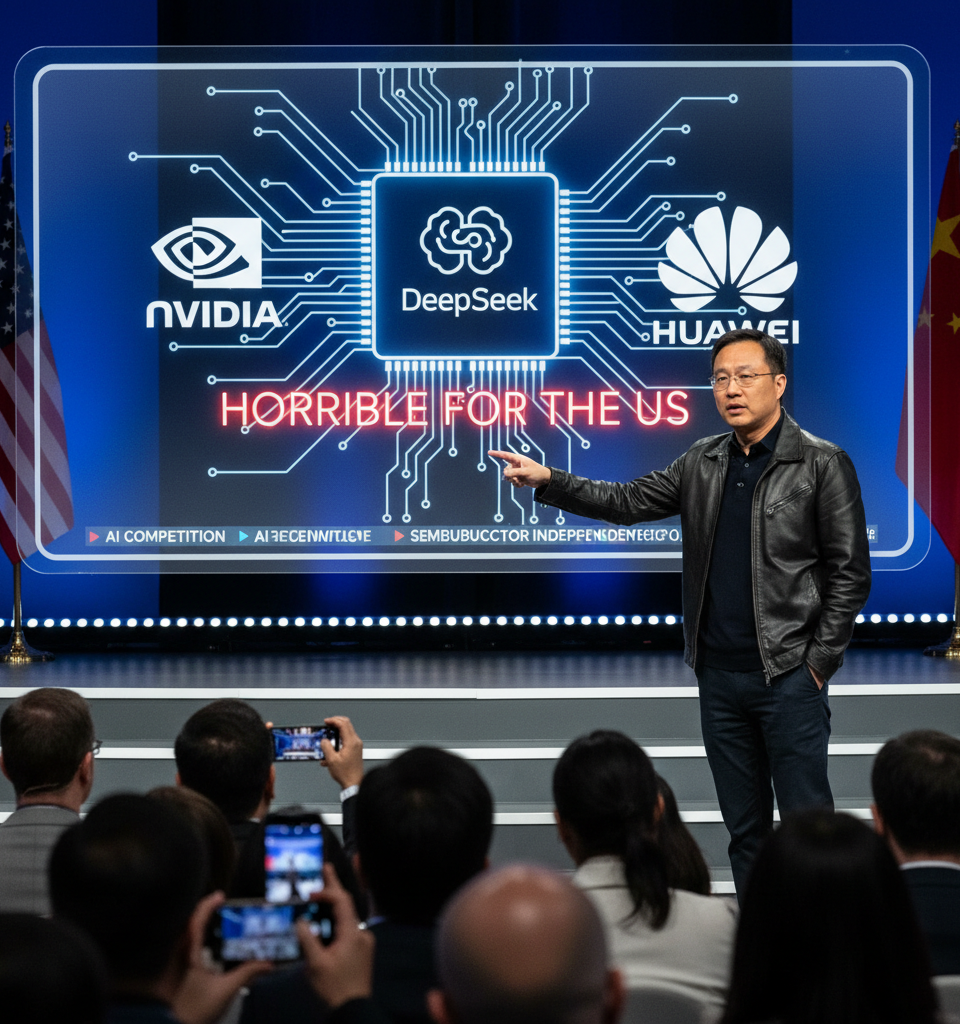
Nvidia CEO Jensen Huang has publicly voiced significant concern over the potential for major Chinese artificial intelligence developers, such as DeepSeek, to optimize their advanced AI models for Huawei's Ascend chip architecture instead of American-made hardware. On the Dwarkesh Podcast, Huang explicitly stated that such a development would represent a "horrible outcome" for the United States, directly highlighting the geopolitical and economic implications of semiconductor technology leadership.
This pronouncement by one of the tech industry's most influential figures underscores the escalating strategic competition between the U.S. and China, particularly in the critical domain of AI and high-performance computing. For decades, American companies, primarily Nvidia, have dominated the market for AI accelerators, providing the foundational technology for global AI development. The prospect of a major Chinese AI entity — like DeepSeek, known for its rapidly advancing large language models — fully embracing a domestic chip ecosystem poses a direct challenge to this established order and could accelerate China's path to technological self-sufficiency, a stated strategic goal for Beijing.
Geopolitical Stakes in AI Hardware
Huang's remarks are not merely a competitive jab; they reflect a deeper anxiety within the U.S. technology sector regarding the long-term implications of China's indigenous innovation drive. DeepSeek, often lauded for its progress in developing increasingly sophisticated AI models, currently uses Nvidia GPUs for much of its training and inference. A deliberate strategic shift to Huawei's Ascend series, particularly the Kunpeng and Ascend Da Vinci architectures, would represent a significant validation of Chinese semiconductor capabilities, built under immense pressure from U.S. export controls and sanctions.
The Ascend series, while still trailing Nvidia's most advanced GPUs in raw performance for cutting-edge AI tasks, has seen substantial investment and improvement. Huawei, backed by significant government support, is aggressively pushing its ecosystem, including the MindSpore AI framework, as a viable alternative. This push is fueled by a desire to insulate China's critical technology infrastructure from foreign dependencies, a strategy intensified following successive rounds of U.S. trade restrictions targeting Chinese tech giants.
Impact on U.S. Technological Leadership
Should DeepSeek and other prominent Chinese AI firms successfully transition to Huawei's chips, the reverberations would extend far beyond quarterly financial reports. It would signal a tangible crack in the U.S.'s technological hegemony, particularly in the foundational layer of AI hardware. Such a move would not only reduce demand for American chips in one of the world's largest and fastest-growing AI markets but also foster the development of an independent and potentially competitive AI ecosystem entirely outside U.S. influence.
Industry analysts have long cautioned that isolating China technologically could inadvertently accelerate its drive for self-reliance. Huang's concern validates this view, suggesting that successful optimization for Huawei chips by leading AI developers would represent a critical turning point. It would demonstrate that despite export controls, China is capable of nurturing a robust domestic alternative, potentially creating what Huang perceives as a "horrible outcome" due to the long-term implications for U.S. economic power and national security.
The Race for AI Ecosystems
Experts familiar with the U.S.-China tech rivalry emphasize that the battle is not just over individual chip performance, but over entire ecosystems. Nvidia's strength lies not only in its hardware but also in its CUDA software platform, which has become the industry standard for AI development. Huawei's strategy involves building out a similar, comprehensive ecosystem around Ascend and MindSpore to entice developers. If developers like DeepSeek invest heavily in optimizing for Ascend, it would create a parallel ecosystem that could eventually challenge CUDA's dominance, at least within China.
This scenario could lead to a fragmentation of the global AI development landscape, with distinct U.S.-aligned and China-aligned technological stacks. For companies operating internationally, this could introduce complexities in development and deployment, potentially forcing difficult choices about which ecosystem to support. The immediate next steps will involve monitoring DeepSeek's announced hardware strategies and Huawei's continued advancements in chip manufacturing and software optimization. The U.S. government, meanwhile, will likely continue to evaluate its export control policies to weigh the benefits of restricting technology against the risk of inadvertently accelerating China's independent innovation capabilities.