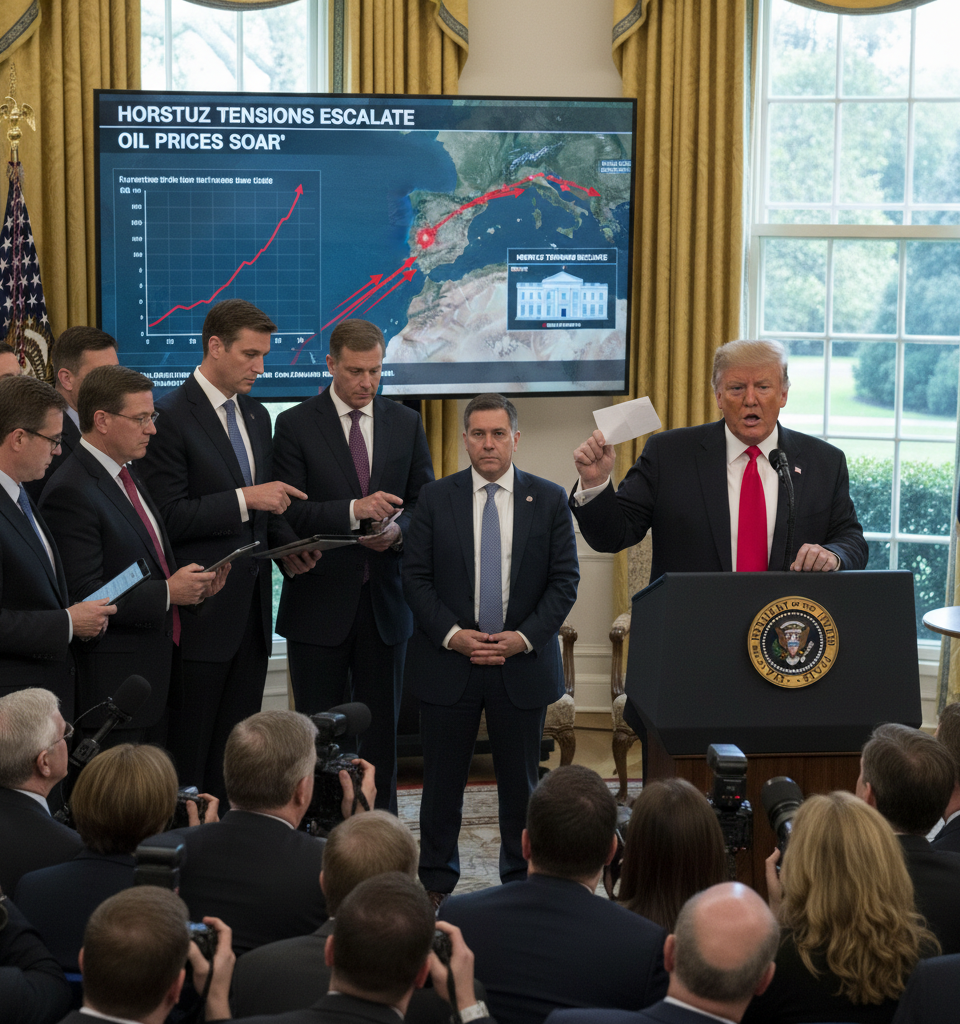
NEW YORK/LONDON – Global oil prices experienced a notable uptick on Tuesday following President Donald Trump's issuance of a fresh ultimatum to Tehran, signaling a significant escalation in geopolitical tensions. The U.S. President explicitly warned that American forces would target power plants and other critical civilian infrastructure in Iran should the strategically vital Strait of Hormuz be blocked, a move that sent immediate ripples through international energy markets and heightened concerns over energy supply stability.
This latest move by the Trump administration marks a critical juncture in the long-standing animosity between Washington and Tehran. The Strait of Hormuz, a narrow waterway between the Persian Gulf and the Arabian Sea, is a choke point through which approximately 20% of the world's total petroleum liquids consumption, or about 21 million barrels per day (bpd), passes. Any disruption to this crucial shipping lane, whether through hostile action or blockade, has historically triggered a sharp ascent in oil prices due to fears of constrained supply. The current rhetoric builds upon months of escalating sanctions, military exercises, and tit-for-tat actions that have progressively pushed the two nations closer to direct confrontation.
President Trump's ultimatum, delivered via social media and later reiterated by White House spokespersons, starkly departed from previous diplomatic postures. The explicit mention of civilian infrastructure as potential targets, including crucial power generation facilities, represents a significant hardening of the U.S. position. While specific details on the timing or scope of such actions were not provided, the message underscored Washington's firm resolve to maintain freedom of navigation through the strait. Benchmark Brent crude futures, already sensitive to regional instability, saw an immediate increase of over 1.5%, reaching $62.50 per barrel, while West Texas Intermediate (WTI) crude climbed by 1.7% to $57.80 per barrel in early trading.
The immediate impact on the energy market was palpable, with investors and traders factoring in a higher geopolitical risk premium. Shipping costs through the Persian Gulf are expected to rise as insurance premiums for vessels traversing the area increase, potentially affecting the final cost of oil delivered to global consumers. Beyond crude, the broader equity markets showed signs of unease, particularly those with heavy exposure to energy sectors or international trade. The looming threat of conflict in such a vital oil-producing region could also defer investment in new drilling and exploration projects, creating long-term supply concerns.
Energy analysts were quick to assess the implications of the President's statements. "This is a dangerous escalation of rhetoric that moves beyond traditional military targets," stated Dr. Elena Petrova, lead geopolitical strategist at Global Energy Insights. "The explicit threat to civilian infrastructure could be interpreted as a significant deviation from international norms, potentially drawing criticism from allies, even as it signals an unyielding stance to Iran. The market is now pricing in a much higher probability of supply disruption than it was just 24 hours ago, pushing the floor for oil prices higher." She added that while a full-scale blockade remains a distant threat, even minor incidents could send prices soaring well past the $70 per barrel mark.
Looking ahead, the international community will be closely watching for Iran's response to this direct challenge. Tehran has previously warned that it could close the Strait of Hormuz in retaliation for U.S. sanctions, particularly those stifling its oil exports. The coming days and weeks will likely see increased naval presence in the region by both U.S. and allied forces, and diplomatic efforts to de-escalate the situation will intensify, even as the possibility of miscalculation remains high. Traders will be particularly attuned to any further communication from either side, as well as the weekly inventory reports from the U.S. Energy Information Administration (EIA), which could amplify or temper price movements depending on supply-demand dynamics within this volatile geopolitical landscape.
The volatility sparked by this renewed brinkmanship serves as a stark reminder of the interconnectedness of geopolitics and global energy security. The financial stakes are immense, with a sustained closure of the Strait potentially leading to a global oil shock with widespread economic ramifications. All eyes are now on the next move in this high-stakes geopolitical chess match, as the world braces for potential further developments in the Persian Gulf.