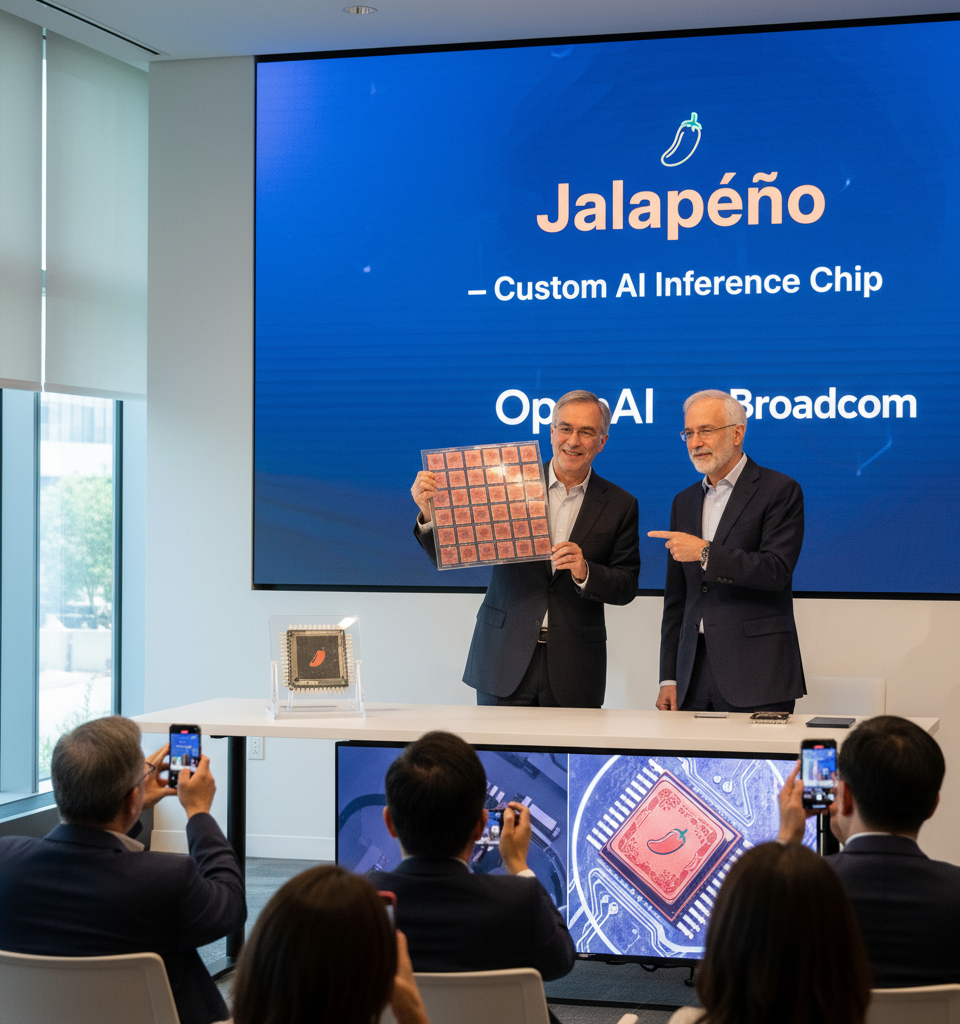
OpenAI and Broadcom have today unveiled their inaugural custom AI accelerator chip, dubbed "Jalapeño." This collaborative effort positions the new silicon as a purpose-built processor engineered specifically for large language model (LLM) inference workloads, offering an alternative to the more generalized Graphics Processing Units (GPUs) currently supplied by industry stalwarts such as Nvidia and AMD. The announcement underscores a strategic move by OpenAI to tailor its hardware infrastructure for its burgeoning AI operations.
The genesis of Jalapeño is particularly noteworthy, with its creators explicitly stating that the chip's development was significantly accelerated through the application of OpenAI's own advanced AI models. This self-referential innovation highlights a growing trend where AI companies are increasingly leveraging their proprietary technologies not just for external products but also for internal research and development, potentially creating a virtuous cycle of technological advancement. The specialized focus on inference, rather than the broader training demands, reflects a mature understanding of resource allocation required for deploying large-scale AI models.
According to official statements from both OpenAI and Broadcom, Jalapeño is meticulously engineered to support the demanding computational requirements behind OpenAI's foundational products. This includes the widely recognized ChatGPT, the code-generating AI Codex, OpenAI's API services, and an array of forthcoming agentic products. The explicit targeting of these core applications suggests a deep integration strategy, aiming to maximize efficiency and performance for OpenAI's ecosystem.
This introduction of a custom AI chip could have significant implications for the broader semiconductor and artificial intelligence industries. By developing specialized hardware, OpenAI is signaling a potential reduction in its reliance on third-party GPU providers, which could lead to shifts in market dynamics. While Nvidia and AMD dominate the general-purpose GPU market, a dedicated inference chip like Jalapeño could carve out a significant niche, particularly as LLM applications proliferate and demand for optimized inference processing intensifies.
The strategic thrust behind Jalapeño appears to be twofold: achieving superior performance characteristics for specific AI tasks and potentially gaining greater control over the hardware-software stack. Custom silicon often allows for more precise optimization for particular workloads, leading to improvements in speed, power efficiency, and cost-effectiveness at scale. For a company operating at OpenAI's footprint, even marginal gains in these areas can translate into substantial operational advantages.
While the immediate focus of Jalapeño is on powering OpenAI's internal and flagship products, both companies' press releases hint at broader ambitions. The framing suggests that Jalapeño could eventually be made commercially available, potentially opening a new revenue stream for the partnership and offering specialized inference solutions to other enterprises engaged in large-scale LLM deployment. Such a move would position OpenAI and Broadcom as key players not just in AI software, but also in the foundational hardware infrastructure.
The move also highlights the increasing trend of major tech companies investing in custom silicon to differentiate their offerings and optimize performance for their unique software ecosystems. This strategy, previously adopted by giants like Google with its TPUs, reflects a recognition that off-the-shelf components, while versatile, may not always deliver the ultimate efficiency required for cutting-edge AI. The "Jalapeño" name itself, potentially evoking speed and a certain 'spice' or innovation, seems to encapsulate the ambitious nature of this project.
The coming months are expected to provide more details regarding the performance benchmarks and broader availability plans for Jalapeño. Industry observers will be closely watching how this custom chip integrates into OpenAI's extensive infrastructure and its potential to reshape the competitive landscape for AI accelerators. The success of Jalapeño could serve as a blueprint for future collaborations between AI developers and chip manufacturers, further blurring the lines between software and hardware innovation in the rapidly evolving artificial intelligence sector.