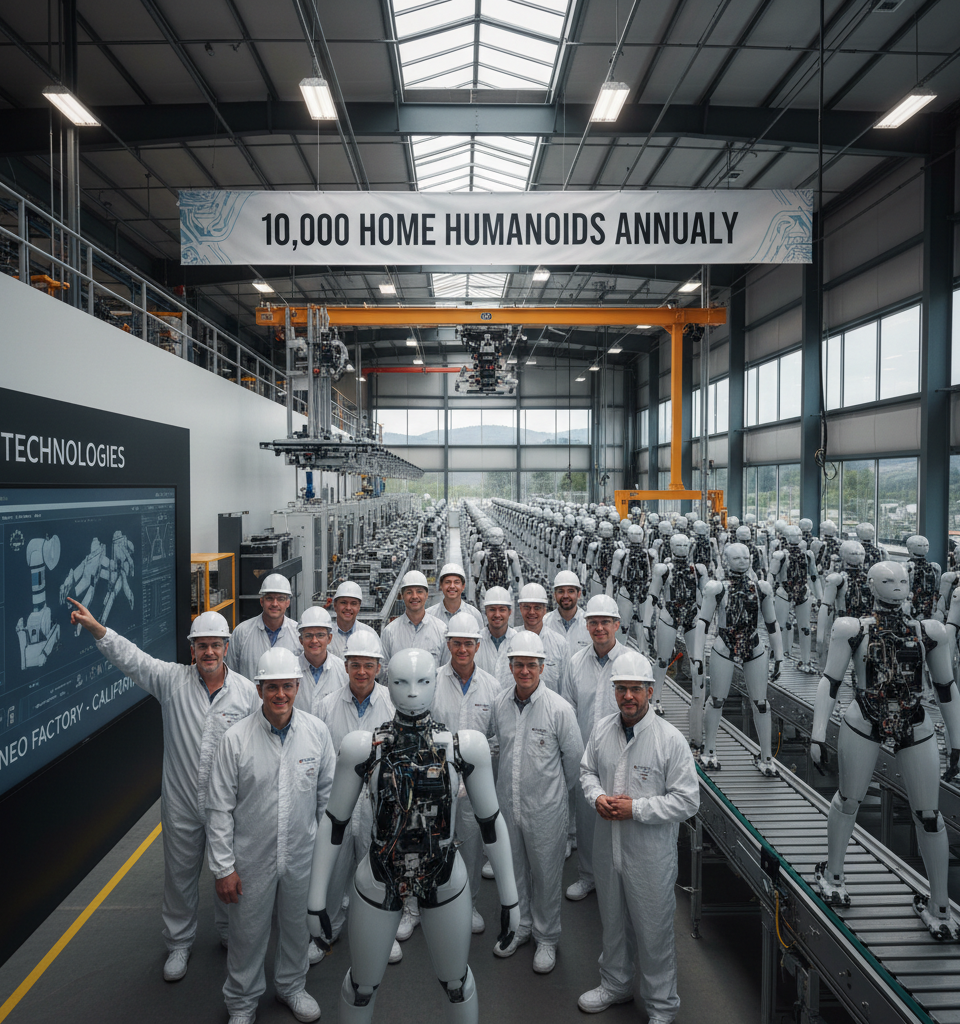
1X Technologies, a Norwegian robotics company backed by OpenAI, has inaugurated a new 58,000-square-foot manufacturing facility in Hayward, California. This vertically integrated "NEO factory" marks a pivotal moment in the quest to bring general-purpose humanoid robots into private homes, with the company announcing planned shipments of its NEO model later this year. The facility represents the first substantial U.S.-based push for consumer-grade humanoid robot production, setting a challenging goal of manufacturing 10,000 units within its inaugural year.
Context and Industry Significance
The launch of 1X's Hayward factory underscores a rapidly accelerating race within the robotics industry to develop and deploy commercially viable humanoid robots. While industrial robots have been commonplace in factories for decades, the aspiration for a general-purpose robot capable of performing diverse tasks in unstructured environments like homes has long been a holy grail. This venture by 1X, with the strategic backing of AI leader OpenAI, suggests a confluence of advanced AI capabilities with sophisticated robotic hardware, aiming to unlock new possibilities for automation and assistance in everyday life. The timing is critical, as numerous startups and established tech giants are vying for market share in this nascent yet potentially transformative sector.
Key Details and Production Strategy
1X's NEO humanoid robot is designed for consumer deployment, emphasizing affordability and adaptability for household tasks. The Hayward facility is central to this strategy, employing a vertically integrated approach to streamline production and control quality. While specific pricing has not been publicly announced, the company's objective to reach a production volume of 10,000 units signifies an intent to achieve economies of scale necessary for competitive consumer pricing. The CEO, Bernt Øyvind Børnich, emphasized the importance of this U.S. facility for scaling operations and tapping into the American market and talent pool. He highlighted the company's focus on user experience and the iterative development needed to meet household demands. Initial shipments are anticipated to begin before the end of the year, targeting early adopters and testers.
Market Impact and Competitive Landscape
The entry of 1X into large-scale humanoid robot manufacturing intensifies an already competitive field. Companies like Tesla with its Optimus robot, Agility Robotics' Digit, and Boston Dynamics' Atlas (though primarily research-focused) are all pushing boundaries in humanoid development. However, 1X's explicit focus on a consumer-grade, home-oriented robot differentiates its strategy, aiming for mass adoption rather than just industrial or logistics applications. This move could catalyze a broader race among competitors to transition from industrial prototypes to consumer products, potentially driving down costs and accelerating technological advancements across the sector. The success of 1X could validate the market for home humanoids, attracting significant investment and innovation.
Expert Perspectives and Challenges
Robotics and AI experts view 1X's ambition as both exciting and challenging. "Achieving robust, general-purpose intelligence in a physical form factor suitable for homes is immensely difficult," states Dr. Anya Sharma, a professor of AI ethics at Stanford. "The hardware must be reliable, the software adaptable, and crucially, the user interface intuitive and safe." Analysts point to the regulatory hurdles and public perception challenges, particularly concerning privacy and job displacement, as critical factors for mass adoption. The reliability and safety of robots interacting with children and pets within a home environment will be paramount. However, the backing from OpenAI suggests a strong foundation in AI, crucial for the robot's ability to learn and adapt to diverse household tasks.
What's Next for 1X and the Industry
Looking ahead, 1X plans to rapidly iterate on the NEO design based on early user feedback, aiming to expand its capabilities beyond initial household assistance. The company is expected to continue leveraging its ties with OpenAI for advanced AI integration, allowing NEO to understand complex commands and learn from new situations. Success in this initial phase will likely lead to further investment rounds and expanded production capabilities.
For the broader industry, 1X's progress will serve as a bellwether for the consumer humanoid market. Developments in sensory technology, battery life, and ethical AI frameworks will be crucial for the widespread integration of such robots into daily life. The next 12-24 months will be crucial in determining whether the dream of a home humanoid transitions from science fiction to widespread reality, with 1X positioned as a key player in this unfolding narrative.