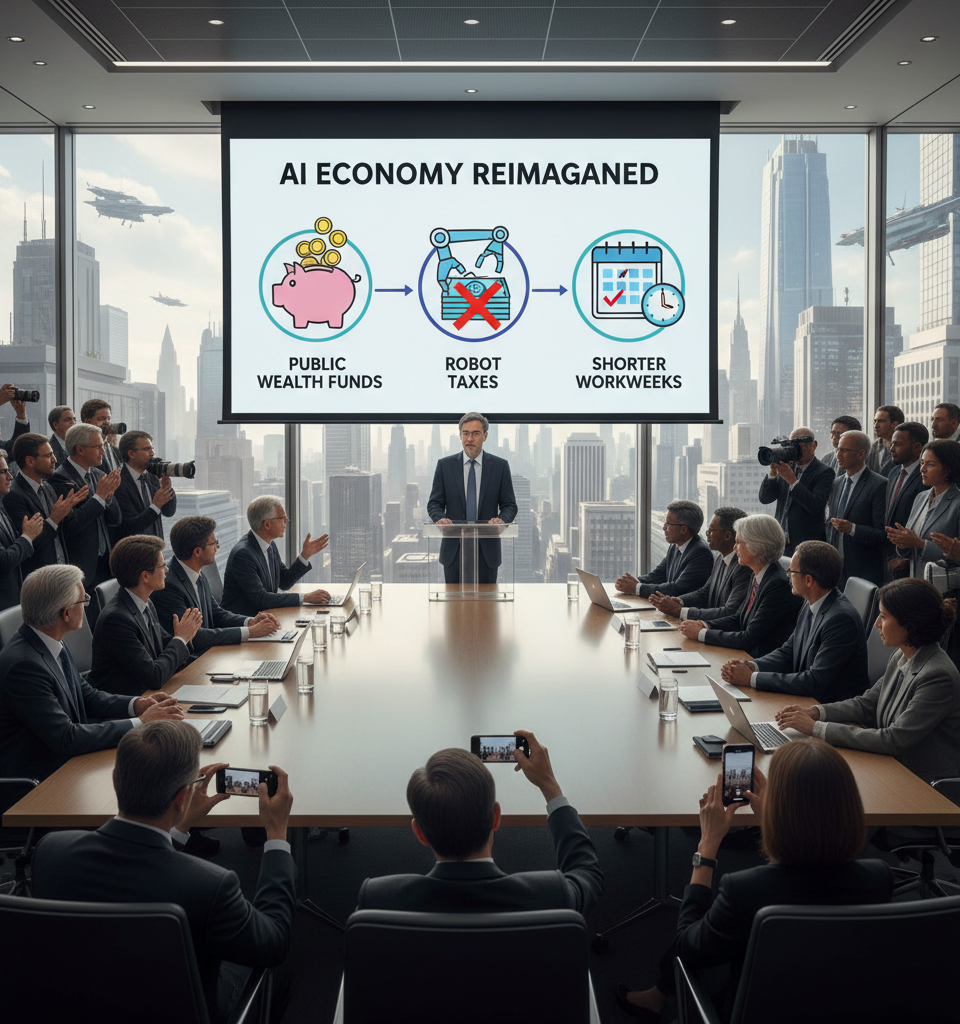
San Francisco, CA – [Date] – OpenAI, the groundbreaking artificial intelligence research company, has introduced a far-reaching economic blueprint designed to mitigate the profound societal shifts anticipated from advanced AI. The proposals, detailed in a recent policy paper, advocate for a suite of interventions including substantial taxes on AI-derived profits, the establishment of national public wealth funds, and the adoption of a four-day work week. This ambitious framework aims to address potential mass job displacement and escalating economic inequality, positioning OpenAI not merely as a tech innovator but as a key voice in global economic restructuring debates.
The Urgency of Adaptation: AI's Economic Disruption
OpenAI's initiative stems from a growing consensus among economists and technologists that artificial intelligence, particularly advanced models like their own GPT series, will fundamentally reshape labor markets and wealth distribution. The historical parallels often drawn include the Industrial Revolution, which, while ultimately creating new jobs, also led to significant social upheaval and required new social safety nets. OpenAI's paper underscores the unprecedented speed and scale of AI's potential impact, necessitating proactive policy measures rather than reactive ones. Without such interventions, the company warns, the economic benefits of AI could concentrate among a small elite, exacerbating existing societal divides and leading to widespread discontent.
Core Tenets: Taxation, Redistribution, and Leisure
Central to OpenAI's blueprint are several interconnected policies. Firstly, they propose a robust taxation scheme on profits directly generated by AI systems, often referred to colloquially as a "robot tax." While specific rates were not defined, the intent is to capture a portion of the vast economic surplus created by highly automated processes. Secondly, these revenues, alongside other progressive taxation, would fund publicly managed wealth funds, similar in structure to sovereign wealth funds but explicitly designed to benefit all citizens, potentially through universal basic income (UBI) or enhanced social services. The third cornerstone is the advocacy for a four-day work week, positing that increased productivity from AI could allow for a reduction in working hours without a commensurate decrease in output, thereby improving quality of life and potentially distributing available work more broadly. These proposals extend beyond simple welfare, aiming to redefine the social contract in an AI-dominated era.
Industry Response and Market Implications
The technology sector's reception to OpenAI's proposals is mixed but largely acknowledges the impending need for economic adjustments. While some Silicon Valley executives might balk at increased taxation, many recognize the long-term sustainability issues if AI benefits are not broadly shared. Investment analysts are beginning to evaluate the long-term implications for corporate profitability under such a regime. Companies developing automation technologies, ranging from robotic manufacturers to enterprise AI software providers, could face higher operating costs or revised revenue models if such taxes are implemented. Conversely, a more stable and equitable society, as envisioned by OpenAI, could provide a stronger foundational market for continued technological innovation and adoption, reducing the risk of a social backlash against AI itself.
Expert Perspectives: A Balancing Act
Economic policy experts and futurists are intensely scrutinizing OpenAI's propositions. Dr. Eleanor Vance, a labor economist at the University of Chicago, commented, "OpenAI's vision represents a crucial intellectual leap from merely observing AI's impact to proposing concrete, systemic solutions. The concept of public wealth funds, for instance, offers a dignified alternative to traditional welfare, empowering citizens as stakeholders in the AI economy." However, critics point to implementation challenges, including defining AI-generated profits, managing large public funds transparently, and the potential for capital flight if taxation becomes too onerous. The debate also extends to the practicalities of a four-day work week across diverse industries, with some sectors potentially less adaptable to such a compressed schedule.
The Road Ahead: Policy Debates and Global Collaboration
OpenAI's proposals are clearly intended to spark global dialogue among policymakers, governments, and international organizations. The company emphasized that no single nation can address these challenges in isolation, calling for international cooperation to establish global standards and frameworks for managing the AI economy. Upcoming forums, such as the G7 and World Economic Forum, are expected to feature discussions influenced by these ideas. The coming years will likely see a cascade of white papers, legislative drafts, and pilot programs exploring elements of OpenAI's vision, as nations worldwide seek to harness the immense potential of AI while safeguarding societal well-being. The debate is far from settled, but OpenAI has arguably set a new baseline for the ambition and scope of future economic policy in the AI age.
Future Implications: Redefining Work and Wealth
Should elements of OpenAI's plan gain traction, the implications for the future of work and wealth distribution would be transformative. A society where a significant portion of economic output is automated and profits are recirculated could lead to a re-evaluation of societal values, emphasizing leisure, education, and creative pursuits over traditional employment. While the journey to such a societal structure will undoubtedly be fraught with complexities and political battles, OpenAI's proactive stance marks a significant moment in the ongoing narrative of artificial intelligence's integration into human civilization, shifting the conversation from a purely technological one to a deeply economic and social one. The company’s vision suggests a future where AI not only generates unprecedented wealth but also catalyzes a more equitable and fulfilling human experience.