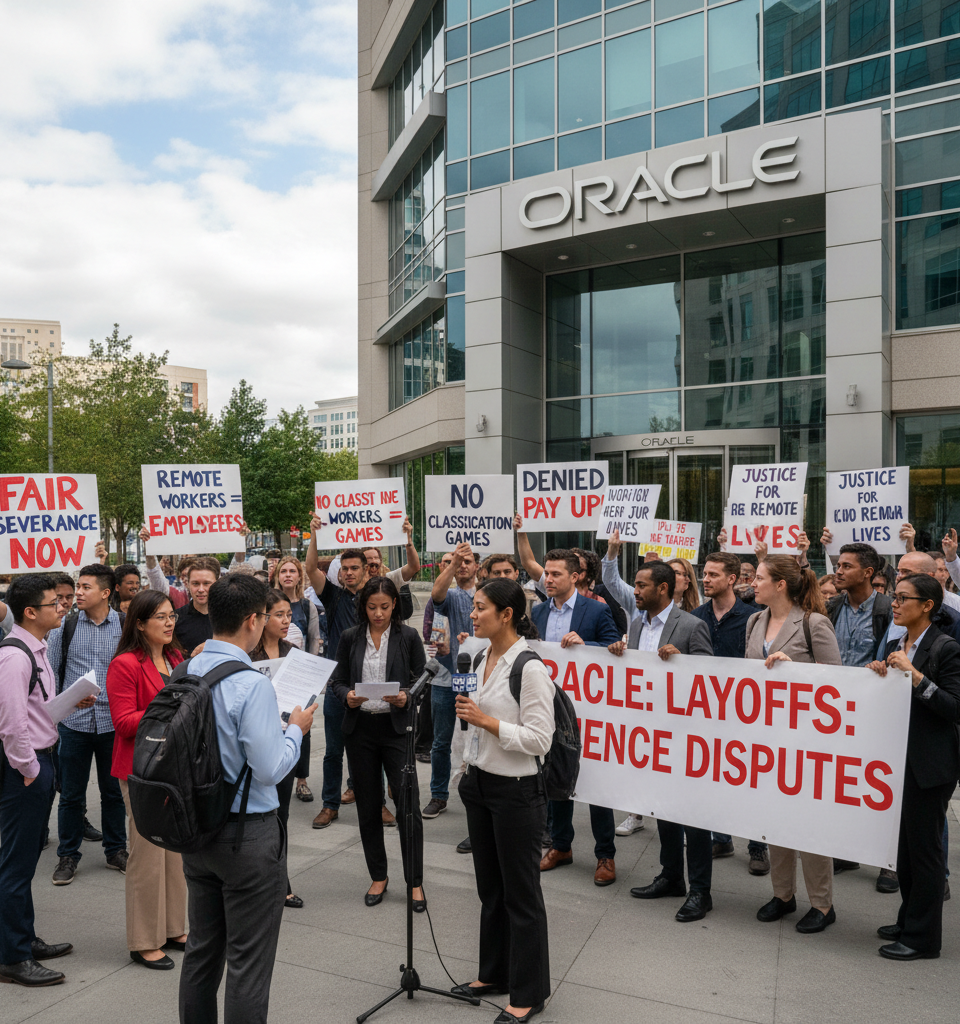
Oracle Corporation, a global leader in enterprise software, is facing scrutiny following a recent round of layoffs where affected employees allege the company denied requests for improved severance packages. The most contentious point of disagreement centers on Oracle's classification of some laid-off personnel as remote workers, a designation employees claim was strategically used to bypass the Worker Adjustment and Retraining Notification (WARN) Act, which mandates 60 days' notice or equivalent severance for mass layoffs.
Background to the Workforce Reduction
This dispute unfolds against a backdrop of increasing volatility within the technology sector, where major players, including Google, Meta, and Amazon, have announced significant workforce reductions over the past year. While Oracle has not publicly disclosed the exact number of employees affected in this particular round, reports suggest it impacted various departments. The company's refusal to negotiate further severance, coupled with the WARN Act contention, underscores a growing challenge for employees navigating the shifting landscape of remote work and labor protections. Unlike traditional office-based roles, the legal interpretations surrounding remote employees and WARN Act obligations can be complex, creating potential loopholes that companies may exploit.
Employee Claims and Legal Nuances
Numerous former Oracle employees, speaking anonymously due to non-disclosure agreements, shared accounts of receiving what they considered insufficient severance offers, typically ranging from a few weeks to a few months' pay depending on tenure. Their primary grievance hinges on the WARN Act. This federal law requires employers with 100 or more full-time employees to provide 60 calendar days' advance written notice of plant closings and mass layoffs. Crucially, the act defines a 'plant closing' as a permanent or temporary shutdown of a single site of employment. Employees argue that their homes, despite being their primary work location, should still qualify under the spirit, if not the letter, of the law, especially when their termination contributes to a company-wide reduction often impacting a specific business unit or function.
Industry-Wide Implications
The situation at Oracle could set a precedent for how large multinational corporations handle layoffs of their remote workforce. As remote and hybrid work models become increasingly prevalent, the legal framework governing employee protections, particularly during terminations, is evolving. This incident brings to light the potential for companies to leverage the distributed nature of remote work to sidestep labor laws designed for more traditional employment structures. If Oracle's interpretation holds, it could embolden other companies to adopt similar strategies, potentially eroding protections for millions of remote workers across various industries. This could also fuel further legislative efforts to update labor laws to explicitly address the nuances of remote employment.
Expert Analysis on Remote Work and Severance
Labor law experts indicate that the legal standing for remote workers under the WARN Act is currently ambiguous and often depends on state-specific interpretations and the precise definitions of a 'single site of employment.' "The WARN Act was drafted in an era before widespread remote work," commented Dr. Eleanor Vance, a labor law professor at a prominent West Coast university. "Companies like Oracle are operating in a grey area. While a remote worker's home isn't typically considered a 'single site of employment' in the traditional sense, a mass layoff impacting a particular remote team or business unit operating virtually could certainly be argued as deserving of similar protections." She added that the lack of clear federal guidance on this issue puts employees at a disadvantage.
What Lies Ahead for Oracle and its Former Employees
While individual lawsuits are possible, affected Oracle employees face an uphill battle given the legal ambiguities and the company's strong legal resources. The outcome of these disputes, whether through legal challenges or public pressure, will likely influence future corporate practices regarding remote worker severance and layoff notifications. This situation may also prompt lawmakers to consider amendments to the WARN Act or similar state-level legislation to better encompass the modern workforce's realities, ensuring equitable treatment for all employees, regardless of their physical work location. The broader tech community will be watching closely to see if Oracle's approach becomes a standard or an anomaly in future layoff events.
Wider Economic Context
The tech industry has seen a significant recalibration following years of rapid growth and aggressive hiring. Companies that over-hired during the pandemic-driven digital acceleration are now rightsizing their workforces amid concerns about an economic slowdown, rising interest rates, and evolving consumer demand. For Oracle, specifically, the integrations following its acquisition of Cerner for approximately $28 billion in mid-2022 have also led to some redundancy and reorganization within its vast workforce. These layoffs often target roles that overlap or are no longer central to the company's strategic direction, further complicating the emotional and financial impact on affected individuals.