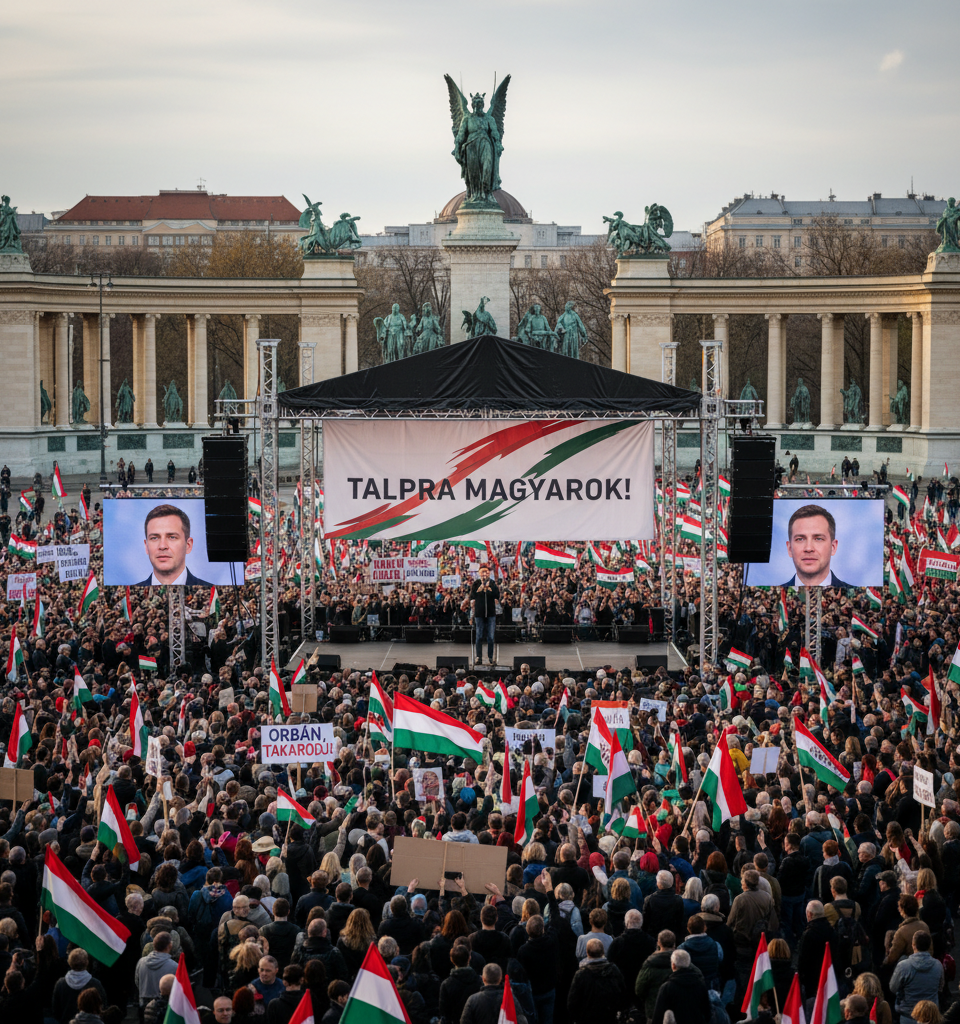
BUDAPEST, HUNGARY – A palpable sense of anticipation gripped Heroes' Square on Saturday as tens of thousands of Hungarians, galvanized by the charismatic figure of Péter Magyar, rallied in a final push to unseat Prime Minister Viktor Orbán's Fidesz party ahead of the upcoming European elections. The massive demonstration, a culmination of months of rapid ascendancy for Magyar's Tisza Party, underscored a growing disaffection with the incumbent government and a burgeoning hope for political change.
This populist insurgency marks a pivotal moment in contemporary Hungarian politics. For over a decade, Orbán's Fidesz has maintained a tight grip on power, consolidating its influence through nationalist rhetoric, media control, and perceived challenges to democratic norms. Magyar, a former government insider and estranged husband of a former Orbán minister, has skillfully tapped into a deep vein of public frustration over corruption, the cost of living, and the erosion of democratic institutions, positioning himself as a credible alternative to the established opposition.
The scale of the protest at Heroes' Square, a symbolic heart of Budapest, was a stark visual testament to Magyar's burgeoning influence. Organizers estimated attendance well into the tens of thousands, dwarfing previous opposition gatherings. Magyar, addressing the energized crowd, pledged to dismantle what he termed Orbán's "deep state" and restore principles of transparency and accountability. His campaign has been characterized by direct appeals to the populace, bypassing traditional media channels, leveraging social media and direct engagement to build a grassroots movement that has taken both Fidesz and the established opposition by surprise.
The implications of this political shake-up extend beyond Hungary's borders. Viktor Orbán has long been a contrarian voice within the European Union, often clashing with Brussels over rule of law, migration, and foreign policy. A significant reduction in Fidesz's parliamentary power, or even an unexpected defeat in the European elections, could alter the political calculus within the conservative EPP group and influence broader EU policy debates. Should Magyar's movement gain substantial traction, it could inspire similar anti-establishment movements in other CEE countries grappling with entrenched leadership.
Political analysts are divided on the ultimate impact of Magyar's challenge. Dr. Katalin Hegedűs, a professor of political science at Corvinus University, notes, "Magyar's appeal lies in his ability to present himself as an outsider, despite his past connections to the Fidesz elite. He offers a fresh face and a clear critique of the status quo that traditional opposition parties have struggled to articulate effectively." However, she cautions, "Fidesz's electoral machine is incredibly robust, with deep roots in rural communities and significant control over state resources and media. Overcoming that infrastructure will be a monumental task, even with significant public support."
Looking ahead, the immediate focus will be on the results of the European parliamentary elections. A strong showing for Tisza would solidify Magyar's position as the leading opposition figure and could pave the way for a more competitive general election in 2026. Conversely, a weaker-than-expected performance might allow Fidesz to reassert its dominance and dismiss Magyar's movement as a fleeting phenomenon. Regardless of the outcome, the emergence of Péter Magyar has irrevocably altered Hungary's political landscape, injecting a degree of uncertainty and renewed vigor into a system long dominated by a single party.
The coming days will be crucial as the final votes are cast and counted, determining whether Hungary is on the cusp of an unprecedented political realignment or if Orbán's enduring grip on power will once again weather the storm. The eyes of Europe will be fixed on Budapest, watching to see if the groundswell of support for change translates into concrete electoral gains, potentially ushering in a new era for Hungarian democracy.