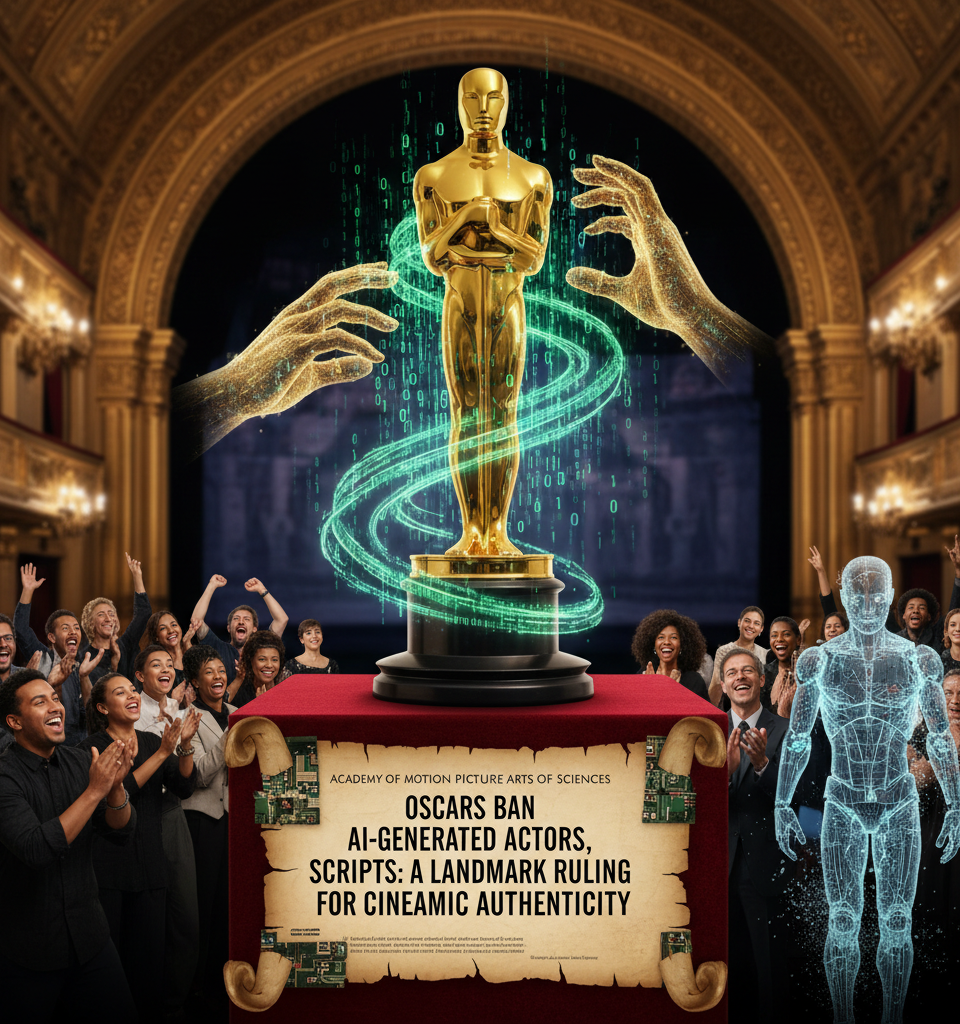
In a significant policy shift impacting the future of cinema, the Academy of Motion Picture Arts and Sciences (AMPAS) has declared that films featuring AI-generated actors or scripts primarily authored by artificial intelligence will be ineligible for its prestigious awards, including the coveted Oscars. The announcement, made this week, establishes clear boundaries for creative contributions to be recognized by the Academy, emphasizing the irreplaceable role of human creativity and performance in eligible works.
Context and Background
This decision comes amidst mounting anxiety within Hollywood regarding the rapid advancements and increasing deployment of AI technologies. From scriptwriting algorithms to sophisticated deepfake applications capable of replicating or creating human likenesses, AI's presence in film production has expanded dramatically. The Screen Actors Guild–American Federation of Television and Radio Artists (SAG-AFTRA) and the Writers Guild of America (WGA) have both cited the unregulated use of AI as a major concern in recent contract negotiations, highlighting fears of job displacement and intellectual property theft. The Academy's ruling reflects a broader industry effort to define ethical and artistic parameters for AI integration, ensuring that the human element remains paramount in storytelling.
Key Details of the New Rules
Under the newly ratified rules, a film aiming for Oscar qualification must demonstrate a "majority human creative contribution." Specifically, for a performance to be eligible, the actor portraying the character must be genuinely human. Similarly, for screenwriting categories, the original screenplay or adaptation must be predominantly developed by human writers. While minor AI assistance in background visuals, sound editing, or even early script drafts might be permissible, the final, significant creative input for character portrayal and narrative structure must unequivocally originate from human artists. The Academy has indicated it will establish a review committee to assess potential rule infringements, with a focus on intent and the scale of AI involvement rather than merely its presence.
Industry and Market Impact
The implications of this ruling are far-reaching. Production studios that have been investing heavily in AI-driven technologies for cost reduction or accelerated production schedules may need to re-evaluate their strategies, particularly for projects aspiring to awards recognition. For instance, companies like Disney and Netflix have explored AI for animation, visual effects, and even rudimentary script generation. This policy could steer studio investment back towards human talent and traditional creative roles, potentially boosting employment for actors, writers, and artists. It also sets a precedent for other major film festivals and awards bodies globally, influencing how the broader entertainment industry addresses AI's role.
Expert Perspective
Film critics and industry analysts have largely welcomed the Academy's move, viewing it as a necessary safeguard for artistic integrity. Dr. Evelyn Reed, a leading media ethics professor at the University of Southern California, commented, "This isn't an outright ban on AI in filmmaking, but rather a critical delineation of where human authorship truly lies. The Academy is asserting that an Oscar remains an award for human achievement, not algorithmic sophistication." She added that without such guidelines, the very definition of a "film" could become blurred, diminishing the profound connection audiences have with human-crafted narratives and performances.
What's Next?
While the current rules address actors and scripts, the conversation surrounding AI's role in cinema is far from over. Future discussions are expected to delve into categories such as directing, editing, and cinematography, where AI tools are also rapidly evolving. The Academy may need to continuously refine its policies as AI capabilities advance, potentially introducing more nuanced guidelines for different stages of production. This initial ruling, however, firmly establishes a baseline: for an achievement to be truly celebrated at the Oscars, it must be fundamentally driven by human creativity and artistic intent, setting a significant tone for the ongoing evolution of filmmaking in the age of artificial intelligence.