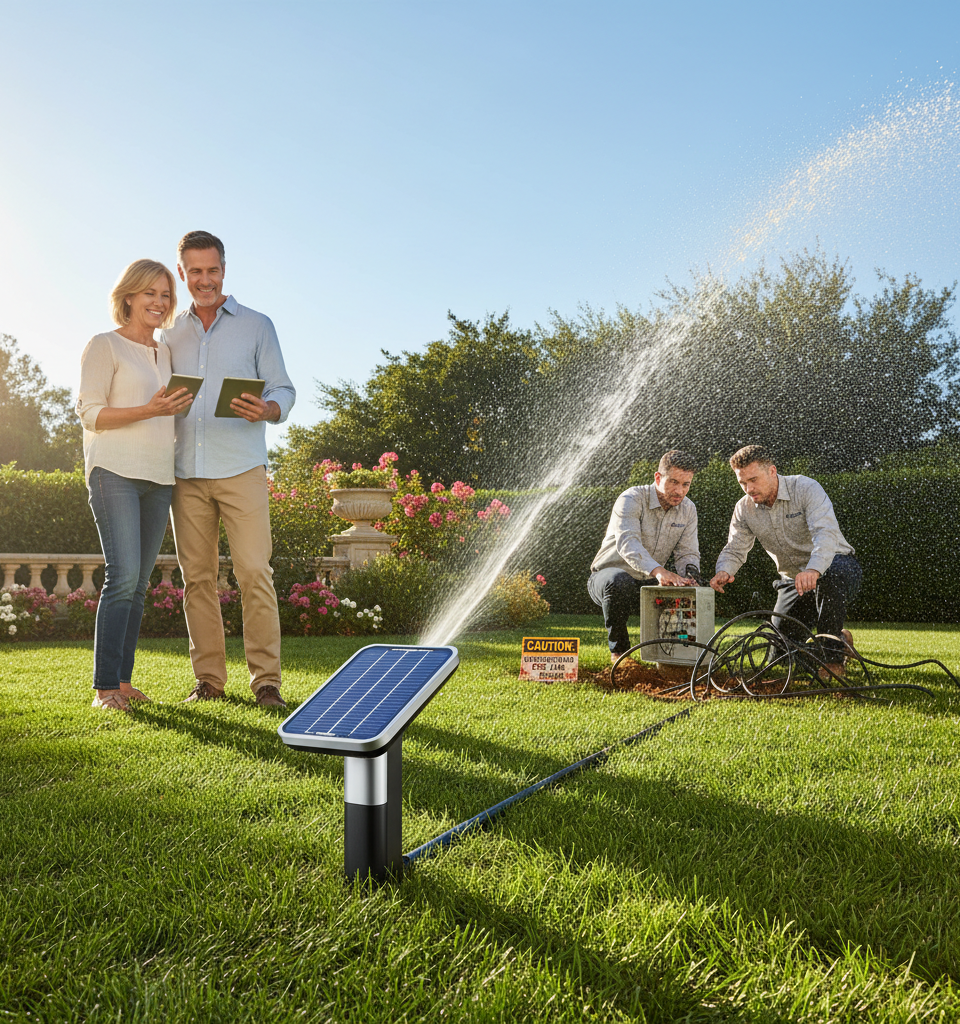
The residential lawn care market is witnessing a notable innovation with the introduction of the Oto Smart Sprinkler, a solar-powered irrigation system designed to autonomously manage watering needs. Touted for its user-friendly interface and environmental benefits, the device's operational efficiency is intrinsically linked to its solar charging capabilities, specifically requiring a minimum of three hours of direct sunlight daily to maintain optimal function.
The advent of smart home technology has steadily permeated various aspects of daily life, and lawn care is no exception. Traditional irrigation systems often involve complex programming or manual intervention, leading to inefficiencies and water waste. The Oto Smart Sprinkler enters a growing segment focused on automation and sustainability, addressing consumer demand for products that reduce labor and environmental footprint. This move aligns with a broader industry trend towards 'set-and-forget' solutions, aiming to simplify home maintenance tasks for a tech-savvy generation.
Key details of the Oto Smart Sprinkler highlight its innovative design. Priced at approximately $350, the unit integrates a photovoltaic panel directly into its casing, eliminating the need for external power sources or frequent battery replacements. Its accompanying smartphone application allows for zone-specific watering schedules, soil moisture monitoring, and weather-adaptive adjustments, promising to reduce water consumption by up to 30% compared to conventional timers. However, the manufacturer explicitly states the three-hour daily direct sunlight requirement, emphasizing that shaded areas or prolonged overcast periods will necessitate manual charging or result in performance degradation.
The introduction of a fully integrated solar-powered sprinkler could significantly disrupt the $10 billion global smart irrigation market, which has traditionally relied on grid power or less efficient battery systems. While several companies offer smart irrigation controllers, few have ventured into fully self-sustaining, solar-powered units for individual zones. This product could spur competitors to accelerate their green technology initiatives, potentially lowering prices and increasing feature sets across the board for sustainable home irrigation solutions. Moreover, its emphasis on water conservation resonates with increasing environmental regulations and public awareness regarding resource management.
Industry analysts generally view the Oto Smart Sprinkler as a pioneering piece of technology but caution about its specific energy demands. "While the concept of a solar-powered, intelligent sprinkler is highly appealing from a sustainability standpoint, its dependence on consistent direct sunlight could be a significant hurdle for adoption in certain geographical regions or properties with dense tree cover," states Dr. Evelyn Reed, an environmental technology expert at the University of California. "The market will need to see if the convenience outweighs the potential installation and placement challenges for a broad consumer base, particularly in areas like the Pacific Northwest or regions prone to extended cloudy spells."
Looking ahead, the success of the Oto Smart Sprinkler will likely depend on its ability to evolve beyond its initial iteration. Future models could explore more efficient solar cells, larger battery capacities to store charge for longer periods, or even hybrid charging options that seamlessly switch to an electrical hookup if solar power is insufficient. The company may also consider integrating advanced weather prediction algorithms to optimize watering schedules more effectively during periods of anticipated low sunlight. Its sales trajectory will serve as a crucial indicator for the viability of fully solar-reliant outdoor smart home devices on a mass market scale.