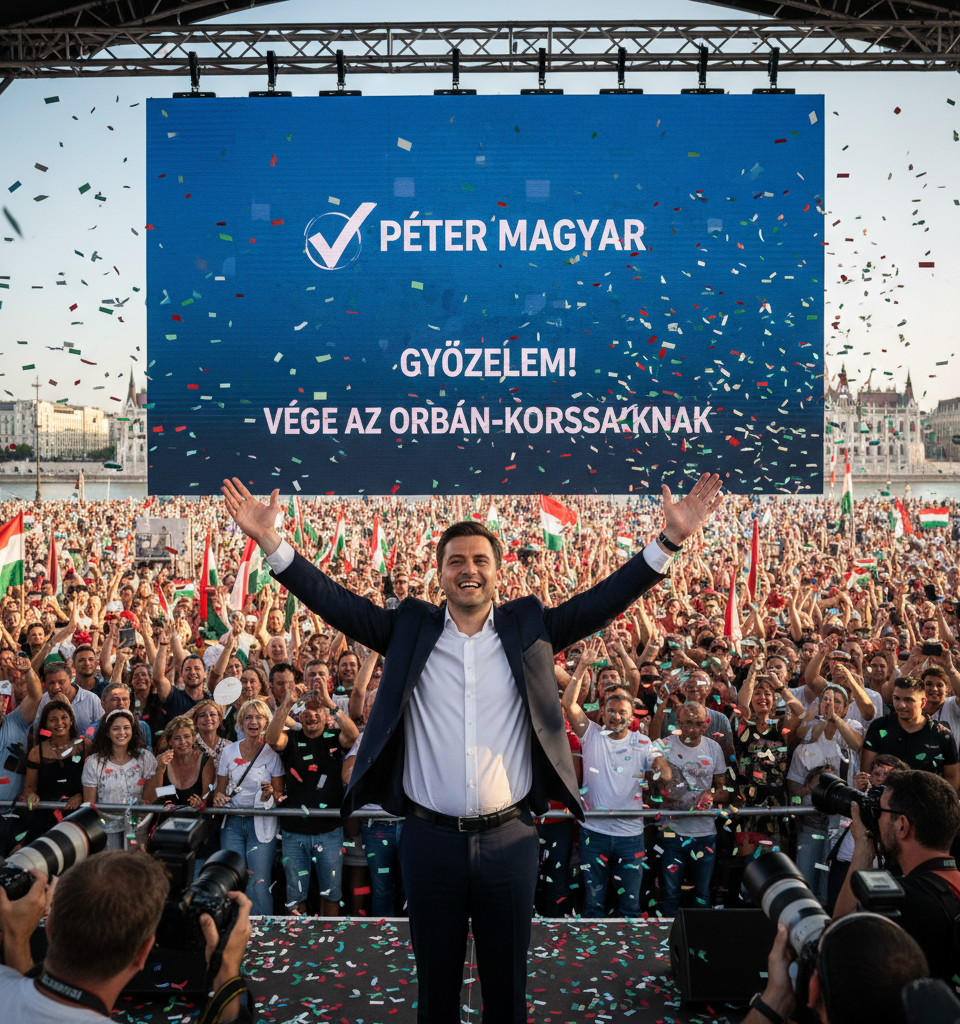
Budapest, Hungary – In a political earthquake that has sent reverberations across Europe, Péter Magyar, a charismatic 45-year-old former Fidesz insider, has sensationally swept Hungary's general election, concluding Viktor Orbán's dominant 16-year rule. The stunning victory, declared late Sunday, sees Magyar's newly formed Respect and Freedom (TISZA) Party capture a significant majority of parliamentary seats, reflecting a profound public desire for change and a rejection of the established political order. This outcome marks the most significant political upheaval in Hungary since the fall of communism, positioning Magyar as the nation's new leader and setting a fresh course for the Central European state.
A Historical Referendum on Power
Orbán's nearly two decades at the helm had transformed Hungary, centralizing power, challenging EU norms, and cultivating a robust, if often controversial, nationalist agenda. His Fidesz party had enjoyed unparalleled electoral success, largely due to its strong rhetoric on immigration, family values, and national sovereignty. However, growing concerns over corruption, the erosion of democratic institutions, and a struggling economy began to chip away at his seemingly unassailable popularity. Magyar, leveraging his insider knowledge and articulate criticism, managed to tap into a deep vein of disillusionment, offering a compelling alternative that resonated with a broad spectrum of voters disillusioned with both Fidesz and the traditional opposition.
Key Figures and the Campaign Trail
The election results, still being fully tabulated, indicate that TISZA has secured well over 50% of the vote, a remarkable feat for a party formed mere months ago. This far outpaces Fidesz’s performance, which is projected to hover around 35-40%, a significant decline from its previous supermajorities. Magyar’s campaign was characterized by large, energetic rallies across the country, particularly drawing younger voters and urban populations who felt marginalized by Orbán’s policies. He vociferously criticized government inefficiency and alleged cronyism, promising to restore the rule of law, combat corruption, and foster a more open and accountable government. Orbán, in a remarkably subdued concession speech, acknowledged the public's decision, pledging a smooth transition of power.
Implications for Hungarian Economy and EU Relations
The political shift under Magyar is expected to have immediate and significant implications for Hungary's economy and its often-strained relationship with the European Union. Orbán's government frequently clashed with Brussels over issues ranging from judicial reform to migration policy, resulting in withheld EU funds and a tarnished international reputation. Magyar has indicated a desire to mend fences with the EU, advocating for a more constructive and cooperative stance. Economically, his administration is expected to prioritize fiscal transparency, attract foreign investment through predictable policies, and address the rising cost of living that has plagued many Hungarian households. Analysts predict a cautious but positive market reaction, anticipating greater stability and a potential unlock of EU recovery funds.
Expert Perspectives on the Political Paradigm Shift
Political analysts are describing Magyar's triumph as a watershed moment, not just for Hungary but for the broader European political landscape. Dr. Katalin Kovács, a Budapest-based political scientist, commented, "This is a genuine grassroots movement that capitalized on Fidesz fatigue and the fragmentation of the traditional opposition. Magyar presented himself as a credible, articulate outsider, despite his past connections, and voters clearly bought into his vision for a less divisive and more accountable Hungary." Others highlight the role of social media and online mobilization in Magyar's success, noting his adept use of digital platforms to bypass state-controlled media narratives.
The Road Ahead: Challenges and Transformations
The incoming Magyar administration faces a daunting task. While the electoral victory is decisive, the institutional changes enacted under Orbán's long tenure present significant hurdles. Reforming the judiciary, restoring media pluralism, and overhauling public administration will require sustained political will and potentially constitutional amendments. Domestically, Magyar will need to unify a nation that has been deeply polarized. Internationally, observers will be keen to see how he navigates the complex balance between national interests and European integration, particularly concerning the war in Ukraine and Hungary’s role within NATO. His policy platform, centered on anti-corruption and pro-EU sentiment, suggests a fundamental reorientation of Hungary's foreign and domestic policies, promising a transformative period for the nation over the coming years.