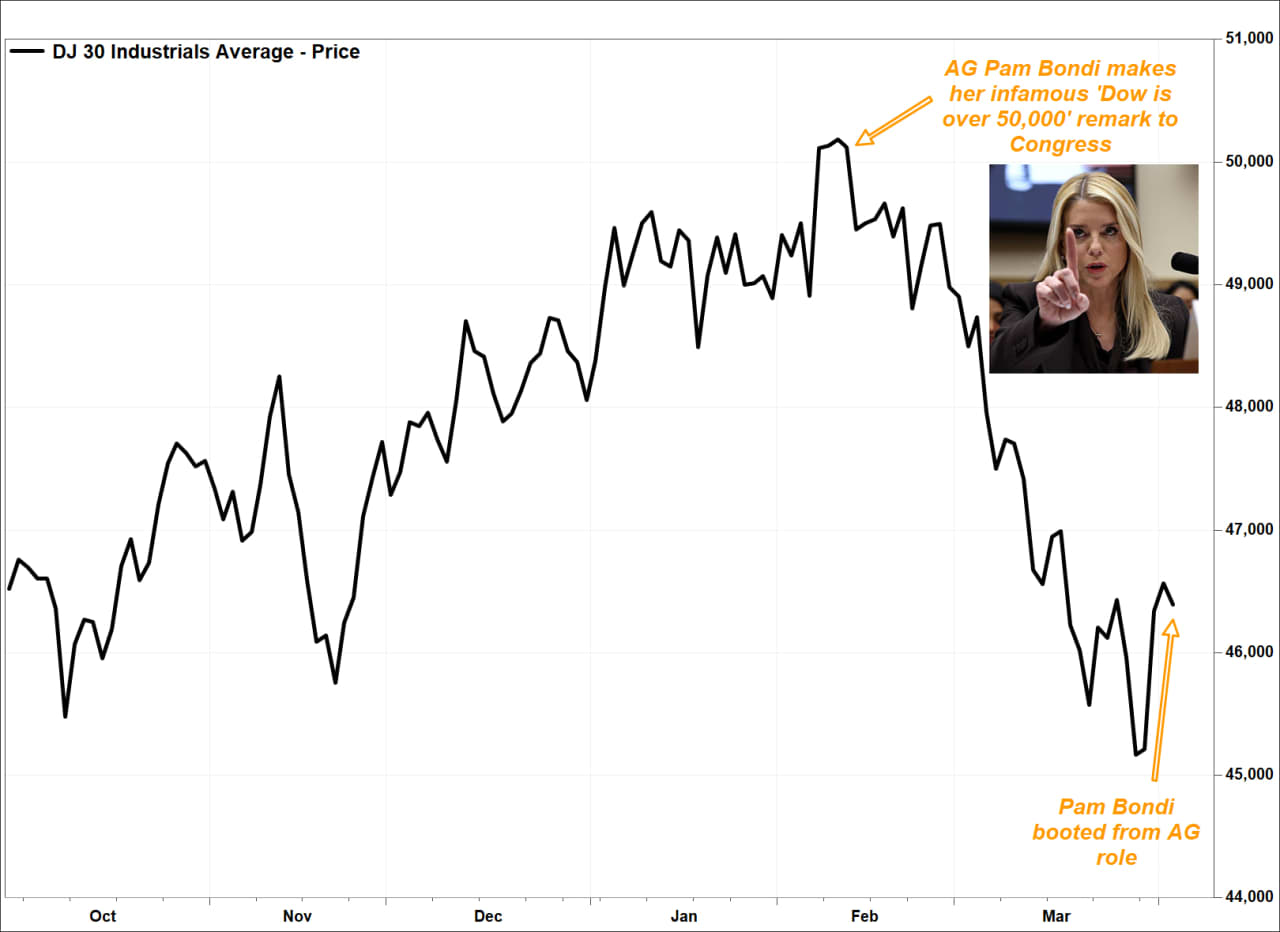
Pamela Bondi, the former Florida Attorney General and a prominent political figure, has reportedly been fired by Donald Trump, according to recent developments. This dismissal immediately brings into sharp relief her much-discussed pronouncement regarding the Dow Jones Industrial Average (DJIA), where she famously projected the index would soar to 50,000 points. Her departure, approximately two years after that viral statement, inevitably invites scrutiny of market performance relative to her bold prediction. The period since her declaration has been marked by significant volatility and economic shifts, paintinbg a complex picture of the stock market's resilience and challenges.
Bondi's "Dow 50,000" comment, made during a period of considerable economic optimism, was widely circulated and became a touchstone for market watchers. At the time, the DJIA was trading significantly lower, making her forecast appear exceptionally bullish to many. The context of her remarks was often linked to broader support for economic policies aimed at fostering growth. Her recent departure from Trump's orbit, whatever the specific reasons, casts a retrospective light on such past public statements and their alignment with subsequent economic realities. Political figures often make economic predictions, but few receive as much public attention or generate as much debate as Bondi's projection.
Market Realities Post-Bondi's Prediction
Since Bondi's notable forecast, the stock market has indeed experienced a mixed bag of results, decidedly "not great" when viewed against the ambitious target she set. While specific figures are not available in the immediate report, general market sentiment and readily observable trends indicate that the Dow has remained well short of the 50,000 mark. The global economy has navigated through unprecedented events, including geopolitical tensions, inflationary pressures, and evolving monetary policies from central banks worldwide. These factors have exerted considerable influence on equity markets, often leading to periods of correction and slower growth than what highly optimistic predictions might have envisioned.
The performance of the DJIA, a bellwether for the broader U.S. stock market, is influenced by a multitude of variables. Corporate earnings, interest rate decisions, consumer confidence, and international trade relations all play critical roles in its daily movements and long-term trajectory. Any prediction as specific and high-reaching as "Dow 50,000" necessarily relies on an almost perfect confluence of positive economic indicators and sustained corporate prosperity, often sidelining unforeseen global disruptions. The intervening years have demonstrated the inherent unpredictability of such a complex system, challenging linear projections of growth.
Broader Economic Context and Implications
Bondi's past commentary and current dismissal serve as a focal point for discussing the intersection of politics and economic forecasting. Public figures, especially those in positions of influence or close to power, often use economic metrics to bolster their arguments or paint a positive outlook for their favored policies. However, the market operates on fundamental data, investor psychology, and external events that can quickly recalibrate expectations. The "not great" performance described in the context of her prediction underscores the caution with which such bold economic forecasts should be viewed. It also highlights the inherent risks of tying political fortunes too closely to specific market targets.
The implications of market performance, especially when contrasted with such high-profile predictions, extend beyond mere financial statistics. They can influence public trust in economic leadership, shape investor behavior, and become part of the broader narrative surrounding economic policy effectiveness. For everyday investors, the divergence between an optimistic forecast and actual market returns can impact retirement planning, investment strategies, and overall financial confidence. The ongoing review of market trends, particularly in light of high-profile political statements, remains a crucial exercise for financial analysts and the public alike.
What Lies Ahead for the Market and Political-Economic Discourse
Looking forward, the financial markets will continue to be shaped by evolving macroeconomic conditions, technological advancements, and geopolitical shifts. While Pam Bondi's specific "Dow 50,000" prediction has not materialized, the discourse surrounding such forecasts will likely endure. Her departure from Trump’s team represents another shift in the political landscape, potentially ushering in new voices and new economic perspectives from that quarter. The market’s response to future economic policies and expert predictions will undoubtedly continue to be a subject of intense scrutiny.
Investors and analysts will remain focused on earnings reports, inflation data, interest rate cues from the Federal Reserve, and global developments. The ability of the market to sustain growth, manage inflation, and adapt to changing conditions will be paramount, irrespective of specific numerical predictions. The current economic environment suggests a continued need for prudent analysis rather than relying on aspirational targets. Bondi's legacy in this context may well be a reminder of the inherent complexities and uncertainties in projecting the future of dynamic financial markets.