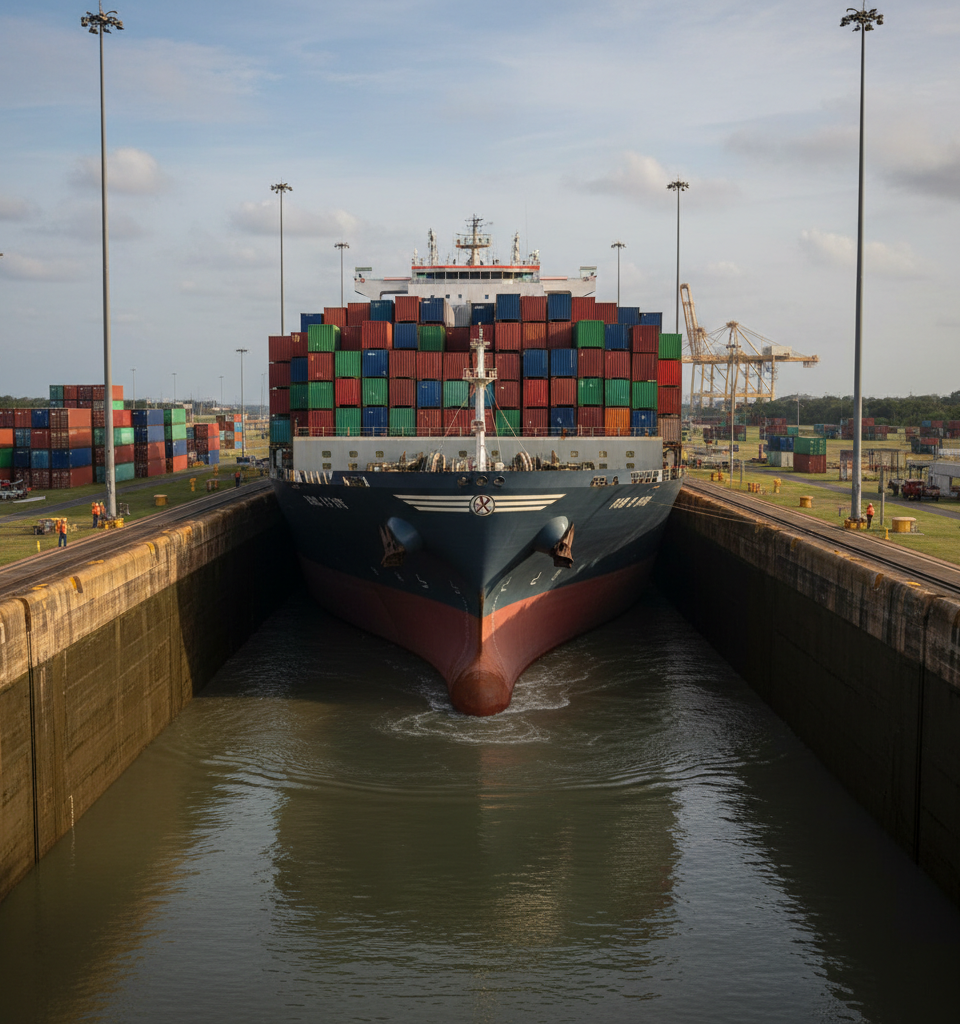
Global supply chains face renewed uncertainty as the Panama Canal Authority signals that persistent falling water supplies will likely constrain cargo reliability, elevate costs, and necessitate rerouting for U.S. East and Gulf Coast ports. This development puts a critical choke point for international trade under mounting pressure, directly affecting import and export operations for businesses spanning various sectors.
The Panama Canal, a linchpin of global maritime trade connecting the Atlantic and Pacific Oceans, has long been a predictable and cost-effective pathway for goods bound for or originating from the U.S. East and Gulf Coasts. Its strategic importance has allowed businesses to optimize logistics, manage inventory, and maintain competitive pricing. However, the current situation, driven by environmental factors and exacerbated by climatic shifts, threatens to erode these efficiencies, potentially leading to widespread re-evaluations of supply chain strategies. Historically, reliable transit through the Canal has underpinned the operational models of countless American and international enterprises.
The authority's communication explicitly warns of impending capacity cuts, implying a reduction in the number of vessels permitted to transit daily, or limitations on vessel draft, or both. Such measures are direct consequences of decreased water levels in Gatun Lake, which supplies the massive quantities of fresh water needed to operate the Canal's lock systems. These operational adjustments are not merely administrative; they translate directly into longer waiting times for ships, increased fuel consumption as vessels idle or take longer routes, and potentially higher insurance premiums for shipping companies. The cumulative effect will be passed down through the supply chain, impacting consumer prices and business profitability.
The broader industry impact could be substantial. Shipping lines are likely to introduce or increase surcharges to compensate for extended transit times or rerouting expenses. This could lead to a shift in cargo away from the Panama Canal, with some vessels potentially opting for longer journeys around Africa's Cape of Good Hope or through the Suez Canal, adding weeks to transit times and significantly increasing fuel costs. Furthermore, U.S. West Coast ports, which have seen a decrease in traffic due to diversions to the East Coast via the Panama Canal, could experience a resurgence in volume, potentially straining their infrastructure and labor resources. The reliability of "just-in-time" inventory systems, heavily dependent on predictable shipping, could be severely compromised.
While the original description does not include specific expert perspectives or analyses beyond the Panama Canal Authority's signal, the implications are clear for logistics specialists and economists. The anticipation of constrained capacity underscores the vulnerability of global trade to environmental factors and the critical need for diversified logistics strategies. The Authority's proactive signaling, while necessary, also places an onus on businesses to quickly adapt their planning to mitigate future shocks.
Looking ahead, the situation necessitates close monitoring by businesses with significant reliance on this trade route. Companies may need to explore alternative shipping methods, re-evaluate inventory levels, or even consider regionalizing supply chains to reduce dependence on a single, environmentally susceptible corridor. The long-term implications could include accelerated investments in port infrastructure capable of handling larger vessels or different types of cargo, as well as a re-prioritization of digital tools for real-time supply chain visibility to better navigate these evolving challenges. The coming months will likely reveal the full extent of these capacity cuts and their cascading effects across global commerce, and particularly U.S., trade networks.