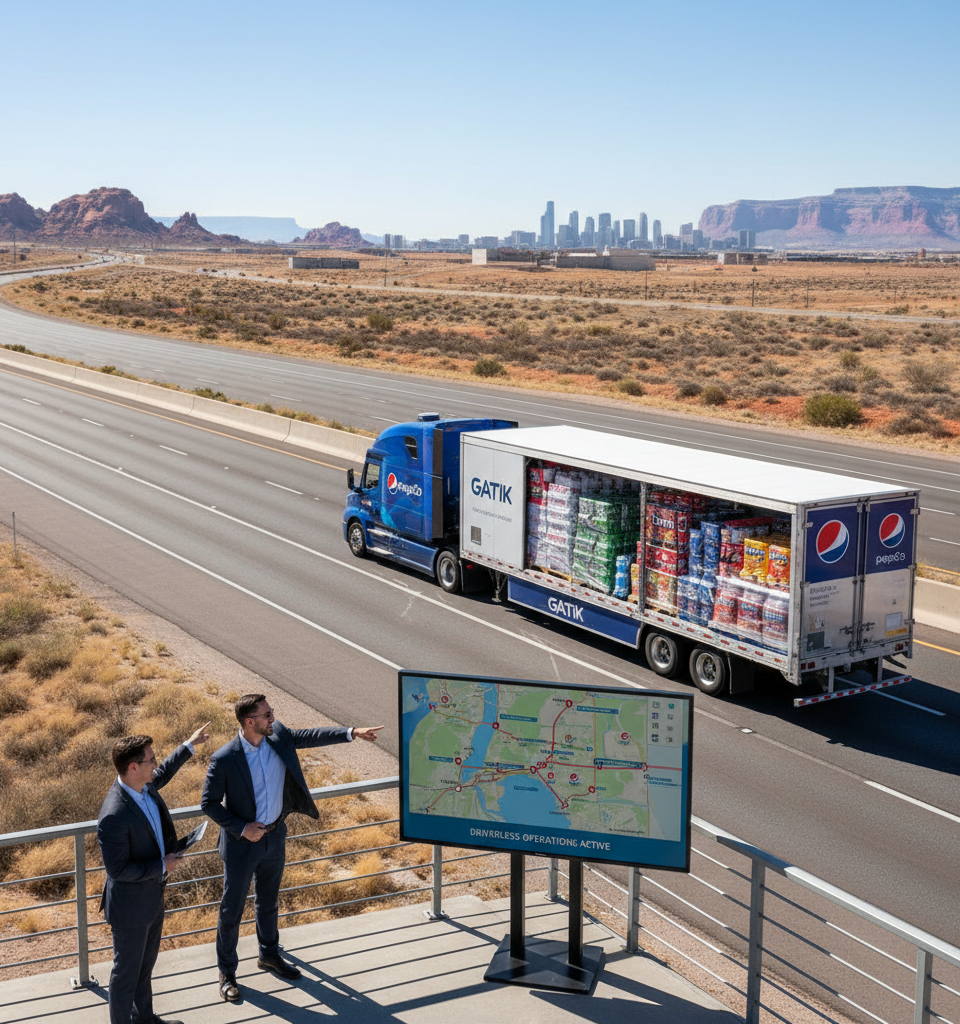
PepsiCo and Gatik have officially launched what is being heralded as the largest commercial driverless trucking deployment to date, with operations now actively underway across Texas, Arizona, and Arkansas. This groundbreaking initiative sees autonomous vehicles integrating into the logistics network of one of the world's leading food and beverage companies, signaling a major step forward for autonomous middle-mile delivery.
Context and Significance
The deployment underscores a growing trend in the logistics sector towards automation to address challenges such as driver shortages, increased demand for faster delivery, and operational efficiency. PepsiCo, with its vast distribution network for brands like Frito-Lay and Quaker Oats, stands to gain significant advantages from this technology, potentially optimizing supply chain operations and reducing long-term costs. The collaboration with Gatik, a leader in autonomous middle-mile logistics, leverages specialized technology designed for fixed, repeatable routes, which are ideal for handling predictable, high-frequency freight movements between distribution centers, factories, and retail hubs.
Operational Details and Scope
The driverless trucks are now operating on commercial routes, transporting goods for PepsiCo's various brands. While specific route details and the exact number of vehicles involved were not disclosed in the initial announcement, the mention of three distinct states – Texas, Arizona, and Arkansas – points to a substantial geographic footprint for this initial phase. The operations are fully commercial, meaning they are contributing directly to PepsiCo's supply chain without human safety drivers in many of the scenarios, a testament to the maturity and safety protocols of Gatik's autonomous driving system. This scale of deployment surpasses previous endeavors in the autonomous trucking space, setting a new benchmark for commercial viability and breadth of operation.
Industry Impact and Future Outlook
This deployment is expected to have far-reaching implications for the broader transportation and logistics industry. It validates the commercial readiness of autonomous trucking technology, particularly for middle-mile applications where fixed routes and hub-to-hub deliveries present fewer complexities than urban last-mile scenarios. The success of this partnership could accelerate investment and adoption of similar technologies by other large enterprises facing similar logistical challenges. Furthermore, it highlights the potential for autonomous vehicles to improve road safety, reduce fuel consumption through optimized driving patterns, and provide more consistent delivery times.
The Autonomous Middle Mile
The focus on the "middle mile" is critical. This segment of the supply chain, connecting manufacturing facilities and distribution centers to retail stores, is often characterized by repetitive routes and highway driving, making it an ideal candidate for automation. By automating this segment, companies can free up human drivers for more complex last-mile deliveries or long-haul routes, optimizing human capital. The partnership between PepsiCo and Gatik exemplifies this strategic approach, aiming to create a more resilient and efficient supply chain.
Regulatory Landscape and Public Acceptance
The expansion into multiple states also brings into focus the varying regulatory environments for autonomous vehicles across the United States. Texas, Arizona, and Arkansas are known for having relatively progressive stances on autonomous vehicle testing and deployment, which likely facilitated the rapid scaling of these operations. As more commercial deployments like this come online, there will be increasing pressure for a more harmonized national regulatory framework to support widespread adoption. Public acceptance and understanding of driverless technology will also be crucial for the long-term success of such initiatives, requiring ongoing education and demonstrations of safety and reliability.
Moving Forward
The launch marks a significant milestone not just for PepsiCo and Gatik, but for the entire autonomous driving industry. It paves the way for further expansion and integration of driverless technology into commercial supply chains. The insights gained from these large-scale operations in Texas, Arizona, and Arkansas will be invaluable in refining the technology, optimizing operational workflows, and demonstrating the tangible benefits of autonomous logistics to a wider audience. The partnership stands as a powerful demonstration of how leading companies are leveraging cutting-edge technology to transform their operations and prepare for the future of global commerce.