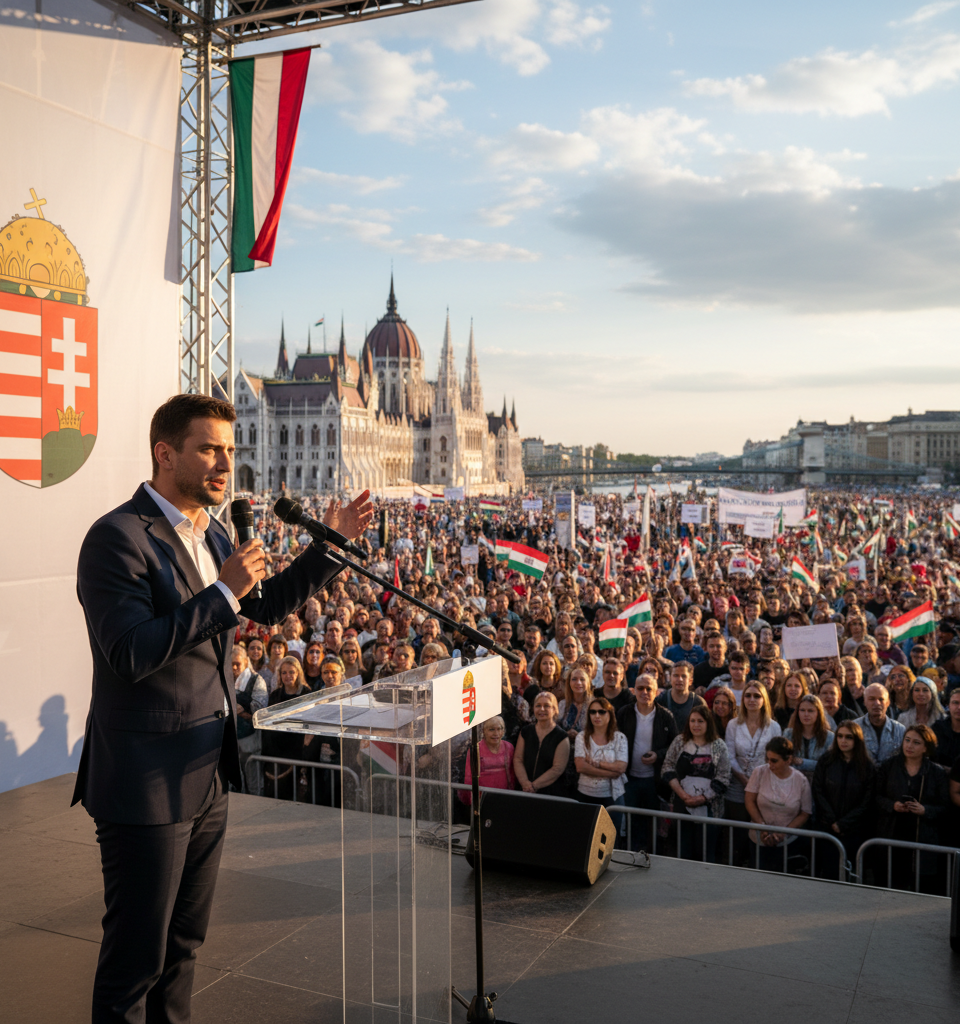
Budapest, Hungary – In a dramatic political upheaval, Peter Magyar, a former government insider and disaffected husband of a prominent Orbán ally, has surged onto the Hungarian political scene, galvanizing popular anger against corruption and sluggish economic growth. His unlikely ascent, culminating in significant electoral gains, marks the most potent challenge in years to Prime Minister Viktor Orbán's seemingly unshakeable two-decade dominance. Magyar's movement, campaigning on an anti-corruption platform, has tapped into a deep vein of public frustration, effectively transforming the upcoming political discourse and presenting a credible alternative to the established Fidesz party.
The Erosion of Public Trust and Economic Discontent
Magyar’s success is intrinsically linked to a widespread erosion of public trust in the ruling Fidesz party, fueled by persistent allegations of cronyism and misuse of public funds. Despite Orbán's strong parliamentary majority, dissatisfaction has been simmering, particularly concerning the perceived entrenchment of corruption within state institutions and the business elite. Furthermore, Hungary's economic performance, once a cornerstone of Fidesz's appeal, has faltered. Recent data indicates a significant slowdown in GDP growth, projected at around 2.4% for 2024, coupled with persistent inflation, which peaked at nearly 25% in early 2023 before moderating to around 4% by late 2024. These economic headwinds have put considerable strain on household budgets and reduced real wages, amplifying public demand for change.
Key Details: A Former Insider's Unprecedented Challenge
Peter Magyar, previously a relatively unknown lawyer and diplomat, was married to Judit Varga, Orbán's former Justice Minister and a leading figure in Fidesz. His public break with the government, triggered by a child abuse pardon scandal that forced Varga's resignation, provided him with unique credibility as a whistleblower. Magyar presented recordings and made accusations of deep-seated corruption within the highest echelons of power, resonating profoundly with a public eager for accountability. His TISZA party (Respect and Freedom Party) rapidly amassed support, transforming from a nascent protest movement into a formidable electoral force. In recent polls, TISZA has garnered support upwards of 15-20%, a startling figure for a newly formed political entity, directly chipping away at Fidesz's long-held dominance which often exceeded 50% of the vote.
Impact on Hungary's Political and Business Landscape
Magyar’s rise poses a significant shift for Hungary’s political landscape, long characterized by the fragmented and ineffective nature of the traditional opposition. His ability to consolidate anti-Orbán sentiment into a single, potent force represents a new paradigm. For the business community, particularly those with close ties to the Fidesz government, this development introduces a new layer of uncertainty. A potential future government under Magyar could lead to increased scrutiny of public procurement processes, stricter anti-corruption measures, and potentially a re-evaluation of economic policies that have benefited pro-government entities. This could disrupt established business networks and re-route large infrastructure projects or state contracts, potentially benefiting smaller, less connected enterprises.
Expert Analysis: A Populist Counter-Movement
Political analysts are observing Magyar’s phenomenon with keen interest. Dr. Anna Kovács, a political scientist at Corvinus University of Budapest, notes, “Magyar has successfully occupied the vacuum left by a discredited opposition, combining a strong anti-corruption narrative with a national conservative tone that appeals to a broad demographic, including disaffected Fidesz voters. He is effectively creating a new populist counter-movement.” Other experts highlight his mastery of social media and direct public engagement, bypassing traditional media channels largely controlled by the government, as a key factor in his rapid outreach and sustained momentum. His movement is seen as a direct challenge to the illiberal democratic model promoted by Orbán, signaling a potential return to more democratic norms and European integration.
What Lies Ahead: A Pivotal Juncture for Hungary
Looking forward, the upcoming municipal and European parliamentary elections will serve as crucial barometers of Magyar’s enduring influence and his party’s organizational strength. A strong showing could propel TISZA into a dominant opposition role, fundamentally altering the political calculus for the 2026 general election. The government, in response, is expected to intensify its efforts to discredit Magyar, potentially through legal challenges or media campaigns. The coming months will be pivotal for Hungary, as the nation grapples with a burgeoning political force that has the potential to fundamentally redefine its political future and its relationship with the European Union, marking a period of unprecedented volatility and change in Central European politics.