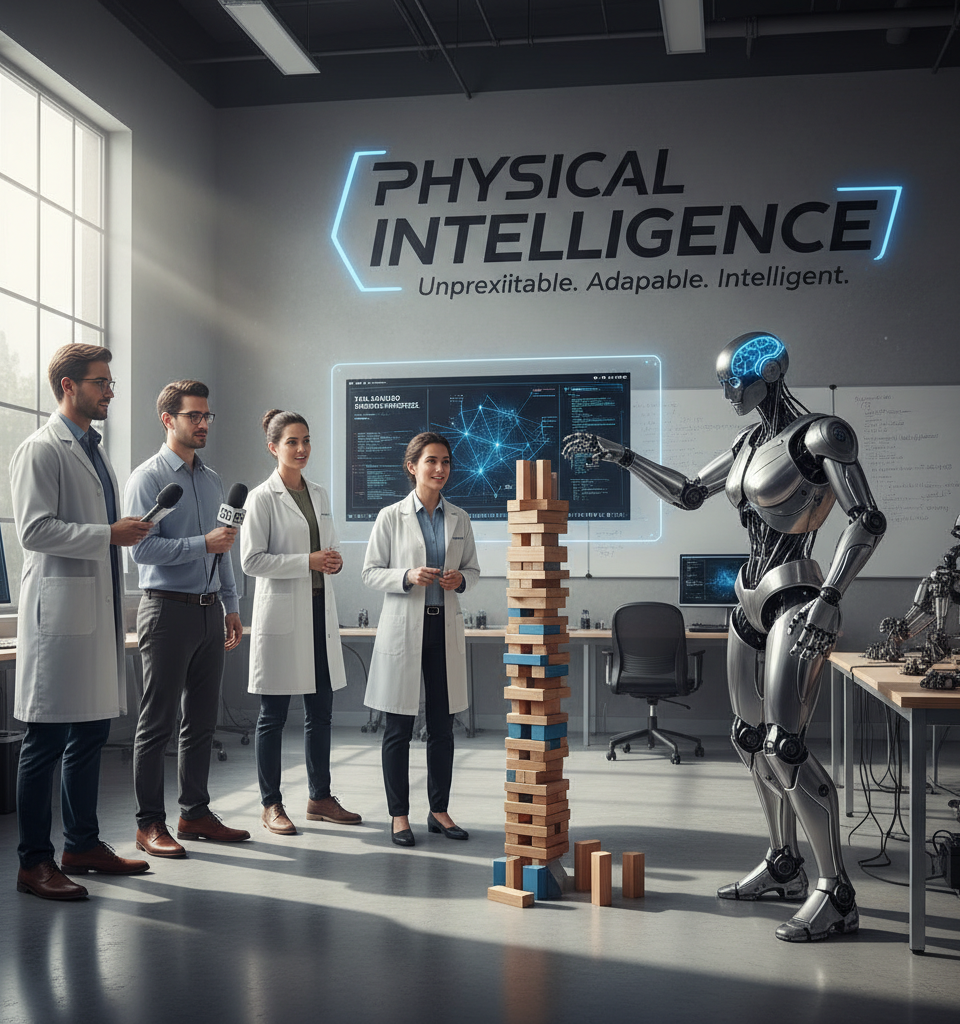
Physical Intelligence today revealed its latest innovation, the π0.7 model, a robot brain designed to autonomously comprehend and execute tasks for which it has received no explicit prior training. This development, according to the burgeoning robotics firm, marks a crucial preliminary stride toward realizing a truly versatile, general-purpose intelligence for robotic systems, a long-standing ambition within the AI and robotics communities.
Advancing Robotic Autonomy
The ability for a robot to perform tasks it has never been specifically taught represents a profound leap beyond current state-of-the-art robotics. Traditionally, industrial robots are meticulously programmed for highly specific, repetitive actions within controlled environments. Any deviation from these pre-programmed parameters often requires extensive human intervention and reprogramming. Physical Intelligence's claim suggests a paradigm shift, moving robots from rigid, task-specific tools to more adaptable, problem-solving entities. Such autonomy has significant implications for various sectors, from complex manufacturing and logistics to hazardous environment exploration and elder care.
The π0.7 model is being presented as an early-stage but meaningful step in this ambitious quest. While specific technical details of its architecture remain largely under wraps, the company emphasizes the model’s capacity for what it terms 'unsupervised task inference.' This likely indicates an advanced machine learning framework that allows the robot to analyze its environment and the desired outcome, then formulate a sequence of actions without direct human instruction on that particular task. The distinction here is crucial: it's not merely adapting to minor variations but understanding new objectives entirely.
Implications for Industry and Research
Should π0.7 deliver on its promise, the implications for the robotics and AI industries are substantial. For manufacturers, it could drastically reduce the time and cost associated with deploying and reconfiguring robotic systems. Instead of extensive retraining for every new product line or manufacturing process, robots equipped with such a brain could potentially observe and adapt, learning new assembly steps or movements on the fly. This flexibility could unlock new levels of efficiency and agility in factories worldwide.
Beyond manufacturing, the impact could extend to logistics and warehousing, where robots might optimize picking and packing operations for novel product assortments without explicit programming. In research and development, a general-purpose robot brain could accelerate experimentation in fields requiring complex manipulation or autonomous data collection. The vision is to empower robots to operate more akin to human apprentices, observing and learning rather than simply executing commands.
The Path to General-Purpose Intelligence
The concept of a general-purpose robot brain has long been considered the holy grail of robotics, often appearing more in science fiction than in practical applications. The challenges are immense, encompassing not just physical dexterity and sensor integration but also sophisticated perceptual understanding, cognitive reasoning, and robust error handling. Physical Intelligence is careful to frame π0.7 as an 'early' step, acknowledging the considerable development still required to reach truly human-level cognitive flexibility in a robotic platform.
Achieving this long-sought goal involves overcoming hurdles related to generalization across diverse environments, adapting to unexpected stimuli, and developing an intuitive understanding of physics and object properties. The ability of π0.7 to handle untaught tasks suggests progress in these areas, potentially through advanced reinforcement learning techniques or novel neural network architectures that allow for meta-learning — learning how to learn new tasks more efficiently.
Next Steps and Future Outlook
Physical Intelligence has not yet disclosed a timeline for commercial deployment or further iterations of the π0.7 model. However, the announcement undoubtedly signals an intensified focus within the company on foundational AI research aimed at cognitive robotics. Future developments will likely involve rigorous testing in various unstructured environments to validate the model's capabilities and robustness across a broader spectrum of tasks and scenarios. The robotics community will be keenly watching for demonstrations and further technical details that elaborate on the internal workings and performance metrics of π0.7.
This announcement is expected to fuel further investment and research into similar general AI initiatives within robotics, potentially accelerating the timeline for more adaptive and intelligent autonomous systems. The journey toward a truly general-purpose robot brain is arduous and protracted, but Physical Intelligence’s π0.7 model may well represent a foundational block in constructing that future.