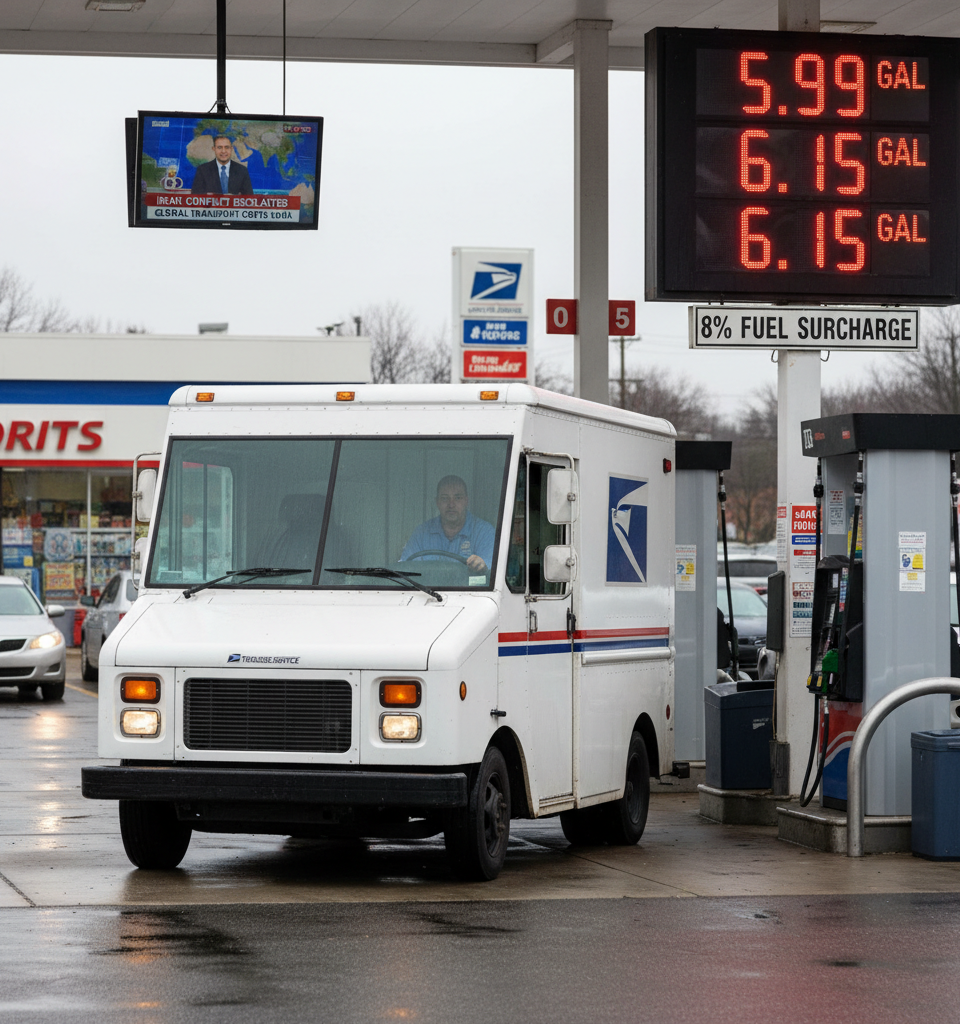
WASHINGTON D.C. — The U.S. Postal Service (USPS) announced today its decision to levy a historic 8% fuel surcharge on all parcel customers, a move signaling a significant shift in its operational pricing strategy. Slated to take effect on October 15th, this unprecedented measure is a direct consequence of rapidly escalating fuel prices, primarily driven by heightened geopolitical tensions in the Middle East and the subsequent disruption to global oil supplies. The surcharge aims to mitigate the ballooning transportation expenses faced by the postal powerhouse, ensuring continued operational stability in an increasingly volatile energy market.
This marks the first time in the USPS's extensive history that a broad fuel surcharge of this magnitude has been implemented across its parcel services. The decision underscores the severe financial pressure the independent agency is facing, highlighting its reliance on fuel to power its vast logistical network, which delivers to over 167 million addresses six days a week. The agency emphasized that without such a measure, the rising costs could significantly jeopardize its ability to maintain reliable and affordable service across the nation.
Details released by the USPS indicate that the 8% surcharge will apply to all domestic and international parcel services, including Priority Mail Express, Priority Mail, Parcel Select, and certain international package services. While the exact revenue impact remains to be seen, initial projections suggest it could generate hundreds of millions of dollars annually, directly offsetting the estimated 20-25% increase in fuel expenditures observed over the past six months. "This is a necessary step to address the extraordinary market conditions we are currently facing," stated Postmaster General Louis DeJoy in an internal memo, "ensuring we can continue to fulfill our universal service obligation without compromising financial solvency."
Industry and Market Implications
The ripple effects of this surcharge are expected to be far-reaching, impacting a diverse array of businesses and consumers. E-commerce retailers, particularly small and medium-sized enterprises (SMEs) heavily reliant on USPS for last-mile delivery, will likely face increased shipping costs, which may be passed on to consumers. This could potentially lead to marginal increases in the cost of goods shipped, adding to existing inflationary pressures. Competitors such as FedEx and UPS, which have long implemented dynamic fuel surcharges, may see a marginal shift in market dynamics as USPS aligns more closely with industry-standard pricing mechanisms.
Expert Analysis and Outlook
Industry analysts view the USPS's move as a pragmatic, albeit overdue, response to current market realities. "The USPS has historically absorbed many of these cost fluctuations, but the current geopolitical climate has made that unsustainable," commented Dr. Eleanor Vance, a logistics economist at the University of Pennsylvania. "This 8% surcharge is a critical step towards financial sustainability, bringing their pricing model more in line with commercial carriers who have always had mechanisms to respond to fuel price volatility." Experts also highlight the dual challenge facing USPS: a mandate to provide universal service while operating like a commercial entity, a dynamic often complicated by external economic shocks.
The Road Ahead
The implementation of this fuel surcharge is not seen as a permanent solution but rather an adaptive measure in response to ongoing market volatility. The USPS has indicated it will continuously monitor fuel price trends and geopolitical developments, reserving the right to adjust the surcharge percentage as conditions evolve. Further discussions are expected on long-term strategies to de-risk its operations from fuel price swings, potentially including investments in more fuel-efficient vehicles or alternative energy sources. For now, businesses and consumers are advised to factor the additional 8% into their shipping calculations as the postal service navigates a challenging economic landscape.
This development underscores the intricate link between global events and domestic services, revealing how a conflict thousands of miles away can directly influence the cost of sending a package across town. The coming months will be crucial in observing how the market adapts to this new normal for postal services.