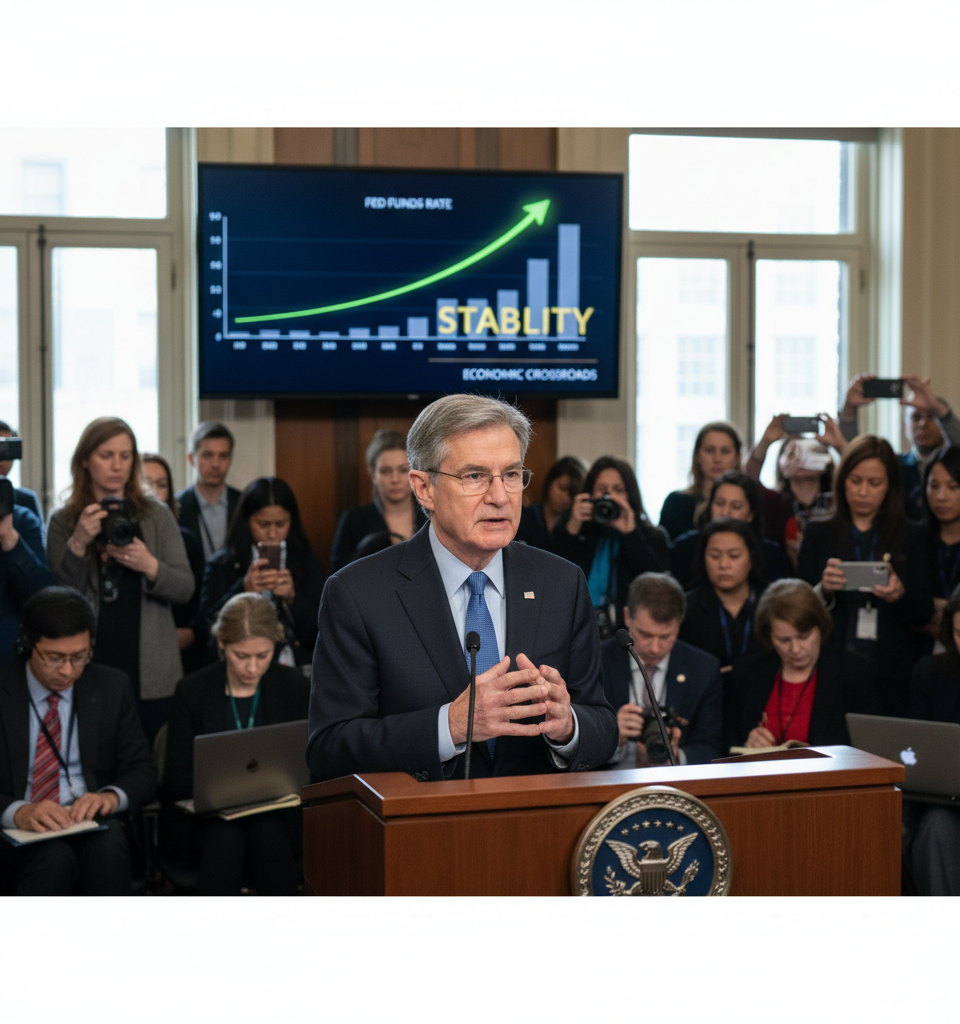
Federal Reserve policymakers began their highly anticipated two-day meeting on interest rate policy on Tuesday, with analysts and markets overwhelmingly forecasting a decision to hold the benchmark federal funds rate steady. This anticipated move underscores a cautious approach by the central bank as it navigates persistent inflation, a robust labor market, and evolving global economic pressures, effectively signaling a period of stability as Chair Jerome Powell's term approaches its conclusion.
A Legacy of Unprecedented Challenges
The likely decision to keep rates unchanged would represent a strategic pause following a period of aggressive monetary tightening, which saw rates skyrocket from near-zero to their current target range of 5.25% to 5.50% over a span of merely 18 months. This tightening cycle was a direct response to the highest inflation rates seen in four decades, peaking at over 9% in mid-2022. The backdrop of Powell's chairmanship has been defined by unprecedented economic shocks, from the COVID-19 pandemic's disruption and the subsequent inflationary surge to the geopolitical instability triggered by conflicts abroad. His tenure, characterized by both bold and controversial decisions, has presided over a period of significant economic volatility and recovery efforts.
Key Economic Indicators and Policymaker Stance The Federal Open Market Committee
(FOMC) will release its official statement on Wednesday afternoon, accompanied by Powell's customary press conference. While no rate hike is expected, the market will scrutinize the statement for nuanced language regarding future policy direction, particularly any hints about the timing of potential rate cuts. Recent economic data present a mixed picture: the unemployment rate remains remarkably low at 3.9%, while core inflation, as measured by the Personal Consumption Expenditures (PCE) price index, still hovers above the Fed's 2% target, though it has significantly cooled from its peak. Furthermore, recent GDP growth figures have shown resilience, suggesting that the economy has absorbed the higher borrowing costs better than many initially anticipated. Some economists point to the 'higher for longer' rhetoric gaining traction among some Fed officials, indicating a reluctance to ease policy prematurely.
Market Reaction and Sectoral Impacts
The equity markets have largely priced in a steady rate decision, with investor focus shifting to forward guidance. A prolonged period of stable, albeit elevated, interest rates has varied impacts across different sectors. Technology and growth stocks, which are particularly sensitive to borrowing costs, have shown resilience, partly due to strong earnings and the AI boom. Conversely, sectors like housing continue to face headwinds, with mortgage rates remaining elevated, restricting affordability and slowing market activity. The commercial real estate market also remains a point of concern, with rising refinancing costs and office vacancy rates posing ongoing challenges to property owners and lenders. Investors in fixed-income markets will be closely watching for subtle shifts in the bond yield curve, which can signal future economic expectations.
Expert Consensus and Divergent Views
Economists are largely in agreement that the Fed will hold rates, with a near-unanimous expectation among Bloomberg surveyed analysts. However, opinions diverge on the path forward. "The Fed is in a holding pattern, balancing the risks of reigniting inflation against a potential hard landing," commented Dr. Eleanor Vance, chief economist at Global Financial Partners. "Their recent rhetoric suggests a preference for patience, indicating that the first rate cut might be pushed further into the latter half of the year." Others, like Dr. Miles Kincaid of Cornerstone Analytics, argue for earlier cuts. "Delaying cuts for too long risks stifling economic momentum, especially as other major central banks consider easing," Kincaid stated, highlighting the evolving global monetary policy landscape.
The Road Ahead: Inflation, Elections, and Leadership Transition
The immediate future will see the Fed continue to monitor inflation data, labor market dynamics, and geopolitical developments. The upcoming presidential election cycle in the United States could also add another layer of complexity, potentially influencing market sentiment and policy expectations. Beyond the current meeting, the more significant question revolves around the timing and magnitude of future rate adjustments, with market participants currently pricing in at least one rate cut by year-end, though conviction varies. As Chair Powell's term concludes, the process of selecting and confirming his successor or re-appointing him will be critical, shaping the central bank's direction for years to come and influencing stability long after the present meeting has concluded and its implications fully absorbed.