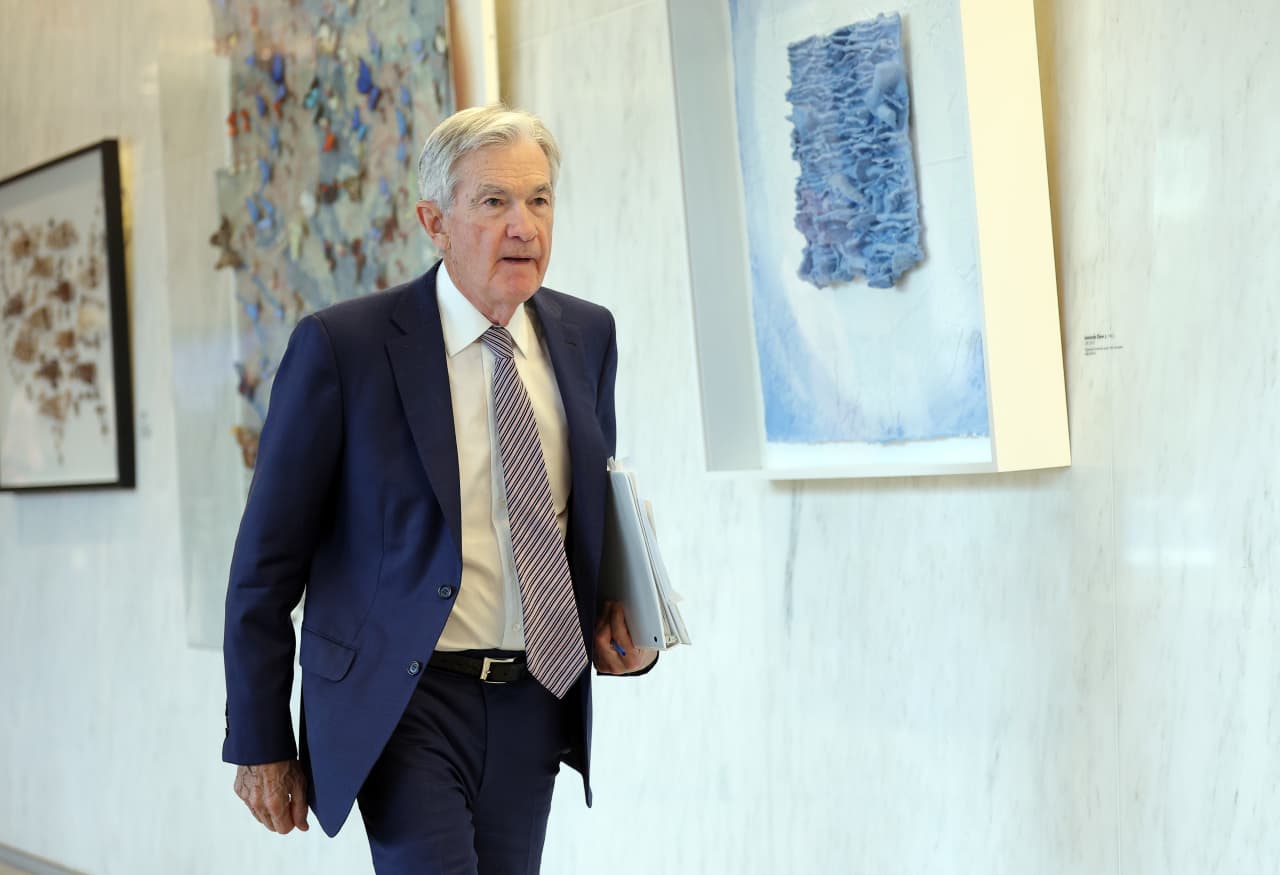
WASHINGTON D.C. — Federal Reserve Chairman Jerome Powell indicated that the path for interest rates remains highly uncertain, with the central bank observing a unique economic juncture where rates could potentially move both higher or lower. Speaking to reporters on, Powell emphasized that the Fed is not facing an immediate decision on monetary policy, primarily due to the unpredictable economic fallout from recent geopolitical events, specifically referencing the ongoing tensions in the Middle East following the Iran war.
This statement underscores the Federal Reserve's heightened state of vigilance, a significant departure from previous, more clearly articulated policy directions. The admission that rates could move in either direction highlights the unprecedented complexity introduced by global instability, challenging traditional models of economic forecasting and policy formulation. For years, the Fed has operated within a framework guided by domestic economic indicators, but the current environment necessitates a broader, more integrated assessment that accounts for geopolitical forces.
Powell elaborated on the Fed's cautious stance, stating, "We don't know what the economic effects" of the Iran war will eventually be. This ambiguity directly impacts the central bank's ability to project inflation and growth trajectories, which are crucial determinants for rate decisions. Historically, geopolitical shocks have often led to supply chain disruptions and energy price volatility, which can quickly translate into inflationary pressures or, conversely, a slowdown in global demand leading to deflationary risks. The current situation presents a confluence of these possibilities.
The uncertainty articulated by Chairman Powell sent ripples through financial markets. Investors, accustomed to clearer forward guidance from the Fed, are grappling with increased volatility. The dollar's strength might fluctuate as global capital flows respond to perceived safety or risk. Commodities, especially oil, are likely to remain highly sensitive to geopolitical developments, with a sustained spike in crude prices potentially reigniting inflation concerns. Conversely, a prolonged period of global uncertainty could trigger a flight to quality, potentially boosting demand for government bonds and other safe-haven assets.
Economists and market analysts are divided on the likely trajectory. Dr. Eleanor Vance, chief economist at Global Insights Group, commented, "Powell's remarks acknowledge the elephant in the room – that traditional economic models are less effective when you have such significant non-economic factors in play. We could see a flight to safety that strengthens the dollar and pushes yields down, or a supply shock that forces the Fed to consider tightening even in a slowing economy." Others point to the resilience of the U.S. labor market as a potential buffer against severe downturns, offering the Fed more flexibility than its global counterparts.
Looking ahead, market participants will be scrutinizing every incoming data point – from inflation figures and employment reports to updates on global supply chains and energy markets. Speeches from other Fed officials will also be closely watched for any additional insights into the central bank's thinking. Furthermore, the geopolitical situation itself will remain a primary driver of market sentiment, with any escalation or de-escalation directly influencing economic expectations and, consequently, the Fed's calculus. The next Federal Open Market Committee (FOMC) meeting will undoubtedly feature robust debate on these very issues, with a definitive policy path likely remaining elusive until greater clarity emerges on the global stage.
The Fed's cautious approach reflects a broader recognition that the global economic landscape is evolving rapidly, with unprecedented interdependencies. The era of purely domestically focused monetary policy seems to be drawing to a close, replaced by a more nuanced strategy that incorporates a wider array of international and geopolitical variables. This new reality demands flexibility and adaptability from the central bank, as it navigates a future fraught with both economic and geopolitical challenges.
Ultimately, the coming months will test the Federal Reserve's ability to balance its dual mandate of maximum employment and price stability against a backdrop of significant global uncertainty. The statement by Chairman Powell signals that the Fed is prepared for a range of outcomes, highlighting a period of heightened watchfulness rather than decisive action.