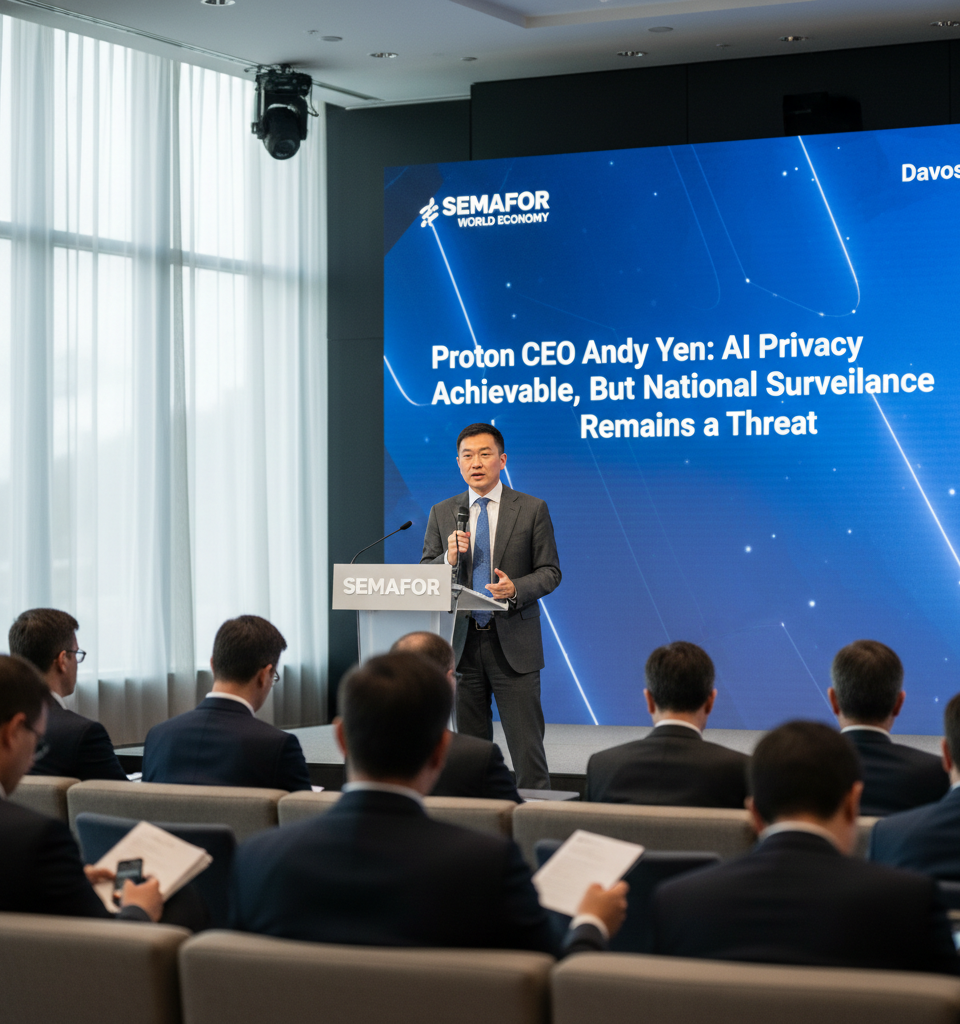
DAVOS, SWITZERLAND — Andy Yen, CEO of privacy-focused technology company Proton, declared at the Semafor World Economy forum that the integration of artificial intelligence does not inherently doom user privacy. Speaking to attendees at the high-profile event, Yen outlined a vision where technological safeguards, localized AI, and robust security protocols could coexist with advanced AI functionalities. His remarks, made against the backdrop of burgeoning global debates on data security and AI ethics, emphasized Proton's commitment to empowering individuals to retain control over their digital footprint, even as AI's capabilities expand exponentially.
The Evolving Landscape of Digital Privacy
Yen's perspective arrives at a critical juncture for digital rights. The rapid proliferation of AI tools, from predictive analytics to facial recognition, has amplified concerns about data collection, algorithmic bias, and the potential for ubiquitous surveillance. Historically, the digital age has seen an erosion of privacy, with tech giants amassing vast datasets for targeted advertising and governments implementing broad surveillance programs under banners of national security. Proton, founded in 2014 out of CERN, emerged from this environment with a mission to offer encrypted communication and internet services, positioning itself as a bulwark against these trends. Yen's current assertions suggest a path forward even amid the accelerating AI revolution, challenging the notion that privacy must be sacrificed for technological progress.
Local AI: A Shield Against Mass Surveillance
A centerpiece of Yen's strategy for AI-era privacy is the concept of local AI. This approach advocates for running AI models and processing data directly on user devices rather than on remote cloud servers. "If your data never leaves your device, it can't be stolen, surveilled, or sold," Yen explained, underscoring the fundamental security principle. He highlighted that advancements in on-device processing capabilities, coupled with more efficient AI models, are making this a tangible reality. This paradigm shift would significantly reduce the attack surface for hackers and limit the ability of large corporations and governments to intercept and analyze user data at scale. Yen also touched upon the critical issue of protecting minors online, suggesting that privacy-by-design principles, including local AI processing, are paramount for creating safer digital spaces for children.
The Unwavering Shadow of State-Sponsored Surveillance
Despite the optimism regarding local AI and technological advancements, Yen expressed profound concern about mass surveillance orchestrated by nation-states. This, he admitted, represents an uncontrollable variable for companies like Proton. While encryption and secure infrastructure can protect data from many threats, a determined state actor with significant resources can employ various tactics, including legal mandates, zero-day exploits, or even physical coercion, to bypass digital defenses.
"We can protect users from corporations, from hackers, but one thing keeps me up at night: the incredible power of governments to compel access, often in secret," Yen stated, acknowledging the ultimate limit to even the most robust technological privacy solutions. This vulnerability extends beyond the digital realm, touching upon broader geopolitical concerns and the balance of power between citizens and the state.
Industry Response and Market Implications
Proton's stance resonates with a growing segment of the tech industry and user base increasingly wary of pervasive data collection. Competitors and Big Tech alike are facing mounting pressure from regulators and consumers for greater transparency and control over personal data. Yen's advocacy for local AI could spur further research and development in decentralized AI solutions, potentially creating a new competitive frontier in the tech market.
Companies that prioritize privacy-enhancing technologies may gain a significant advantage, attracting users who are disillusioned with current data practices. Conversely, those adhering to centralized, cloud-based AI models without strong privacy safeguards may face increased scrutiny, regulatory fines, and reputational damage. The market for privacy tools and decentralized services is projected to grow to over $50 billion by 2027, indicating a strong demand for solutions aligned with Proton's philosophy.
The Road Ahead: Regulation and Ethical AI Development
The future of privacy in the AI era will undoubtedly be shaped by a combination of technological innovation, regulatory frameworks, and societal expectations. Yen's comments underline the urgent need for comprehensive global data protection laws that can keep pace with AI development, similar to the EU's General Data Protection Regulation (GDPR) but with a broader scope for AI. Ethical guidelines for AI development, focusing on data minimization, transparency, and user control, will become increasingly crucial. Furthermore, ongoing public education campaigns about digital literacy and the risks associated with data sharing are vital. As AI continues to evolve, the challenge for technology companies, governments, and individuals will be to collectively build a future where innovation does not come at the cost of fundamental human rights, particularly the right to privacy.