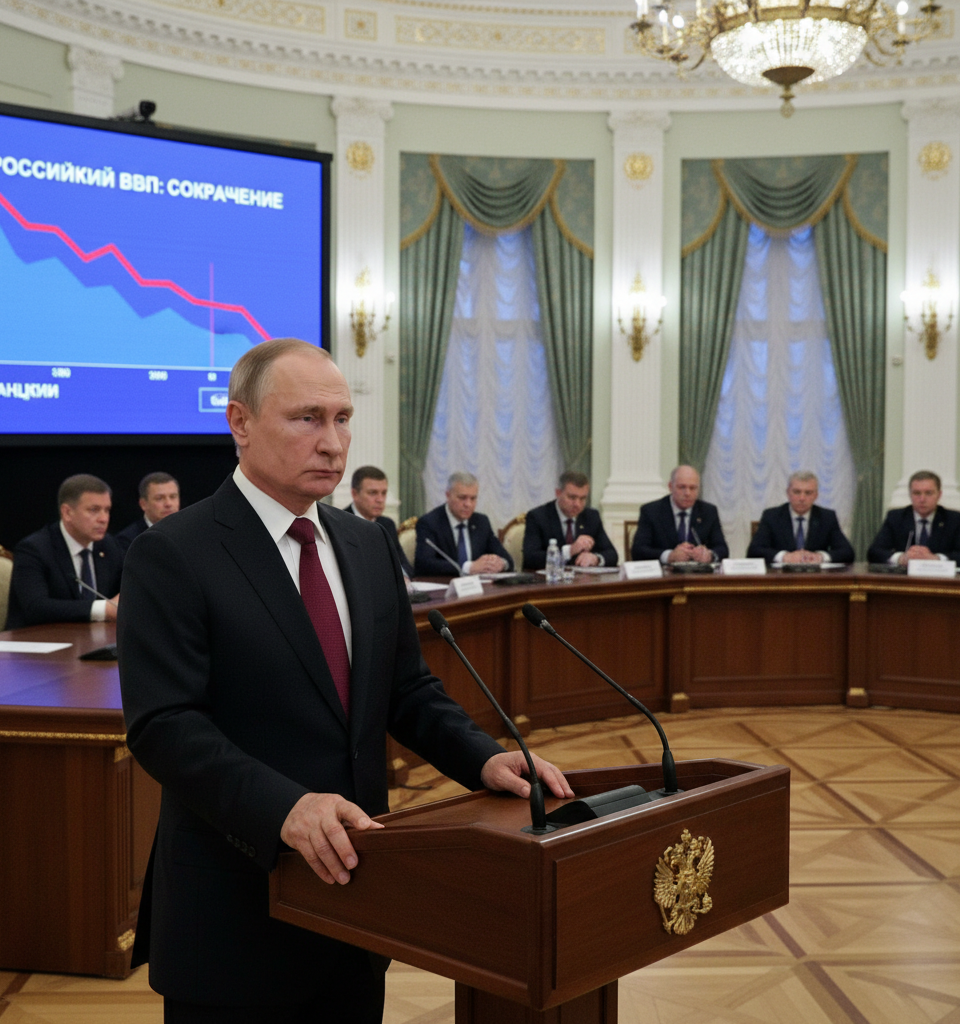
MOSCOW – In a noteworthy deviation from previous assertions of economic resilience, Russian President Vladimir Putin has publicly acknowledged a contraction in the nation's Gross Domestic Product (GDP), reporting a combined decline of 1.8% for January and February. The admission, made during a recent high-level economic briefing, marks a stark pivot for the Kremlin, which has largely downplayed the impact of escalating international sanctions following the ongoing conflict. Putin further detailed negative performance across crucial sectors including manufacturing, industrial production, and construction, signaling a broader economic malaise.
This concession underscores the mounting pressure on the Russian economy, which has been subjected to unprecedented sanctions from Western nations since February 2022. For months, official narratives have emphasized the country's ability to withstand and adapt, even reporting surprisingly robust growth figures in late 2023. However, independent analysts and international organizations have consistently pointed to the long-term corrosive effects of severed trade ties, capital flight, and restrictions on key technologies. Putin's latest statements, therefore, represent a significant, albeit delayed, recognition of realities that have been visible to external observers for some time.
Specifically, the reported 1.8% GDP contraction in the first two months of 2024 is a critical indicator of the deepening economic challenges. This figure, while seemingly modest, represents a stark reversal from the 3.6% growth reported for the entirety of 2023, largely fueled by military spending and reorientation towards new markets like China and India. The downturn in manufacturing and industrial production highlights the impact of technology import restrictions and the strain on supply chains, while the slump in construction reflects a potential drying up of private investment and consumer confidence. Energy revenues, a traditional cornerstone of the Russian economy, have also faced headwinds due to price caps and embargos, albeit partially offset by sales to non-Western partners.
The implications for the broader Eurasian economic landscape are significant. Russia's diminished economic capacity could lead to a reduction in trade and investment flows with its traditional allies and partners in the Commonwealth of Independent States (CIS) and beyond. Furthermore, the struggling industrial base could affect global commodity markets, particularly for metals and agricultural products where Russia holds considerable sway. International companies that either exited the Russian market or chose to remain under duress are meticulously watching these developments, weighing future strategic moves amidst heightened uncertainty and operational complexities.
Economic analysts have largely confirmed the Kremlin's newfound candor, though many believe the actual situation might be even more severe than officially stated. "Putin's admission, while late, validates what many independent economists have been observing through other data points," notes Dr. Tatiana Guskova, a leading expert on post-Soviet economies at the London School of Economics. "The combined impact of brain drain, technology sanctions, and the diversion of resources towards military objectives was always going to catch up. The 1.8% contraction is likely a conservative estimate, but it's a clear signal that the economic model is under serious strain."
Looking ahead, the Russian government is expected to pursue a multifaceted strategy, including further diversification of trade AWAY from Western markets, increased state intervention in key industries, and potentially new fiscal measures to stimulate domestic demand. However, the effectiveness of these measures remains questionable without access to advanced Western technology and significant foreign direct investment. The ongoing conflict in Ukraine also continues to drain resources and present an overarching layer of geopolitical risk that will deter any substantive economic recovery in the near term. The coming months will be critical in observing whether the Kremlin can stabilize the situation or if these initial contractions are merely the harbinger of a deeper, more protracted economic downturn.
Shifting Official Narrative
The acknowledgment represents a notable departure from previous official statements, which often highlighted resilience.
Sectoral Decline
Manufacturing, industrial production, and construction are named as key underperforming sectors.
Expert Consensus
Analysts largely agree with the assessment, often suggesting the true economic picture could be more severe.
Future Uncertainties
The trajectory of the Russian economy hinges on geopolitical developments and the efficacy of future state interventions.
Global Repercussions
Russia's economic struggles carry potential ramifications for global commodity markets and regional trade dynamics.