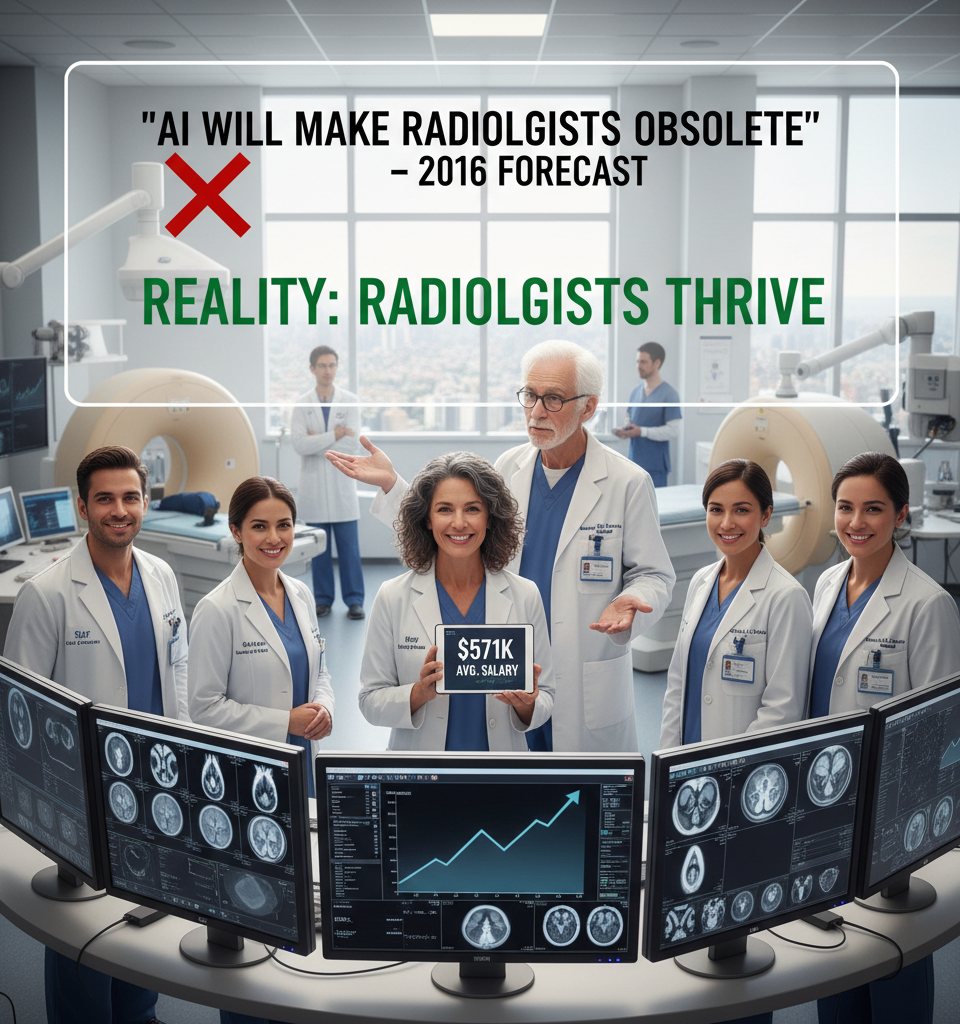
In a striking turn of events that confounds past predictions, the field of radiology is experiencing unprecedented growth in demand and compensation, with salaries for some specialists now reaching an astonishing $571,000 annually. This surge directly contradicts a decade-old projection by Dr. Geoffrey Hinton, often hailed as the 'Godfather of AI,' who famously warned in 2016 that deep learning would render radiologists obsolete within five to ten years. Instead, the medical imaging sector is grappling with a severe shortage of skilled professionals, underscoring the enduring and evolving necessity of human judgment in parallel with technological advancements.
The AI Prophecy and Its Refutation
Dr. Hinton's 2016 assertion envisioned a future where AI algorithms could interpret medical images with superior accuracy and speed, thereby displacing human radiologists. However, that future has not materialised as anticipated. While AI tools have indeed begun to augment radiological work, primarily in tasks such as abnormality detection, measurement, and workflow optimization, they have not replaced the nuanced diagnostic skills, patient interaction, and interdisciplinary collaboration inherent to the profession. The human element, including the ability to contextualize findings, manage complex cases, and communicate with patients and other clinicians, remains indispensable.
Escalating Demand and Remuneration
The current landscape paints a stark contrast to Hinton's forecast. Data from various medical staffing agencies and industry reports indicates a significant uptick in demand for radiologists across North America and Europe. According to recent surveys, average radiologist salaries have climbed steadily, with some highly specialized and experienced professionals commanding over half a million dollars. For instance, a report earlier this year highlighted a rise in average radiologist compensation by 4.8% year-over-year, reaching well into the high $400,000s, with top earners significantly exceeding this figure. This financial upswing is a direct consequence of escalating patient volumes, an aging global population requiring more imaging services, and the sheer complexity of modern diagnostic procedures.
Industry and Market Dynamics
This robust demand is creating a highly competitive market for radiological talent, leading hospitals, imaging centers, and private practices to offer lucrative recruitment packages and retention bonuses. The integration of AI has, counterintuitively, often increased the efficiency and throughput of radiologists, allowing them to handle more cases and focus on more intricate diagnoses rather than mundane tasks. Instead of automation leading to job displacement, it has fostered a synergistic relationship, where AI acts as a sophisticated assistant, enhancing human capability rather than supplanting it. This dynamic has reshaped training programs, with a greater emphasis on interpreting AI outputs and leveraging advanced analytics.
Expert Perspectives on Human-AI Collaboration
Economists and healthcare futurists now largely agree that fears of widespread job displacement due to AI were, in many sectors, overblown, particularly in highly specialized fields like medicine. Dr. David Autor, an economist known for his work on the future of work, has frequently argued that AI is more likely to complement human labor than fully substitute it, especially in roles requiring judgment, creativity, and interpersonal skills. “As long as AI doesn't make this quantum leap of becoming sort of AGI [Artificial General Intelligence],” most jobs are going to be reasonably safe, he stated recently. This sentiment echoes throughout the medical community, where AI is seen as a tool for precision and efficiency, not a physician replacement.
The Path Forward: Integration and Specialization
The future of radiology will likely involve an even deeper integration of AI, but always in support of human expertise. Upcoming developments include more sophisticated AI algorithms for predictive analytics, personalized treatment planning based on imaging, and enhanced capabilities for remote diagnostics. Radiologists of the future will need to be adept at utilizing these advanced tools, understanding their limitations, and continuously adapting their skills. The role will evolve, becoming more specialized and consultative, focusing on the interpretation of increasingly complex data sets and the ethical implications of AI-driven healthcare. This trajectory suggests that human radiologists will remain at the core of medical imaging, their value enhanced by technological partners.
Addressing the Workforce Shortage
The ongoing shortage of radiologists presents a critical challenge for healthcare systems globally. Efforts to address this include increasing the capacity of medical residency programs, promoting radiology as a career path earlier in medical education, and exploring innovative staffing models, such as teleradiology, to distribute expertise more efficiently. The financial incentives, while substantial, also reflect the intense demand and the critical nature of the work. As healthcare systems continue to battle rising patient needs and an aging workforce, the strategic role of well-compensated and highly skilled radiologists, augmented by AI, will only grow in importance.