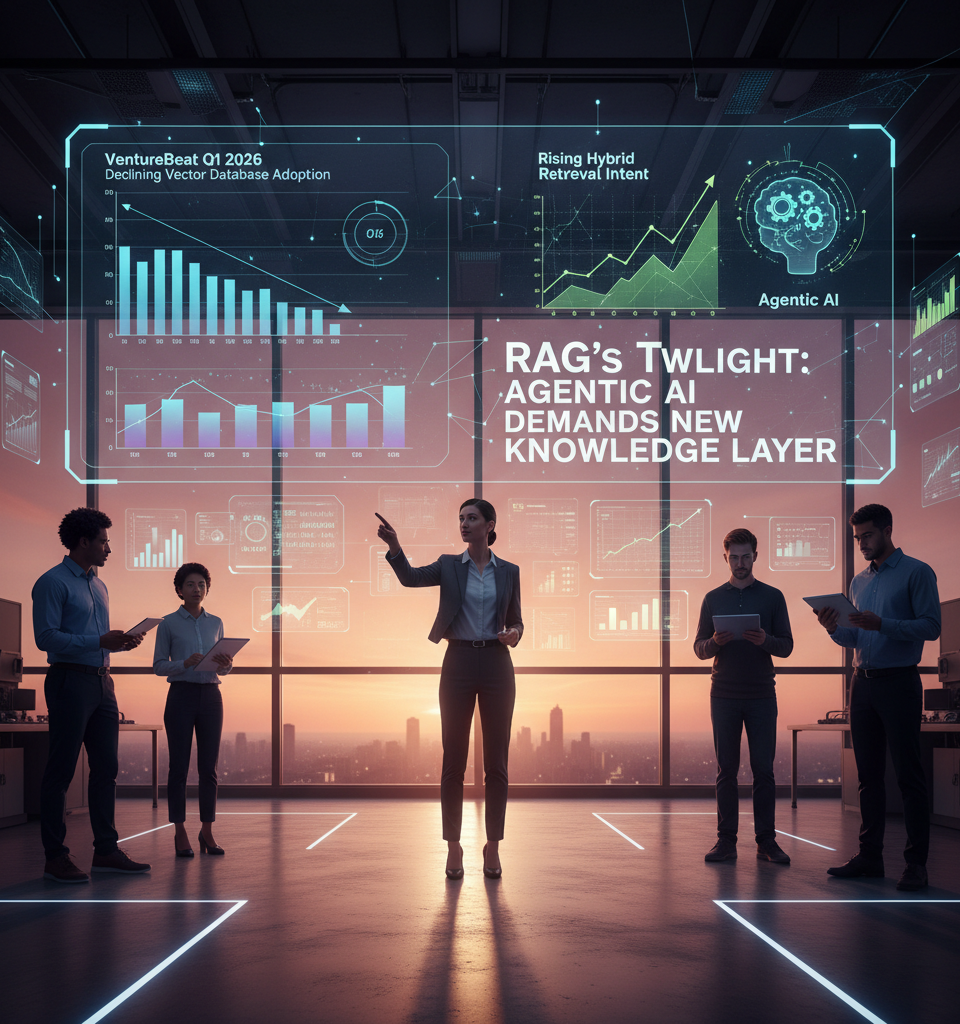
The foundational approach to knowledge integration within artificial intelligence, particularly the Retrieval-Augmented Generation (RAG) framework, is undergoing a profound transformation. As agentic AI systems become more autonomous and task-oriented, their requirements for contextual understanding and dynamic knowledge access are superseding the capabilities of the conventional RAG-to-vector database pipeline. This significant industry shift, highlighted by VentureBeat's Q1 2026 Pulse survey, indicates a rapid re-evaluation of data infrastructure crucial for the next generation of AI.
The Limitations of Legacy RAG
For a considerable period, RAG provided an effective solution for grounding large language models (LLMs) with external knowledge, mitigating hallucinations and enhancing factual accuracy. The process typically involved embedding documents into vector representations stored in a vector database, then retrieving relevant snippets based on query similarity. However, this architecture, while groundbreaking, struggles with the complex, multi-step reasoning and dynamic context switching inherent in agentic AI. Agentic systems perform sequences of actions, interact with diverse tools, and maintain persistent states across various tasks, demanding a knowledge layer that can compile, synthesize, and adapt information in real-time, far beyond simple retrieval.
Shifting Market Dynamics
The VentureBeat Q1 2026 Pulse survey provides compelling evidence of this paradigm shift. Data indicates a clear decline in adoption for standalone vector database products, signaling that the market is moving past a phase where these tools were viewed as sufficient for AI knowledge management. Conversely, the intent for hybrid retrieval solutions has soared, tripling to 33.3%, making it the fastest-growing strategic approach in the dataset. This shift underscores a recognition that simpler vector search alone can no longer meet the sophisticated demands of agentic AI. Pioneering vector database companies are now re-strategizing, focusing on broader 'knowledge layer' platforms rather than singular database functions.
The Rise of Compilation-Stage Knowledge Layers
The emerging solution involves a compilation-stage knowledge layer, an architecture designed to understand and process context dynamically, rather than merely retrieving static information. This new layer moves beyond simple data retrieval to incorporate reasoning, synthesis, and adaptive learning directly into the knowledge acquisition process. It allows agentic AI to not only recall facts but also to understand relationships, apply logic, and generate new insights based on a more holistic and integrated view of information. This includes combining structured and unstructured data, incorporating real-time feedback, and managing the provenance and trustworthiness of information sources.
Industry and Market Implications
This transition has significant implications across the AI ecosystem. Software vendors specializing in vector databases must innovate quickly, expanding their offerings to become comprehensive knowledge platforms. Developers of agentic AI systems will gain more powerful tools for creating intelligent agents capable of more complex and reliable operations. Furthermore, enterprises deploying AI will need to re-evaluate their data infrastructure strategies, potentially investing in new technologies that support these advanced knowledge layers. The market for AI infrastructure is poised for substantial disruption and growth, with new categories of tools and services expected to emerge.
Expert Perspectives on the Evolution
Industry analysts concur with the survey's findings, emphasizing the evolutionary necessity of this shift. "The RAG paradigm served its purpose, but agentic AI requires a more 'cognitive' approach to knowledge," explains Dr. Anya Sharma, lead AI architect at Synapse Tech. "It's not just about finding answers; it's about understanding the nuances of the question, the context of the task, and knowing how to synthesize dispersed information into actionable insights. This necessitates a knowledge layer with compilation capabilities, not just retrieval." She highlights that companies failing to adapt risk falling behind in the rapidly advancing AI landscape.
The Road Ahead: Integrated Intelligence
Looking ahead, the development of these compilation-stage knowledge layers will likely focus on deeper integration with AI agents, autonomous data curation, and advanced reasoning capabilities. Future iterations could involve AI-driven knowledge graphs that dynamically update and enrich themselves, sophisticated semantic parsers that extract deeper meaning from data, and frameworks for automated knowledge validation. The ultimate goal is to create a seamless, intelligent layer that empowers agentic AI to perform with human-like understanding and adaptability across an ever-expanding array of complex tasks. This marks a pivotal step towards truly intelligent automation and decision-making systems.