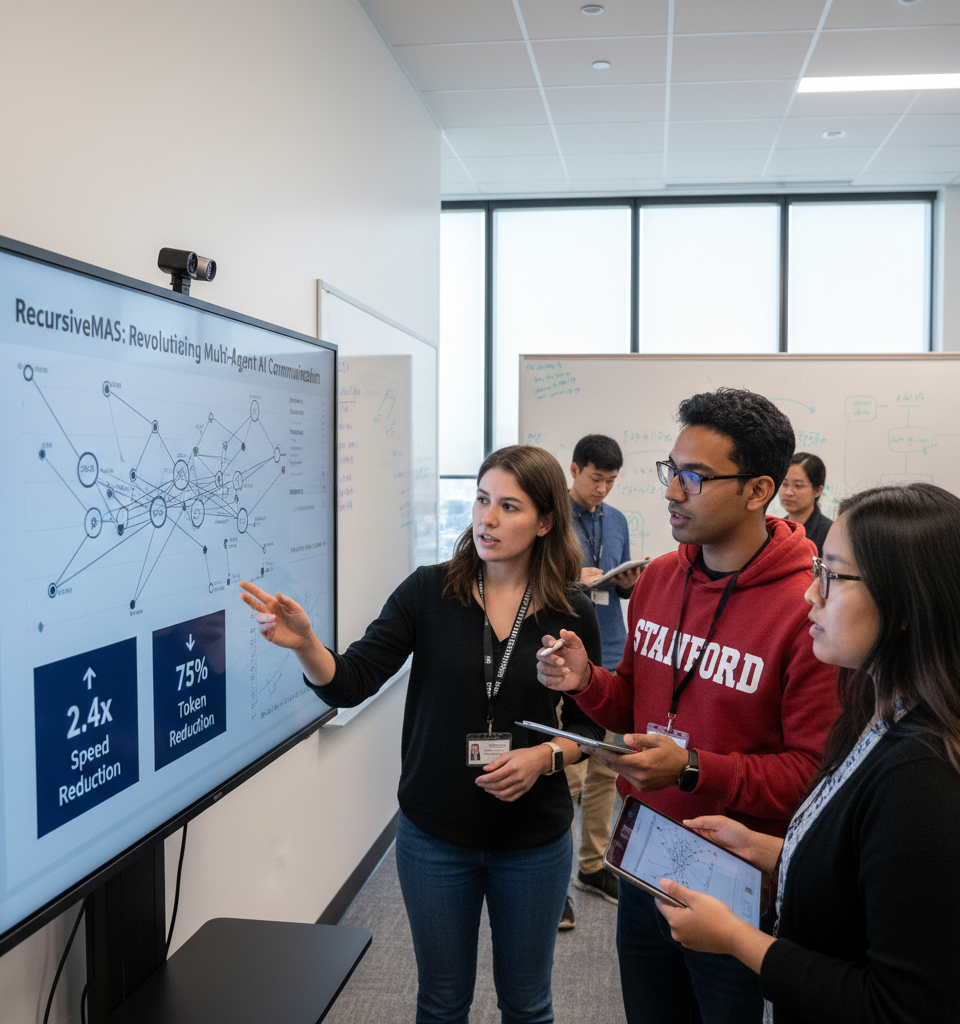
Researchers from the University of Illinois Urbana-Champaign and Stanford University have unveiled RecursiveMAS, a novel framework designed to overcome significant limitations in multi-agent artificial intelligence systems. This innovative approach accelerates multi-agent inference by an impressive 2.4 times and slashes token usage by 75%, fundamentally changing how AI agents collaborate. The key differentiator lies in its ability to facilitate communication through embedding space rather than the more traditional, resource-intensive generation and sharing of text sequences.
The Bottleneck of Text-Based AI Communication
The current paradigm for multi-agent AI systems, where agents communicate by generating and exchanging text, has presented substantial hurdles to their scalability and efficiency. This text-centric communication inherently introduces significant latency, inflates operational costs duepecifically token usage fees for large language models, and complicates the cohesive training and optimization of an entire multi-agent system. These challenges have effectively capped the complexity and responsiveness of collaborative AI endeavors, hindering their deployment in real-world, high-stakes applications.
RecursiveMAS: A Paradigm Shift to Embedding Space
RecursiveMAS tackles these issues head-on by enabling agents to transmit and receive information directly through embedding space. In simple terms, instead of converting complex thoughts or observations into lengthy text strings, agents condense this information into dense numerical representations (embeddings) that can be processed much more efficiently. This method not only reduces the volume of data transferred but also maintains the rich semantic content necessary for effective collaboration. The framework also integrates a recursive summarization mechanism, allowing agents to iteratively refine and distill information, further optimizing their communication bandwidth.
Unprecedented Efficiency Gains and Cost Reductions
Laboratory tests and evaluations have demonstrated the profound impact of RecursiveMAS. The reported 2.4x speedup in multi-agent inference means that complex tasks requiring coordination among multiple AI entities can be completed significantly faster, opening doors for applications demanding real-time decision-making. Concurrently, the 75% reduction in token usage translates directly into substantial cost savings for organizations deploying and operating these systems, especially given the rising expenditure associated with API calls to powerful LLMs like GPT-4 or Claude. These efficiency gains are crucial for making advanced multi-agent AI economically viable for a broader range of enterprises.
Reshaping the AI Landscape
This breakthrough is poised to have a transformative impact across various sectors. In areas like complex scientific simulations, autonomous systems coordination, financial market analysis, and even interactive gaming, RecursiveMAS could enable more sophisticated, responsive, and cost-effective AI solutions. The ability to manage information exchange more efficiently will allow for the development of multi-agent systems with more agents, deeper interactions, and greater overall intelligence, pushing the boundaries of what collaborative AI can achieve. It reduces the barrier to entry for smaller firms or research groups who might previously have been priced out by high token costs.
Expert Commentary on the Innovation
Industry analysts and AI researchers are cautiously optimistic about RecursiveMAS. "This shift from symbolic text to dense embeddings for inter-agent communication is a logical and powerful evolution," noted Dr. Evelyn Reed, a lead AI architect at a prominent Silicon Valley firm. "It addresses core architectural limitations and offers a path to truly scalable multi-agent systems that were previously computationally intractable or prohibitively expensive. The integration of recursive summarization is particularly clever, extracting the signal from the noise effectively." Experts suggest that while the initial results are promising, real-world deployment challenges, such as handling diverse agent architectures and ensuring robust error correction within embedding space, will be key to its widespread adoption.
The Road Ahead for Multi-Agent AI
Looking forward, the development team intends to further refine RecursiveMAS, exploring its application in even more complex, dynamic multi-agent environments. They are particularly interested in investigating how the framework can improve the learning capabilities of multi-agent systems, allowing agents to learn more effectively from each other without incurring massive communication overhead. Future research will also likely focus on integrating RecursiveMAS with various large language models and exploring its potential for creating more robust and generalizable AI societies capable of tackling grand societal challenges. The path is now clearer for more sophisticated, interconnected AI systems to emerge, promising a new era of collaborative artificial intelligence.