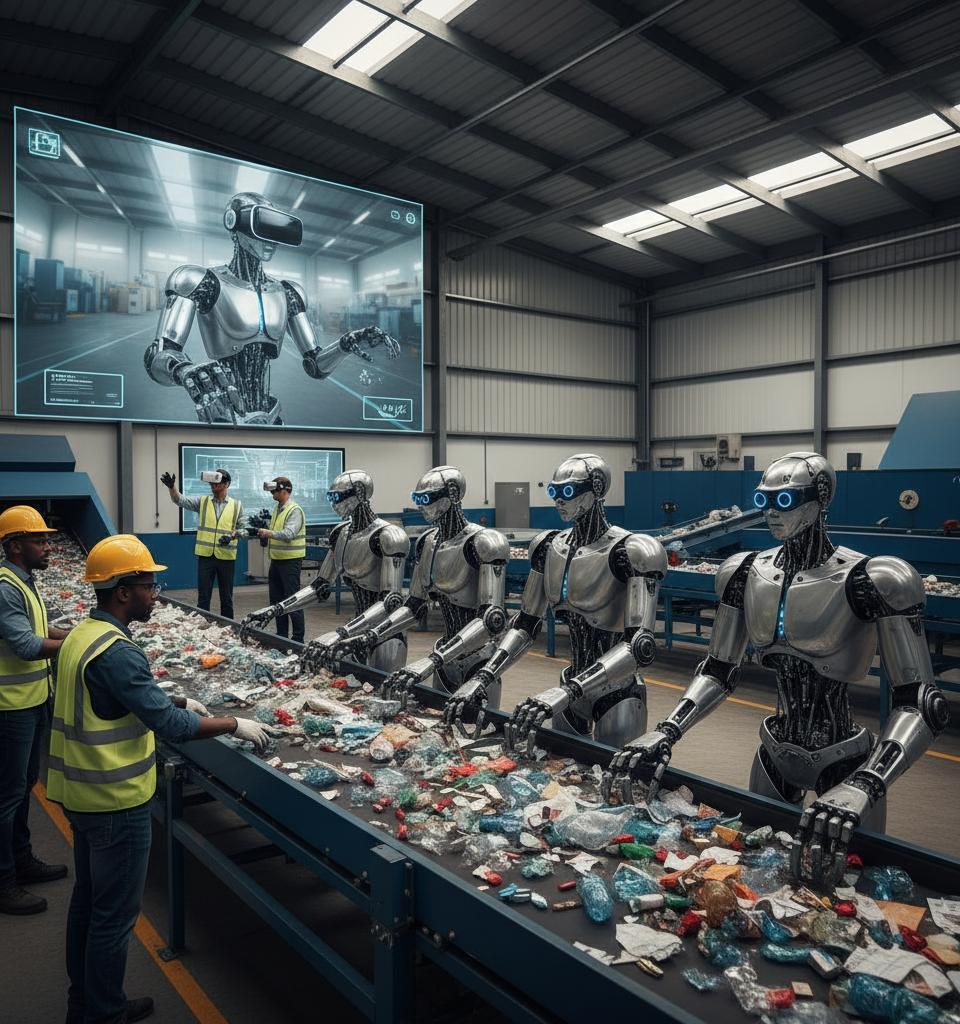
The recycling industry is confronting a profound labor crisis, characterized by an unsustainable 40% annual staff turnover rate at waste sorting facilities. This churn, coupled with a fatality rate eight times the national average across all industries and work-related injury and ill-health statistics 45% higher than other sectors, underscores the critical need for transformative solutions. In response, a novel approach involving humanoid robots, trained through virtual reality (VR) headsets, is being introduced as a potential permanent replacement for human labor in these challenging environments.
The Deep-Rooted Labor Problem
The challenges within the recycling workforce are multifaceted and long-standing. Manual waste sorting is inherently arduous, often involving exposure to hazardous materials, unpleasant odors, and repetitive strain injuries. The high turnover rate not only disrupts operations but also imposes significant financial burdens on companies through constant recruitment and training costs. Furthermore, the elevated risks to worker health and safety create an ethical imperative for innovation, pushing the industry to seek alternatives that can alleviate human exposure to these dangers.
VR-Trained Robotics: A Paradigm Shift
The proposed solution leverages advanced robotics and virtual reality. Humanoid robots are being developed and programmed to perform the intricate tasks of waste identification and sorting. Crucially, their training regimen incorporates VR headsets, allowing human operators to virtually 'teach' the robots by demonstrating sorting procedures in a simulated environment. This method offers a safe and efficient way to transfer complex human cognitive and motor skills directly to machines, bypassing traditional, time-consuming programming. Companies are investing millions in this technology, anticipating a significant return on investment through reduced labor costs, increased efficiency, and improved safety records.
Economic and Operational Impact
Beyond addressing the labor shortage, the deployment of VR-trained humanoid robots is expected to have a profound impact on the recycling industry's economics and efficiency. Robots can operate continuously, 24/7, without succumbing to fatigue, breaks, or human error, potentially boosting sorting accuracy and throughput. This consistent performance could lead to higher purity rates for recycled materials, thereby increasing their market value and strengthening the circular economy. Early projections suggest that such automation could reduce operational costs by up to 30-40% over several years, offsetting the initial capital expenditure.
Expert Perspectives
Industry analysts and robotic experts largely view this robotic integration as an inevitable and necessary evolution. Dr. Elena Petrova, a leading roboticist specializing in industrial automation, states, "The application of VR-driven training for humanoid robots in such a high-risk, high-turnover sector is a game-changer. It not only provides a sustainable workforce solution but also sets a new precedent for human-robot collaboration, where humans are elevated from arduous manual labor to roles of supervision and instruction." However, concerns regarding job displacement are also being raised, prompting discussions about retraining initiatives for displaced workers.
The Road Ahead
While promising, the full-scale implementation of these robotic systems will require significant infrastructure investment and technological refinement. Initial pilot programs are underway in several European countries, with some facilities reporting promising early results in efficiency gains and reduced human intervention. The next phase involves scaling these technologies across more facilities globally, alongside developing standards for robotic performance and safety in waste management. The long-term vision includes creating fully automated, lights-out recycling plants, marking a new era for an industry often seen as lagging in technological adoption.
Social and Ethical Considerations
The introduction of AI and robotics on this scale also brings forth important social and ethical considerations. Questions surrounding the future of human employment in these sectors, the equitable distribution of benefits from automation, and the potential for new types of skilled jobs (e.g., robot maintenance, VR trainers) are critical. Policymakers and industry leaders will need to work in tandem to navigate these transformations, ensuring a just transition for the workforce and maximizing the environmental benefits of advanced recycling technologies.