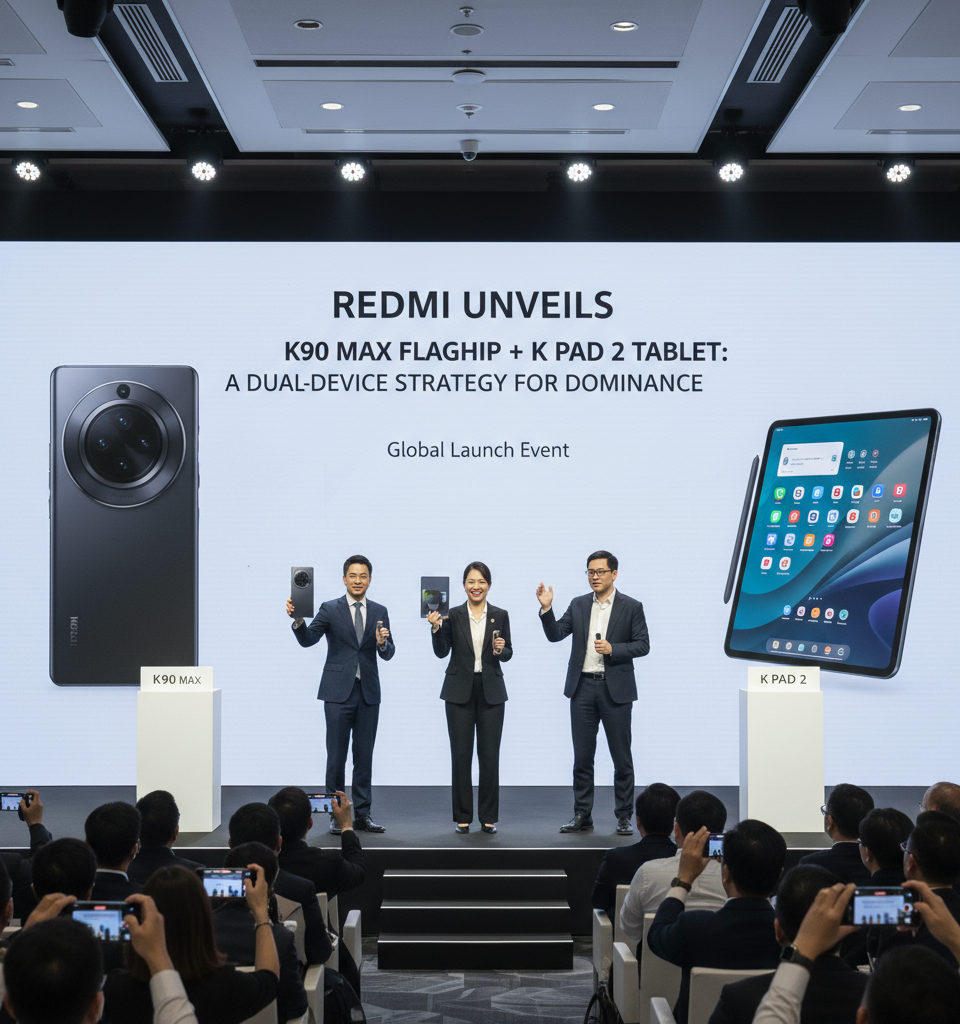
SHENZHEN, CHINA – Redmi, the fiercely competitive sub-brand of Xiaomi, has officially revealed the design and imminent launch of its flagship K90 Max smartphone, slated to debut alongside the all-new K Pad 2 tablet. This strategic dual-launch event, expected in the coming weeks, marks a significant push by Redmi to capture greater market share in both the high-performance smartphone and productivity-focused tablet segments, setting the stage for an aggressive posture against rivals in the mid-to-premium range.
This simultaneous unveiling is more than just a product release; it represents a calculated maneuver by Redmi to broaden its product ecosystem and appeal to a wider demographic. Historically, Redmi has been synonymous with value-for-money propositions, particularly in emerging markets. The K series, however, has increasingly aimed at the performance-centric user, offering specifications often found in far more expensive devices. The addition of the K Pad 2 suggests an ambition to integrate its hardware offerings, potentially creating a seamless user experience across devices and competing more directly with integrated ecosystems like Apple's and Samsung's.
While detailed specifications remain under wraps, the official design reveal of the K90 Max hints at a premium aesthetic, likely featuring advanced camera modules and a sleek form factor consistent with contemporary flagship trends. The K Pad 2, conversely, is expected to offer a compelling blend of entertainment and productivity, positioning itself as a viable alternative in a tablet market that has seen renewed interest, particularly post-pandemic. Industry insiders anticipate the K90 Max to be powered by a top-tier Qualcomm Snapdragon or MediaTek Dimensity chipset, coupled with rapid charging capabilities and a high refresh rate display, maintaining Redmi's tradition of pushing performance boundaries at accessible price points. Preliminary leaks suggest the K90 Max could target a starting price point of approximately $450 - $550, while the K Pad 2 might enter the market around $250 - $350, significantly undercutting many premium competitors.
The impact on the broader electronics market is expected to be considerable. Redmi’s aggressive pricing strategy, combined with high-end specifications, consistently pressures competitors like Samsung, OnePlus, and even Xiaomi's main line to re-evaluate their own pricing and feature roadmaps. The K Pad 2’s entry into the tablet space, a category dominated by Apple and Samsung, could inject much-needed competition, potentially leading to more innovation and better value for consumers. In 2023, the global tablet market saw shipments of around 130 million units, with Android tablets accounting for roughly 45%. Redmi's entry could significantly boost Android's share, particularly in Asian markets.
Technology analysts are weighing in on Redmi's strategic move. Dr. Annelise Huang, a lead analyst at TechInsights, remarked, "Redmi's dual-pronged launch of the K90 Max and K Pad 2 is a shrewd play. It's not just about individual devices, but about strengthening their ecosystem play. By offering compelling options in both premium smartphones and affordable tablets, they're catering to diverse user needs and potentially locking in customers within their brand ecosystem. The K90 Max will likely be a performance-per-dollar leader, while the K Pad 2 could disrupt the mid-range tablet sector, which has been ripe for innovation and better pricing." She further elaborated that this strategy could lead to a 'halo effect,' where the success of one product boosts the perception and sales of the other.
Looking ahead, the success of the K90 Max and K Pad 2 will depend not only on initial sales figures but also on long-term software support, ecosystem integration, and market perception. Xiaomi's broader strategy, including its IoT devices and smart home products, will play a crucial role in creating a cohesive user experience around these new devices. Continued investment in R&D and supply chain optimization will be critical for Redmi to sustain its aggressive pricing and feature sets. The launch event itself, expected to be a global affair, will likely detail robust software features, AI enhancements, and specific regional availability, as Redmi targets its key markets across Asia, Europe, and Latin America. The industry will be closely watching how these new devices perform against incumbent leaders and whether Redmi can truly solidify its position across multiple competitive fronts.