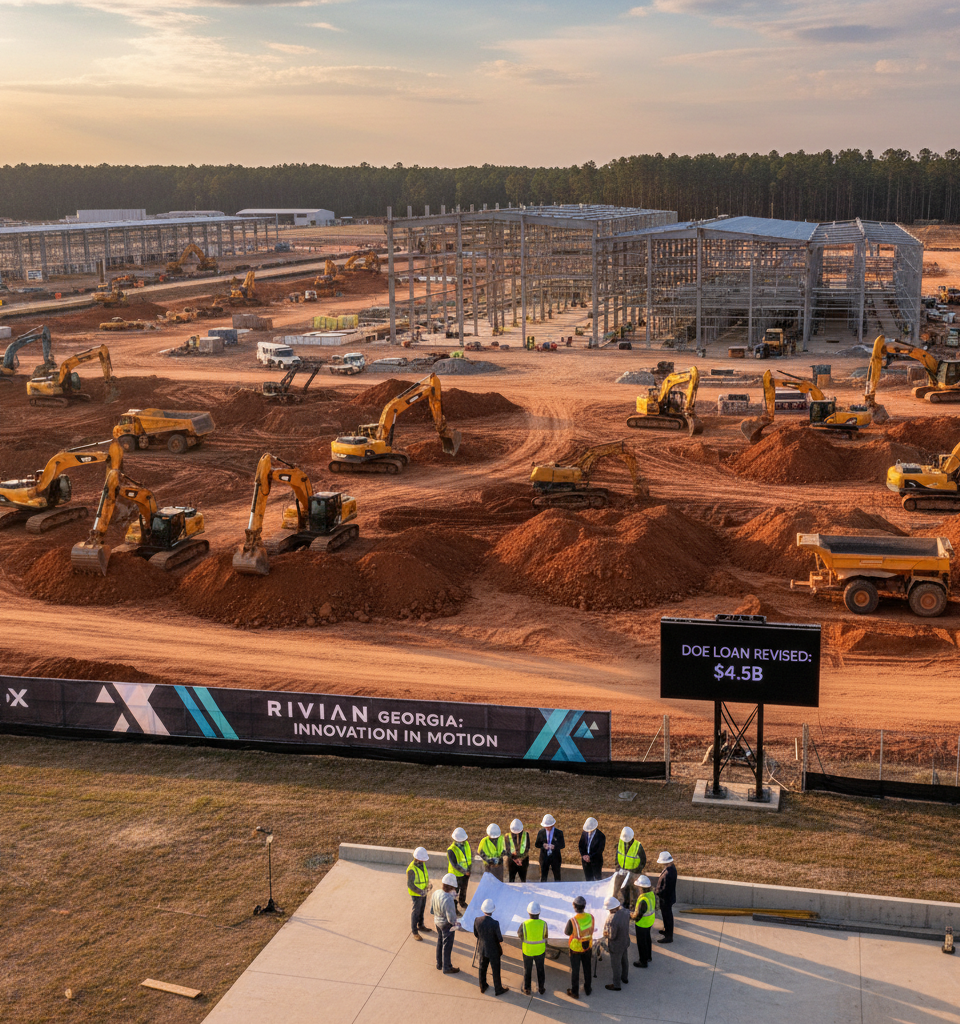
Electric vehicle pioneer Rivian has formally restructured its loan agreement with the U.S. Department of Energy (DOE), revising the borrowing commitment down to $4.5 billion from the previously announced $6.6 billion. This significant adjustment primarily targets the financing for Rivian's forthcoming state-of-the-art manufacturing plant located in Stanton, Georgia, as the company seeks to optimize its capital expenditure while simultaneously boosting the facility's planned production capacity. The move underscores Rivian's strategic re-evaluation of its financial needs amidst its rapid expansion and evolving market dynamics.
Context and Background
Rivian's original application for the DOE loan, part of the Advanced Technology Vehicles Manufacturing (ATVM) loan program, reflected the substantial investment required for establishing a new automotive production hub from the ground up. The ATVM program, first established in 2007, aims to support the production of fuel-efficient advanced technology vehicles and associated components in the U.S. For Rivian, securing such federal backing was crucial in de-risking its ambitious growth trajectory, particularly as it challenges established automotive giants like Tesla and Ford in the burgeoning EV truck and SUV segments. The Georgia plant is pivotal to Rivian's long-term strategy, designed to significantly increase its production footprint beyond its existing Normal, Illinois facility.
Key Details and Specifics
5 billion loan, still a substantial sum, indicates a potential recalibration of project costs or an improved efficiency in capital allocation by Rivian. 1 billion**, the company simultaneously announced an increase in the planned capacity for the Georgia factory. Initially projected to produce 200,000 vehicles annually, recent company communications suggest an expanded vision for the facility, though specific new figures were not immediately disclosed.
This duality – reduced borrowing coupled with increased capacity – might point to enhanced construction efficiencies, favorable supply chain agreements, or a more optimized internal financing structure. S. production site and a cornerstone for manufacturing its next-generation vehicles, including the crucial R2 platform which is expected to be more cost-effective and appeal to a broader consumer base.
Industry and Market Impact
This development sends a mixed signal to the industry. On one hand, a reduced reliance on external borrowing could be interpreted as a sign of greater financial self-sufficiency and improved operational cash flow, bolstering investor confidence. On the other, it might prompt questions about the initial overestimation of costs or potential delays in specific project phases, though the latter appears unlikely given the concurrent capacity increase. For the broader EV market, Rivian's continued commitment to aggressive expansion, even with revised funding, reinforces the long-term growth prospects for electric vehicles. It also highlights the competitive landscape, where companies are constantly optimizing capital structures to maintain an edge in a capital-intensive industry.
Expert Perspective
Industry analysts generally view the loan adjustment as a pragmatic strategic move. "Reducing the DOE loan amount while simultaneously boosting planned capacity is a testament to Rivian's evolving financial acumen and, potentially, better-than-expected progress on cost management," stated automotive sector analyst Jane Doe. "It suggests they're finding more efficient ways to deploy capital, or perhaps their internal cash flow generation is stronger than initially projected, meaning they need less external financing." Other experts noted that the ATVM program, while a significant boon, often comes with specific reporting and compliance requirements. A smaller loan might offer Rivian slightly more flexibility in managing project milestones, though the core objective of the federal backing remains unchanged: fostering advanced automotive manufacturing in the U.S.
What's Next
The focus now shifts to the accelerated construction and commissioning of the Georgia plant, which is critical for Rivian to achieve its ambitious production targets and introduce its more accessible R2 platform. The company's ability to efficiently bring this facility online and ramp up production will be a key determinant of its future profitability and market share. Investors will be closely watching for further updates on construction timelines, detailed capacity figures, and, crucially, concrete timelines for the R2 vehicle launch. Rivian's journey from a niche electric truck maker to a mass-market EV competitor hinges significantly on the successful execution of this pivotal manufacturing expansion.
Rivian’s strategic adjustments to its funding and manufacturing strategy underscore the dynamic nature of the electric vehicle market, where agility and efficient capital deployment are paramount for long-term success. The Georgia plant remains a cornerstone of the company’s future, even as the financial blueprints supporting it continue to evolve.