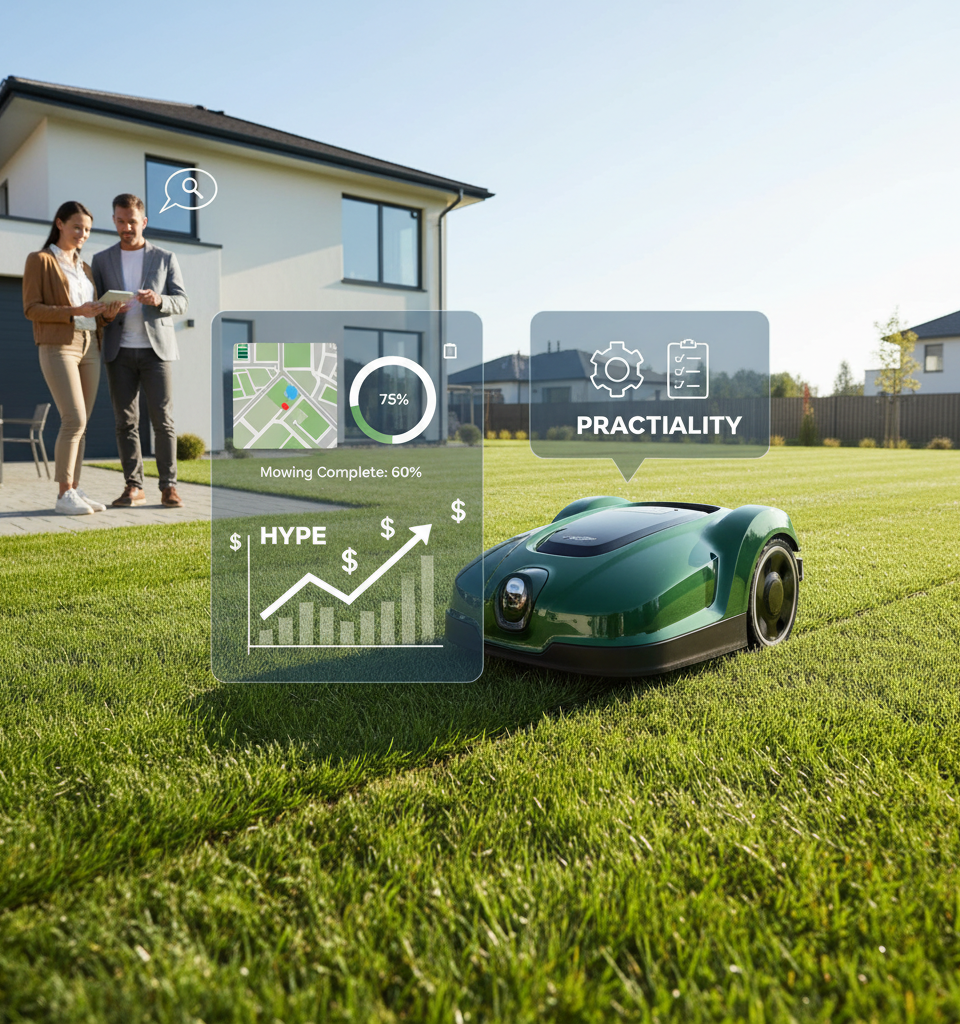
The burgeoning market for robotic lawn mowers, once a niche luxury, is rapidly becoming a mainstream consumer electronics category, offering convenience and automation for household lawn care. However, this expansion has brought a proliferation of technical specifications, some of which are proving to be more marketing puffery than genuinely useful metrics for the average homeowner. This report aims to guide consumers through the complex landscape of robot mower features, highlighting which specifications genuinely contribute to performance and satisfaction, and which can safely be ignored.
The Surge in Robotic Automation and Consumer Confusion
The landscape of home automation has seen significant growth in recent years, with robotic devices moving beyond cleaning floors to encompass outdoor tasks like lawn maintenance. The global robotic lawn mower market, valued at approximately $1.9 billion in 2023, is projected to reach $4.5 billion by 2030, according to market research firm Grand View Research. This rapid expansion means more models, more features, and, consequently, more potential for consumer confusion. Early adopters often focused on basic functionality, but now manufacturers are competing on a dizzying array of technical metrics, from cutting width to battery chemistry, not all of which translate directly to real-world performance or value for the typical homeowner.
Deciphering Key Specifications: What Really Matters
When evaluating a robotic lawn mower, several specifications are paramount. Terrain handling and slope capability are critical, especially for diverse or undulating yards. A mower's ability to navigate inclines of up to 20-25 degrees (approximately 36-47%) is often sufficient for most residential properties.
Battery life and charging time are also vital, impacting the mower's operational efficiency and ability to cover larger areas without frequent recharging. Lithium-ion batteries offering 2-4 hours of run time per charge and recharging in 60-90 minutes are generally preferred. More controversial are metrics like cutting width beyond a certain point, or claims of exaggerated AI navigation in systems that often rely on simpler boundary wires or GPS.
For instance, a cutting width exceeding 8-10 inches might offer marginal time savings for most residential plots but comes with increased cost and potentially less maneuverability.
Market Impact and Manufacturer Strategies
Manufacturers often leverage a 'more is better' marketing strategy, amplifying specifications that may not offer proportional benefits to the end-user. This can lead to increased product costs without significant improvement in performance or user experience for the typical lawn. Brands like Husqvarna, Robomow, and Worx continue to dominate the market, but newer entrants are trying to differentiate through niche features or lower price points. The emphasis on smart home integration, app connectivity, and advanced scheduling features is genuinely beneficial, offering users greater control and convenience. However, features like sub-centimeter GPS accuracy for residential use, while technologically impressive, often exceed practical requirements for simply maintaining a lawn and primarily serve as premium selling points.
Expert Insights on Consumer Priorities
Industry analysts emphasize that consumers should prioritize reliability, ease of setup, and effective customer support over raw, often abstract, technical figures. "The 'set it and forget it' promise of robot mowers is only realized when the core functionalities work flawlessly," says Dr. Eleanor Vance, a consumer robotics expert. "Sophisticated AI algorithms that struggle with basic pathfinding or frequently get stuck are far less valuable than a robust motor and intuitive controls." She adds that durability and weather resistance (e.g., IPX4 or higher ratings) are often overlooked but crucial for outdoor devices, ensuring longevity in varied climatic conditions.
The Evolving Landscape: Future Trends and Consumer Outlook
The future of robotic lawn mowers will likely see continued refinement in navigation technology, potentially moving towards more vision-based systems that eliminate the need for perimeter wires. However, the core challenges of battery efficiency, terrain management, and cost-effectiveness will remain central. Manufacturers are expected to focus on enhancing user experience through more seamless integration with other smart home systems and improved fault detection. For consumers, the takeaway is clear: understanding one's specific lawn needs—size, slope, obstacles—and matching those to genuinely relevant specifications will be key. Discerning meaningful innovations from marketing hyperbole will not only save money but also ensure a satisfactory, hassle-free lawn care experience in the years to come.