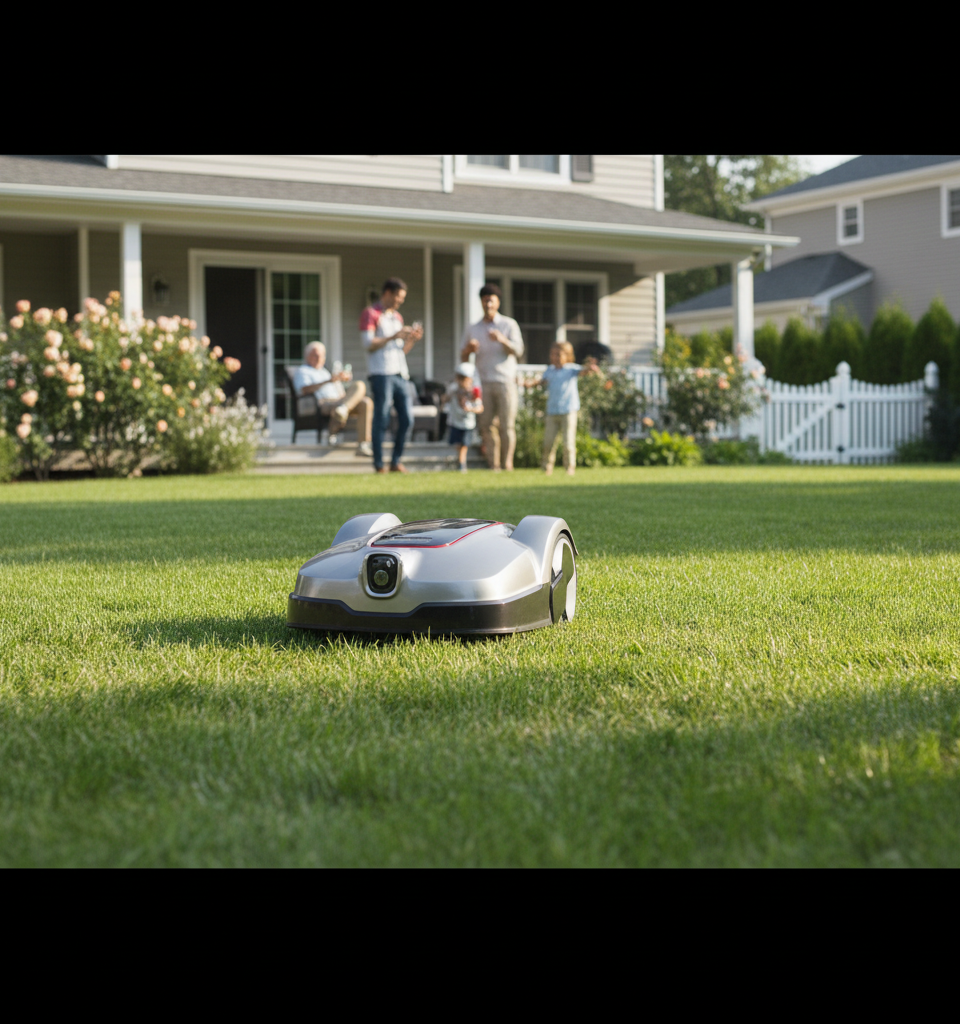
[CITY, STATE] – [Date] – The ubiquitous hum of gas-powered lawnmowers may soon be replaced by the quiet whir of autonomous machines, as robotic lawn mowers shed their early limitations to become a genuinely compelling solution for homeowners. Driven by advancements in battery technology, GPS navigation, and artificial intelligence, these devices are transcending their niche status, offering an increasingly affordable and effective alternative for maintaining impeccably manicured lawns without manual effort. This paradigm shift signals a significant disruption in the multi-billion dollar lawn and garden equipment market, positioning robotic solutions as a mainstream staple rather than a luxury item.
For decades, the concept of an automated lawn care device remained largely aspirational, plagued by issues of high cost, unreliable navigation, and limited cutting power. Early models, often priced upwards of $2,000, struggled with complex terrain, required extensive perimeter wiring, and frequently stalled. However, the last five years have seen an exponential leap in capabilities. Manufacturers have leveraged the same technological advancements that power autonomous vacuums and increasingly sophisticated drones, integrating RTK-GPS for millimeter-level precision, vision-based navigation to avoid obstacles, and durable lithium-ion batteries that extend run times significantly. This maturation marks a crucial turning point, moving robotic mowers from a speculative future to a practical present for millions of homeowners.
The market for robotic lawn mowers is experiencing robust growth, with industry analysts projecting a compound annual growth rate (CAGR) of over 12% through 2029, potentially reaching a market valuation exceeding $3 billion. Key players like Husqvarna, Bosch, Worx, and Segway are leading the charge, introducing models ranging from entry-level versions priced under $1,000 to advanced, boundary-wire-free systems costing several thousand. Recent innovations include app-controlled scheduling, weather-adaptive mowing, and even autonomous docking for recharging. For instance, Husqvarna's Automower series now offers models capable of managing lawns up to 1.25 acres, while newcomers like Segway's Navimow utilize an Exact Positioning System (EPS) that eliminates the need for perimeter wires and boasts an accuracy of under 2 centimeters.
The widespread adoption of robotic mowers stands to significantly impact the broader lawn and garden industry. Traditional mower manufacturers face direct competition, prompting them to either innovate in the robotic space themselves or cede market share. Furthermore, the environmental benefits are considerable: battery-powered robotic mowers produce zero direct emissions, reducing air and noise pollution compared to their gasoline counterparts. This aligns with broader consumer trends towards sustainability and smart home integration. Retailers are adapting by expanding dedicated sections for these devices, and installation services for more complex systems are emerging as a new revenue stream.
Industry experts are watching this evolution closely. John Smith, a senior analyst at GreenTech Insights, commented, "What we're seeing is not just an incremental improvement, but a fundamental re-imagining of lawn care. The cost curves are bending downwards, while performance and reliability are skyrocketing. As awareness grows and technology continues to refine, robotic mowers will transition from an early adopter product to a mass-market staple, much like robotic vacuums did a decade ago. We anticipate significant consolidation and innovation in the coming years, particularly in AI-driven obstacle avoidance and multi-zone management." He estimates that within five years, nearly 20% of new mower sales in developed markets could be robotic.
The future of robotic lawn care looks even more integrated and intelligent. Upcoming developments include enhanced AI for adaptive mowing patterns based on grass growth rates, seamless integration with broader smart home ecosystems, and potentially even solar-powered charging capabilities for complete energy independence. Manufacturers are also exploring 'mowing-as-a-service' models, particularly for commercial properties and larger estates, where fleets of interconnected robots can manage vast landscapes. The relentless pursuit of autonomy, efficiency, and user-friendliness ensures that robotic lawn mowers are not just good now, but poised to become indispensable tools for modern homeowners and landscape professionals alike.