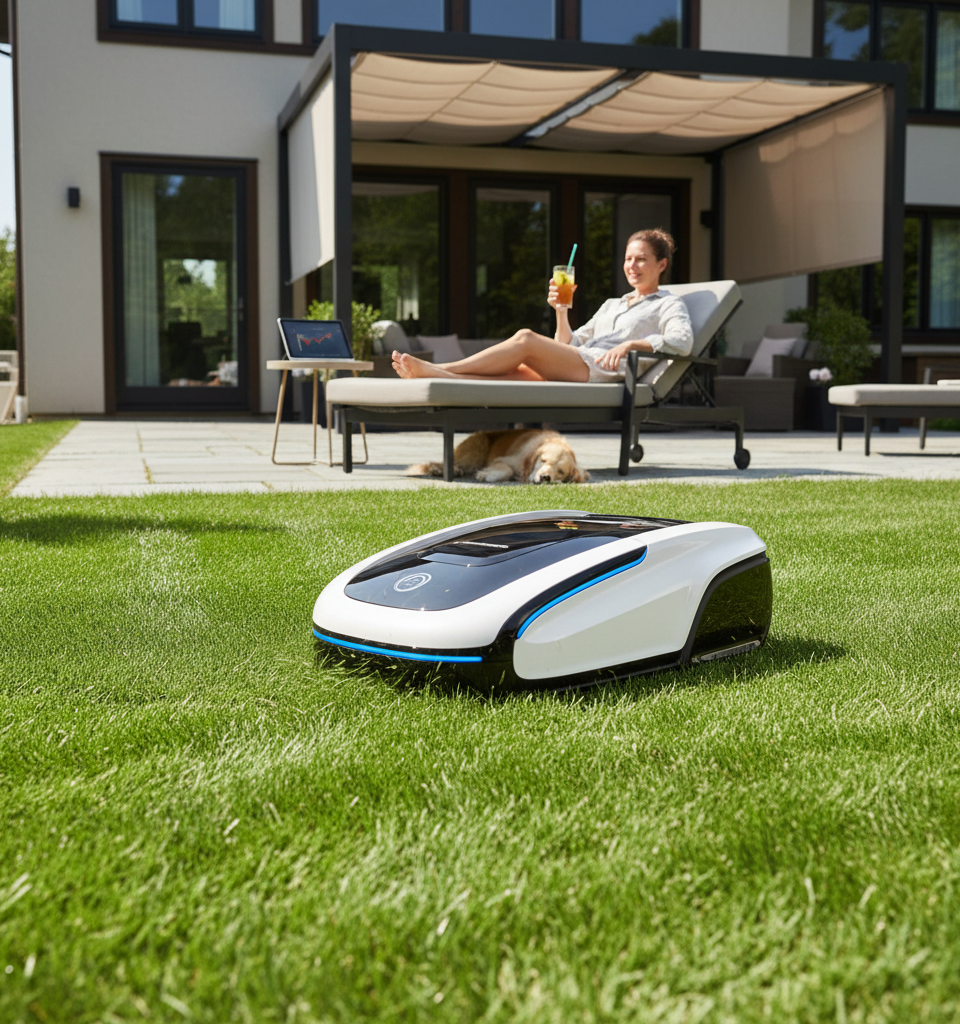
New reports confirm that robotic lawn mowers, initially viewed as niche luxury items, have by 2026 evolved into genuinely effective and reliable solutions for automated yard maintenance. This development signals a pivotal moment for consumer robotics and the landscaping industry, offering homeowners a compelling alternative to manual labor, provided they are willing to invest in the premium technology. Industry experts suggest this maturity is driven by significant advancements in AI, battery life, and durability, finally making the promise of a self-mowing lawn a practical reality for a growing segment of the population.
Historically, the concept of an autonomous lawnmower has captivated imaginations for decades, dating back to prototypes in the mid-20th century. However, early consumer models often suffered from a myriad of shortcomings, including unreliable navigation, limited battery life, and an inability to handle diverse terrain, relegating them to the realm of expensive novelties. The past five years, however, have seen a dramatic acceleration in technological innovation, with manufacturers investing heavily in R&D to overcome these limitations. This sustained effort has culminated in the high-performing models now available on the market, transforming them from futuristic gadgets into genuine labor-saving appliances.
Leading the charge are a select few models, identified through rigorous independent testing, that consistently deliver superior performance. These top-tier machines boast advanced features such as precise GPS-enabled navigation, ensuring comprehensive coverage and eliminating missed spots. They come equipped with robust, multi-sensor arrays that detect obstacles and boundary wires with enhanced accuracy, minimizing common issues like getting stuck or venturing beyond the lawn. Furthermore, improvements in lithium-ion battery technology now allow for extended operating times, often exceeding four hours on a single charge, and faster recharging cycles. Key statistics reveal that the average price for these high-performance models ranges from $1,500 to $3,500, a significant investment but balanced by projected lifespan improvements and reduced maintenance over manual alternatives.
This maturation of robotic lawn mowers is poised to have a substantial impact on the broader landscaping and smart home markets. For the landscaping sector, it presents both challenges and opportunities. While some traditional lawn care services may see a decrease in routine mowing contracts, there's a potential for new niches to emerge, such as robotic mower installation, maintenance, and advanced programming services. Within the smart home ecosystem, these devices are increasingly integrating with broader platforms, allowing for scheduling and monitoring via voice assistants or dedicated smartphone apps, further cementing their role as integral components of the connected home. The global robotic lawn mower market, which was valued at approximately $1.1 billion in 2023, is projected to reach $2.5 billion by 2028, according to market research firm Technavio, underscoring this growth trajectory.
Analysts are largely optimistic about the future of robotic lawn mowers. Dr. Elena Petrova, a leading robotics engineer at the Institute for Smart Automation, commented, "What we're seeing by 2026 is a critical inflection point. Manufacturers have finally cracked the code on reliability and user-friendliness, moving these devices from early adopter territory into the mainstream. The total cost of ownership, when factoring in time saved and potential property value additions, is becoming increasingly appealing." However, experts also caution that widespread adoption still hinges on continued price reductions and increased consumer education to overcome initial skepticism regarding upfront costs and perceived complexity.
Looking ahead, the next wave of innovation promises even greater autonomy and efficiency. Industry roadmaps suggest upcoming models will feature advanced AI for adaptive mowing patterns based on grass growth and weather conditions, as well as integrated vision systems for even more precise obstacle avoidance and edge detection. Further developments in drone-assisted mapping for complex yards and even fully autonomous self-emptying and recharging stations are on the horizon. As battery technology continues to improve and production scales, the expectation is that prices will gradually become more accessible, potentially expanding the market significantly beyond early adopters with larger disposable incomes. This trajectory indicates that by the end of the decade, a robotic helper in the garden could be as common as a robot vacuum cleaner inside the home.